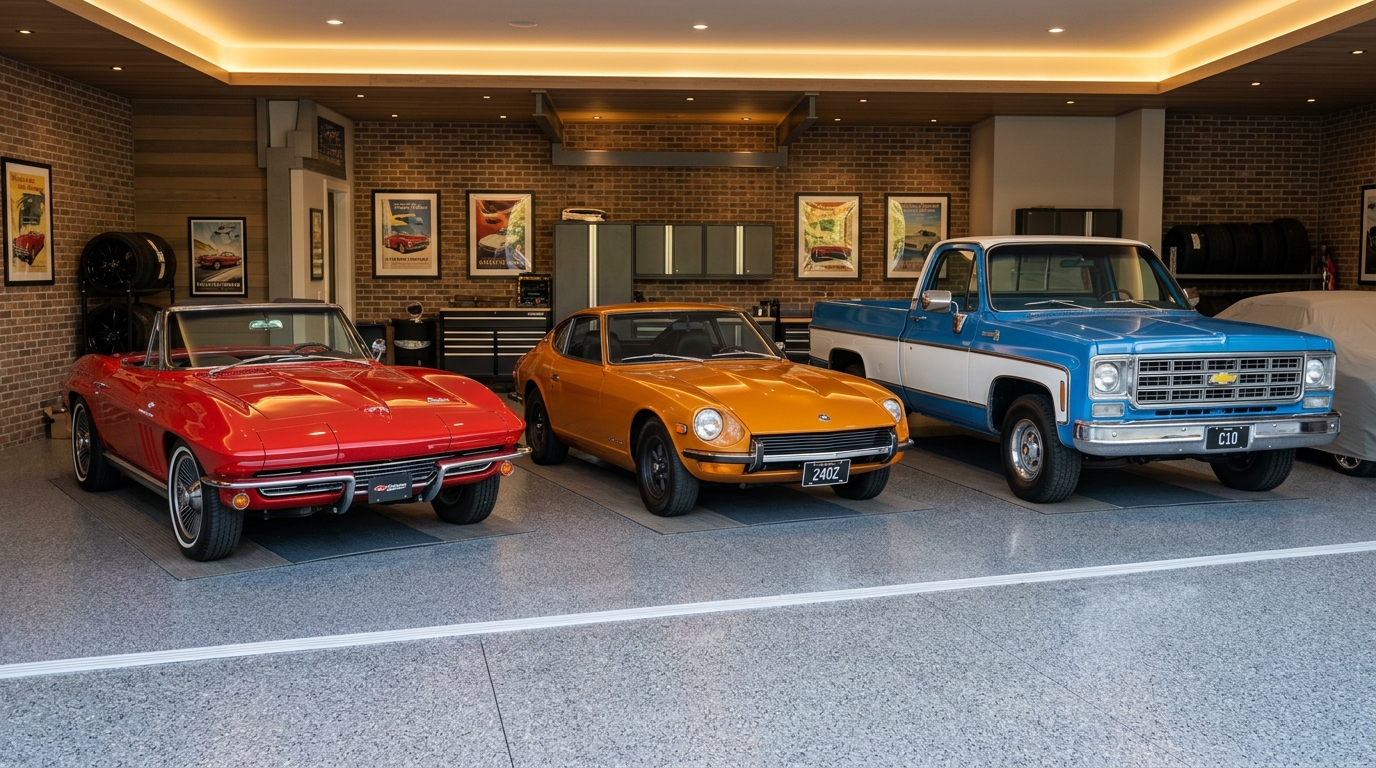
Why Classic Cars Are a Legitimate Asset Class
The classic car market has matured from an enthusiast hobby into a recognized alternative asset class. Over the past decade, the Hagerty Collector Car Index has averaged 12-18% annual appreciation, outperforming the S&P 500 (10.5% annual avg), gold (5.2% annual avg), and art (7% annual avg). Major auction houses now report that 15-20% of buyers explicitly cite investment as a primary motivation, and private collector car funds have attracted over $3 billion in committed capital since 2020.
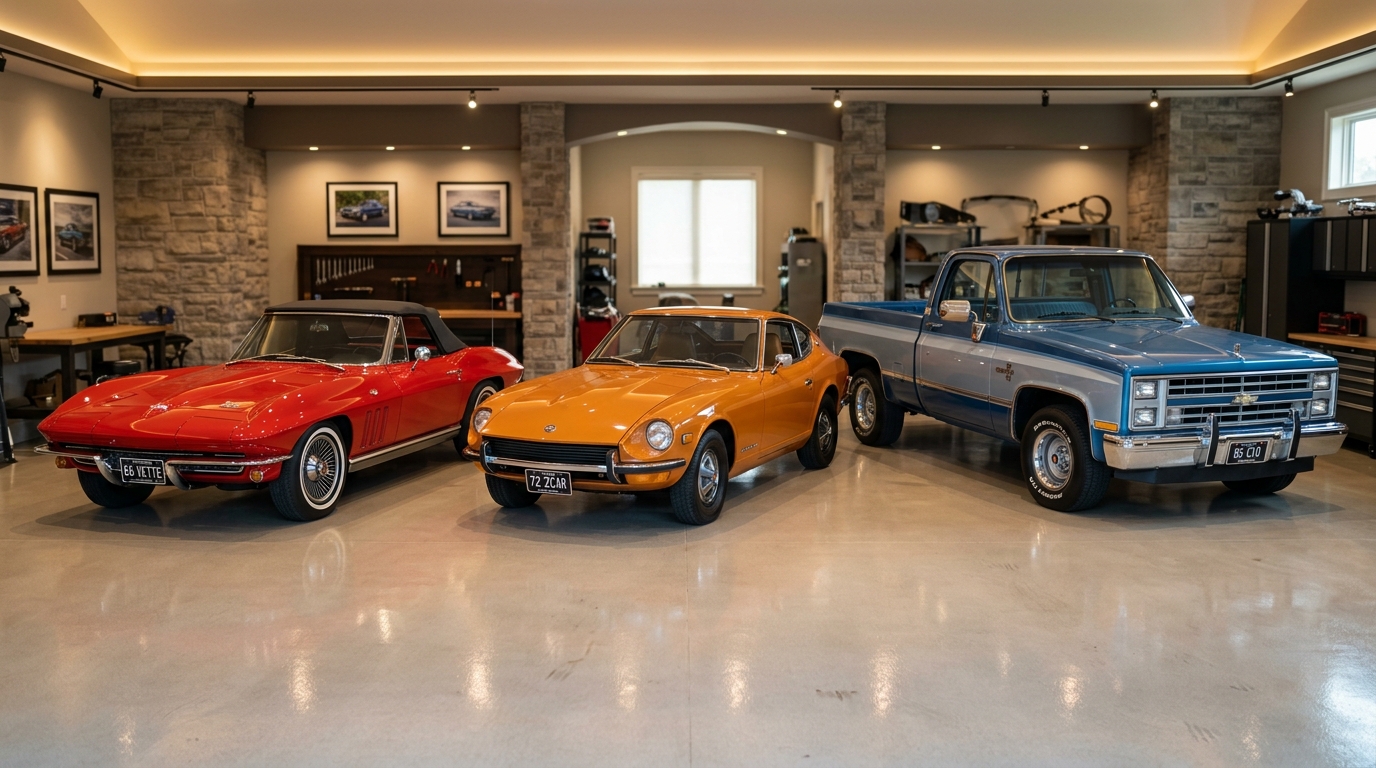
The Hagerty Price Guide tracks valuation data across thousands of transactions annually. The index is divided into segment-specific sub-indices: British, European, American Muscle, Trucks, Hot Rods, and Post-1980. Each sub-index moves independently — trucks and Japanese classics are in bull markets while 1960s Ferrari prices have corrected 15-25% from 2018 peaks.
10-Year Performance: Classic Cars vs Traditional Assets
| Asset Class | 10-Year Return | Annual Avg | Volatility | Liquidity | Min. Investment |
|---|---|---|---|---|---|
| Classic Cars (Hagerty Index) | +162% | 12-18% | Medium | 3-12 months | $10K |
| S&P 500 Index | +105% | 10.5% | Medium | 1-3 days | $1 |
| Gold | +52% | 5.2% | Low | 1-3 days | $100 |
| Real Estate (US Avg) | +78% | 7.8% | Low | 2-6 months | $50K |
| Art (Artprice100) | +70% | 7.0% | Low | 6-24 months | $25K |
| Bitcoin | +8,500% | 54% | Very High | 1-3 days | $1 |
| US Treasury Bonds | +22% | 2.2% | Very Low | 1-3 days | $1K |
Classic cars outperform most traditional asset classes on a 10-year basis, but with lower liquidity and higher holding costs. Data: Hagerty, S&P, Bloomberg, Artprice (2015-2025).
Appreciation Rates by Segment (2020-2025)
Not all classic cars appreciate at the same rate. The market is highly segmented, and understanding which segments are in bull vs bear cycles is the single most important factor in building a profitable portfolio. The data below tracks 5-year compound annual growth rates (CAGR) by segment:
| Segment | 5-Year CAGR | Market Phase | Avg. Entry Price | Risk Level | Examples |
|---|---|---|---|---|---|
| Japanese Classics (pre-1990) | +25% | Bull Market | $15K-$50K | Medium | Datsun 240Z, Toyota AE86, Mazda RX-7 |
| 1980s-90s Trucks | +24% | Bull Market | $15K-$45K | Low | GMT400 C1500, Squarebody C10, F-150 |
| Pre-1973 American Muscle | +12% | Stable Growth | $35K-$150K | Low | Camaro SS, Chevelle SS, GTO Judge |
| C2/C3 Corvette | +10% | Stable Growth | $35K-$95K | Low | 1963-1967 Sting Ray, 1968-1972 C3 |
| Early SUVs (Bronco/Blazer) | +18% | Bull Market | $40K-$95K | Medium | 1966-1977 Bronco, 1969-1972 K5 |
| European Sports Cars | +8% | Stable | $25K-$80K | Medium | Porsche 911, Mercedes 280SL, BMW E9 |
| British Roadsters | +5% | Flat | $10K-$35K | Medium | MGB, Triumph TR6, Austin-Healey |
| 1960s Ferrari | -15% | Correction | $200K-$2M+ | High | 250 GT, 275 GTB, Daytona |
| Pre-War Classics | +3% | Flat | $50K-$500K | High | Ford Model A, Duesenberg, Packard |
| Modern Supercars (2000s) | -8% | Depreciating | $80K-$300K | High | Ford GT, Porsche Carrera GT |
Japanese classics and 1980s-90s trucks are the strongest performing segments. 1960s Ferrari and modern supercars are in correction or depreciation. Data: Hagerty Price Guide, 2020-2025.
Not all high-appreciation segments are sustainable. The 1980s-1990s Ferrari market (Testarossa, 348, F355) saw 40%+ annual gains in 2021-2022, then corrected 20-30% in 2024. Similarly, Countach prices spiked 60% in 2021 and have since fallen 25%. When a segment appreciates more than 30% annually for 2+ years, a correction is likely. Focus on segments with 10-25% sustained growth and active enthusiast communities.
The 12 Best Investment-Grade Classics for 2026
Based on 5-year appreciation data, liquidity, parts availability, and enthusiast community size, these 12 vehicles represent the best risk-adjusted investment opportunities for 2026. They are organized by budget tier:
Tier 1: Entry-Level ($20K-$50K)
| Vehicle | Years | Entry Price | 5-Yr CAGR | Why It's a Buy |
|---|---|---|---|---|
| GMT400 Chevy C1500 | 1988-1998 | $15-25K | +24% | Last OBS truck, Vortec reliability, surging demand |
| Fox Body Mustang LX 5.0 | 1987-1993 | $12-20K | +15% | Iconic 5.0L, huge parts network, growing Gen X demand |
| Datsun 280Z | 1975-1978 | $15-25K | +25% | Japanese classic boom, rust-free examples scarce |
| Squarebody C10 (short bed) | 1979-1987 | $25-45K | +18% | Cleanest designs, 350 V8 swap culture, cross-generational appeal |
Tier 1 offers the highest appreciation rates with the lowest entry prices. Trucks and Japanese classics dominate this tier.
Tier 2: Mid-Range ($50K-$100K)
| Vehicle | Years | Entry Price | 5-Yr CAGR | Why It's a Buy |
|---|---|---|---|---|
| C2 Corvette Sting Ray | 1963-1967 | $70-95K | +10% | Split-window rarity, American icon, stable floor |
| Early Ford Bronco | 1966-1973 | $65-95K | +18% | SUV boom, restomod culture, limited supply |
| Porsche 911 Carrera 2.7 | 1974-1977 | $75-95K | +8% | Air-cooled premium, European diversification |
| Dodge Charger R/T | 1968-1970 | $70-95K | +12% | Muscle car stability, pop culture demand |
Tier 2 balances appreciation with stability. American muscle and early SUVs provide downside protection.
Tier 3: High-End ($100K-$500K)
| Vehicle | Years | Entry Price | 5-Yr CAGR | Why It's a Buy |
|---|---|---|---|---|
| Ford Mustang Boss 429 | 1969-1970 | $180-350K | +10% | Rarest Mustang, NASCAR homologation, blue-chip |
| Plymouth Hemi 'Cuda | 1970-1971 | $200-400K | +8% | Hemi rarity, muscle car ceiling, auction proven |
| Mercedes-Benz 300SL Gullwing | 1955-1957 | $1-1.5M | +5% | Blue-chip European, museum-grade, generational hold |
| Ferrari 365 GTB/4 Daytona | 1968-1973 | $400-600K | +3% | Last front-engine V12 Ferrari, correction complete |
Tier 3 is for established portfolios. Lower appreciation but highest stability and provenance value.
Portfolio Allocation Strategies
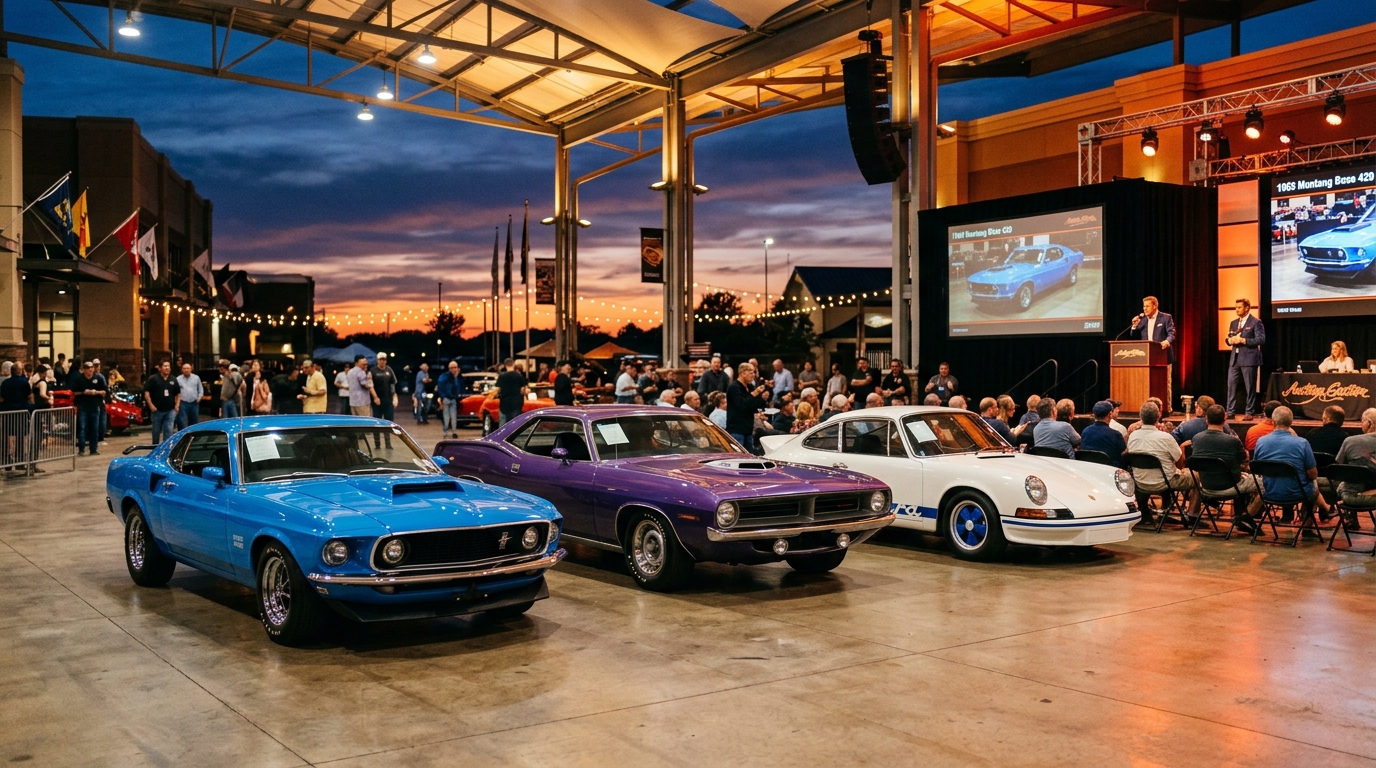
Building a classic car portfolio is like building a stock portfolio — diversification reduces risk and smooths returns. Here are three allocation strategies based on portfolio size and risk tolerance:
Conservative Portfolio ($100K)
| Allocation | Vehicle | Investment | Expected Annual Return |
|---|---|---|---|
| 40% | Squarebody C10 (short bed, #2 condition) | $40K | +18% |
| 30% | Fox Body Mustang LX 5.0 (#2 condition) | $30K | +15% |
| 30% | Datsun 280Z (#2 condition, rust-free) | $30K | +25% |
| Total | 3 vehicles | $100K | Blended: +19% |
The conservative portfolio focuses on high-appreciation, liquid segments with low entry prices. All three vehicles can be sold within 3-6 months at fair market price.
Balanced Portfolio ($200K)
| Allocation | Vehicle | Investment | Expected Annual Return |
|---|---|---|---|
| 25% | GMT400 C1500 (Vortec 5.7L, #2) | $50K | +24% |
| 25% | C2 Corvette Sting Ray (#2) | $50K | +10% |
| 20% | Datsun 280Z (rust-free, #2) | $40K | +25% |
| 15% | Early Ford Bronco (#3, driver) | $30K | +18% |
| 15% | Porsche 911 Carrera 2.7 (#3) | $30K | +8% |
| Total | 5 vehicles | $200K | Blended: +17% |
The balanced portfolio diversifies across American, Japanese, European, and truck segments. The C2 Corvette and Porsche 911 provide stability while trucks and Japanese classics drive appreciation.
Aggressive Portfolio ($500K)
| Allocation | Vehicle | Investment | Expected Annual Return |
|---|---|---|---|
| 20% | Dodge Charger R/T 440 (#2) | $100K | +12% |
| 20% | Ford Mustang Boss 302 (#2) | $100K | +10% |
| 15% | C2 Corvette Sting Ray (#1) | $75K | +10% |
| 15% | Plymouth Hemi 'Cuda (#3) | $75K | +8% |
| 10% | Datsun 240Z (restored, #1) | $50K | +25% |
| 10% | GMT400 C1500 (low mile, #1) | $50K | +24% |
| 10% | Early Ford Bronco (#2) | $50K | +18% |
| Total | 7 vehicles | $500K | Blended: +14% |
The aggressive portfolio includes blue-chip muscle cars for stability and high-appreciation trucks/Japanese classics for growth. The 7-vehicle diversification reduces single-vehicle risk.
Hidden Costs: The True Cost of Ownership
Classic car investment returns are net of holding costs, which are significantly higher than stocks or bonds. A realistic cost model is essential for calculating true ROI:
| Cost Category | Annual Cost (Low) | Annual Cost (High) | Notes |
|---|---|---|---|
| Storage (climate-controlled) | $1,200 | $3,600 | $100-$300/month. Required for #1-#2 condition |
| Insurance (agreed value) | $800 | $3,500 | Hagerty, Grundy, or American Collectors. 0-3K miles/yr |
| Maintenance & Upkeep | $500 | $2,000 | Fluids, battery tender, tires, periodic exercise |
| Repairs & Restoration | $0 | $5,000 | Variable. Budget $1K/yr average for #2-#3 condition |
| Registration & Taxes | $100 | $800 | Varies by state. Antique plates often cheaper |
| Detailing & Cosmetics | $200 | $800 | Professional detail 1-2x/year for #1-#2 condition |
| Total Annual Holding Cost | $2,800 | $15,700 | Budget $5K-$8K/year for a typical #2 condition car |
A $50K classic car costing $6K/year to hold needs 12% appreciation just to break even. Factor holding costs into all ROI calculations.
Classic cars are illiquid assets. Even in a strong market, selling at fair market value typically takes 3-12 months. Auction sales incur 8-15% seller commissions. Private sales take longer but avoid commissions. Never invest money you might need within 12 months — forced sales typically realize 15-25% below market value.
Risk Factors & How to Mitigate Them
| Risk Factor | Impact | Probability | Mitigation Strategy |
|---|---|---|---|
| Market cycle correction | High (-15-30%) | Medium (every 7-10 yrs) | Diversify across segments, hold 5+ years |
| Condition depreciation | Medium (-5-15%) | Low (if stored properly) | Climate-controlled storage, regular exercise |
| Parts obsolescence | Medium (-5-10%) | Low (for popular models) | Buy models with active parts networks |
| Provenance fraud | High (-50-100%) | Low (but catastrophic) | Verify matching numbers, documentation, title chain |
| Regulatory changes (emissions) | Low (-5%) | Low | Pre-1981 vehicles largely exempt |
| Natural disaster / theft | High (total loss) | Very Low | Agreed-value insurance, secure storage |
| Buyer demographic shift | Medium (-10-20%) | Low (long-term) | Focus on cross-generational appeal models |
The biggest risk is a market cycle correction. Diversification and a 5+ year hold period reduce this risk significantly.
How to Verify Investment Quality Before Buying
Before purchasing any classic car as an investment, verify these 8 critical factors. Failing any single check can reduce resale value by 10-50%:
- Matching numbers — Engine block stamping, transmission stamping, and rear axle stamping must match the VIN. Non-matching reduces value 15-40%.
- Verify engine block suffix code against VIN
- Check transmission case stamping
- Verify rear axle ratio code
- Documentation chain — Original window sticker, build sheet, Protect-O-Plate, title history, and restoration receipts.
- Gaps in title chain are red flags
- Original documentation adds 10-30% value
- Restoration receipts verify work quality
- Rust-free body — Frame, floor pans, rockers, cab corners, and bed floors (for trucks). Rust repair costs $5K-$20K+.
- Inspect frame rails with flashlight
- Check inner rocker panels
- Look for bubbling paint (rust underneath)
- Correct engine family — Original engine family (e.g., 350 V8 not 305 V8 for a Camaro SS). Wrong engine family reduces value 20-40%.
- Verify engine block casting number
- Check suffix code for correct application
- Original engine is ideal, correct family is acceptable
- Condition grade accuracy — Verify the seller's claimed condition grade independently. Over-graded cars sell 10-25% below asking.
- Use Hagerty condition guide (#1-#4)
- Hire a pre-purchase inspector ($200-$500)
- Check paint thickness with a gauge
- Title status — Clean title only. Rebuilt, salvage, or reconstructed titles reduce value 30-60%.
- Verify title is clean (not salvage/rebuilt)
- Check for liens
- Verify VIN on title matches vehicle
- Market liquidity — Check how many similar vehicles sold in the past 12 months on Bring a Trailer, Mecum, and Barrett-Jackson.
- Fewer than 5 sales/year = low liquidity
- 20+ sales/year = high liquidity
- Low liquidity means longer sell time
- Enthusiast community size — Active clubs, forums, and events ensure ongoing demand and parts availability.
- Check forum activity (brand-specific forums)
- Verify parts availability from major suppliers
- Active community = stable long-term demand
Classic car investments perform best with a 5-15 year hold period. Short-term flipping (under 2 years) rarely beats the combined cost of purchase premiums, selling commissions, and holding costs. The best returns come from buying quality, holding through a full market cycle, and selling into strength.
Tax Considerations for Classic Car Investors
Classic cars are treated as collectibles under US tax law. Profits on the sale of a classic car held for more than one year are subject to a 28% capital gains tax rate (higher than the 15-20% rate for stocks). However, there are several tax-advantaged strategies:
- 1031 Exchange — Classic cars may qualify for like-kind exchanges if structured properly, deferring capital gains taxes by reinvesting proceeds into another collectible.
- Collectibles in Self-Directed IRA — Some custodians allow physical collectibles (including cars) in self-directed IRAs, though rules are complex and fees are high.
- Business Use — If the vehicle is used in a legitimate business (e.g., rentals, film, display), depreciation and expenses may be deductible.
- Charitable Donation — Donating a classic car to a qualified museum or charity can provide a tax deduction equal to fair market value.
Tax laws for collectibles are complex and vary by state. The 28% collectibles capital gains rate applies to federal taxes. State taxes may apply additionally. Always consult a tax professional who specializes in collectibles before making investment decisions.
Building Your Portfolio: Step-by-Step
- Set your budget and investment horizon — Minimum $50K for a single car, $200K+ for diversification. Plan to hold 5-15 years.
- Choose your allocation strategy — Conservative (trucks + Japanese), Balanced (American + European + Japanese), or Aggressive (blue-chip + growth).
- Research target vehicles — Use our valuation tools and generation hubs to understand market data, production numbers, and trim levels.
- Verify before buying — Complete the 8-point verification checklist above. Hire a pre-purchase inspector for any car over $30K.
- Arrange storage and insurance — Climate-controlled storage and agreed-value insurance are mandatory for investment-grade vehicles.
- Track your portfolio — Document purchase price, condition, and ongoing costs. Re-evaluate annually against Hagerty Price Guide data.
- Sell into strength — Monitor market cycles. Sell when your segment is in a bull market and you've held for 5+ years.
Ready to value your classic car portfolio? Get an AI-powered valuation based on real auction data and market trends.
Get AI ValuationSources & References
- Hagerty Price Guide — Valuation Tools — The industry-standard price guide for classic car valuations and condition grading
- Bring a Trailer — Auction Results — Real-world auction sale prices for market comparison and liquidity assessment
- Knight Frank Wealth Report — Classic Cars as Alternative Assets — Annual wealth report tracking classic car performance vs other luxury assets
- Related: Best Classic Cars Under $100K (2026) — 8 investment-grade collectibles under $100K with appreciation data
- Related: Best Classic Cars Under $50K (2026) — 7 investment-grade collectibles under $50K for entry-level portfolios
- Related: Classic Car Market Trends 2026 — Full-year market analysis with segment-by-segment performance data
- Related: Car Restoration ROI Calculator — Calculate the return on investment for restoration work before buying a project car
- Related: Vintage Car Appraisal Guide 2026 — Professional appraisal methodology and condition grading standards