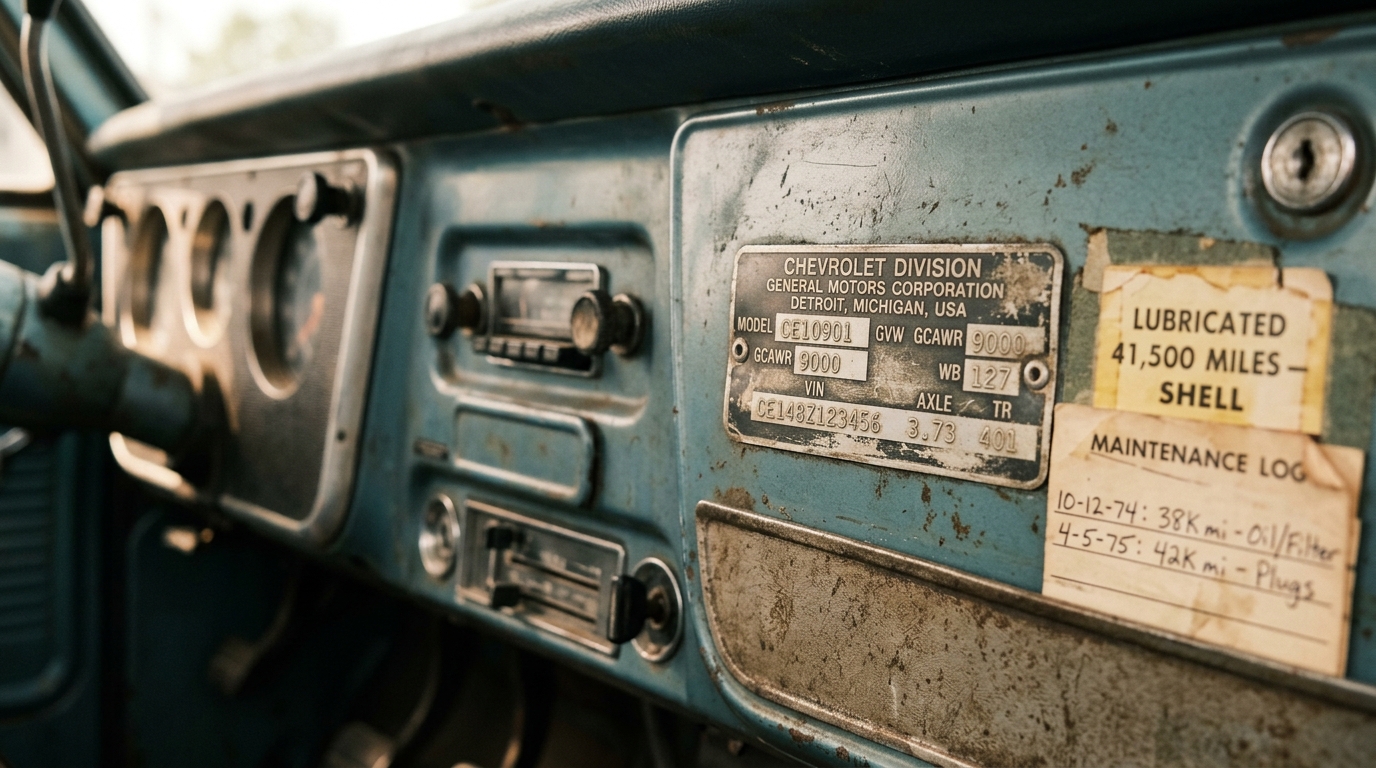
Why Pre-1981 VINs Are Different
Before January 1, 1981, there was no universal VIN standard in the United States. Each manufacturer used its own format with different lengths, positional encodings, and code meanings. The National Highway Traffic Safety Administration (NHTSA) standardized the 17-digit VIN format with 49 CFR Part 565, effective for all vehicles manufactured on or after January 1, 1981. Everything before that date uses manufacturer-specific formats.
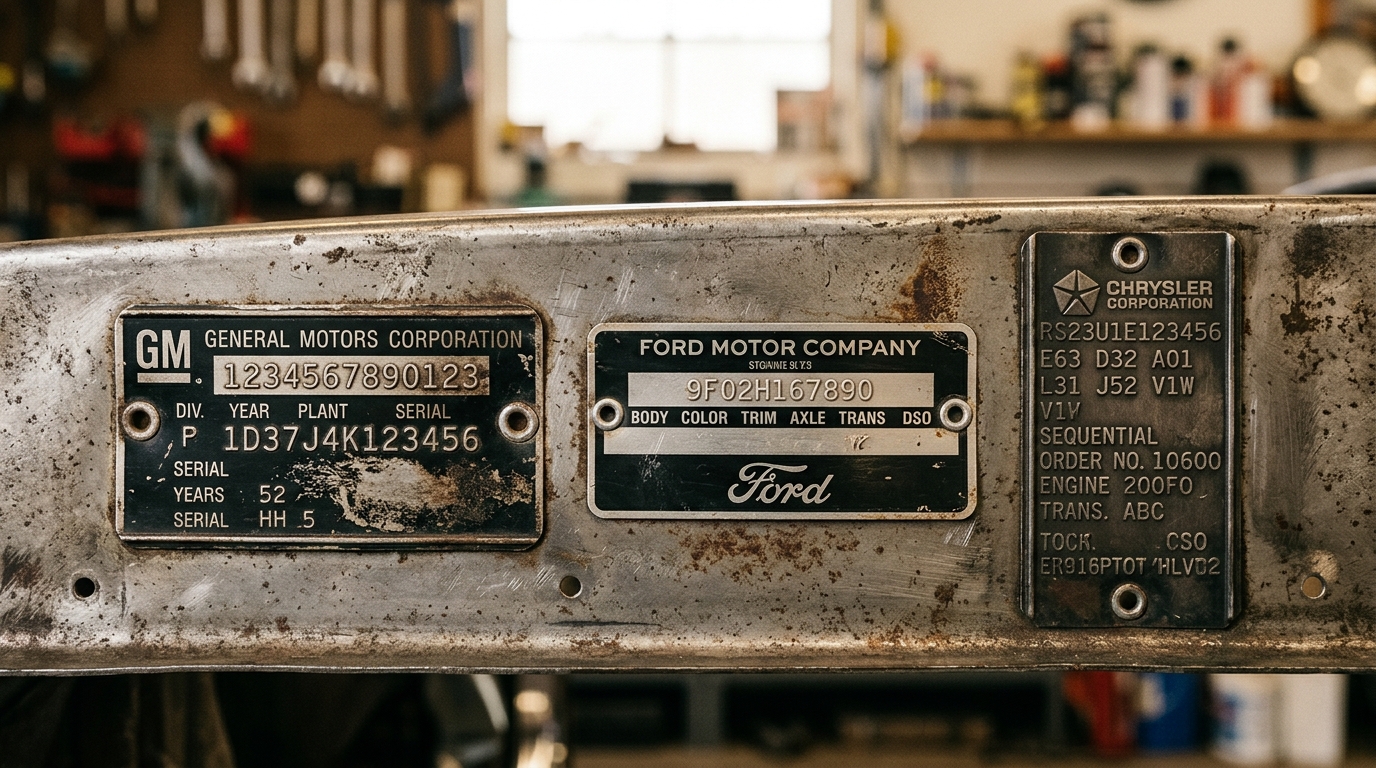
Most AI valuation tools and chatbots blend post-1981 17-digit NHTSA checksum logic with pre-1981 non-standard serials. This produces factually incorrect decodings — for example, treating position 1 as the country of manufacture (a 17-digit convention) when it actually encodes the series/division on a GM 13-digit VIN. Our decoder uses the correct positional syntax for each manufacturer.
GM 13-Digit VIN Format (1973–1980)
General Motors used a 13-digit VIN for trucks from 1973 through 1980. Each position encodes a specific attribute:
GM 13-Digit VIN Positions (Example: CE140U1234567)
| Code | Name / Description |
|---|---|
Pos 1 | Series / Division C = Chevrolet 1/2 ton 2WD, D = 1/2 ton 4WD, K = GMC 1/2 ton 4WD, T = GMC 1/2 ton |
Pos 2 | Engine Code E = 350ci V8, K = 454ci V8, D = 250ci L6, H = 305ci V8, J = 400ci V8 |
Pos 3-4 | GVWR Class 10 = 1/2 ton (C10), 14 = 1/2 ton, 20 = 3/4 ton (C20), 30 = 1 ton (C30) |
Pos 5 | Body Style 0 = Fleetside, 2 = Stepside, 3 = Suburban, 5 = Crew Cab, 8 = Chassis Cab |
Pos 6 | Assembly Plant T = Tarrytown NY, J = Janesville WI, F = Flint MI, R = Arlington TX, etc. |
Pos 7 | Model Year C = 1973, D = 1974, E = 1975, F = 1976, G = 1977, H = 1978, J = 1979, A = 1980 |
Pos 8-13 | Sequential Serial Number Production sequence number, unique per vehicle |
Ford 11-Digit VIN Format (Pre-1981)
Ford Motor Company used an 11-digit VIN for trucks before 1981. The format starts with "F" followed by a series number, then plant, year, engine, and serial:
Ford 11-Digit VIN Positions (Example: F10HKA12345)
| Code | Name / Description |
|---|---|
Pos 1-2 | Series F1 = F-100/F-150 (1/2 ton), F2 = F-250 (3/4 ton), F3 = F-350 (1 ton), F6 = F-600 |
Pos 3 | Assembly Plant F = Dearborn MI, K = Kansas City MO, S = Louisville KY, J = Los Angeles CA, etc. |
Pos 4 | Model Year B = 1971, C = 1972, D = 1973, E = 1974, F = 1975, G = 1976, H = 1977, J = 1978, K = 1979 |
Pos 5 | Engine Code B = 300ci L6, D = 302ci V8, F = 351ci V8 Windsor, H = 351ci V8 Cleveland, P = 460ci V8 |
Pos 6-11 | Sequential Serial Number Production sequence number |
Mopar 13-Digit VIN Format (Pre-1981 Dodge / Plymouth)
Chrysler Corporation (Mopar) used a 13-digit VIN for Dodge and Plymouth trucks. The format differs significantly from GM — the positions encode different attributes:
Mopar 13-Digit VIN Positions (Example: B1F4E1234567)
| Code | Name / Description |
|---|---|
Pos 1 | Make / Division B = Dodge Truck, D = Dodge, P = Plymouth, W = Dodge W-series, R = Dodge Ram |
Pos 2 | Series / GVWR 1 = 100 series (1/2 ton), 2 = 200 series (3/4 ton), 3 = 300 series (1 ton) |
Pos 3 | Body Style 1 = Pickup conventional, 2 = Sweptline, 3 = Utiline (stepside), 5 = Crew Cab |
Pos 4 | Engine Code C = 225ci Slant Six, D = 318ci V8, G = 360ci V8, M = 440ci V8, F = 340ci V8 |
Pos 5 | Model Year D = 1973, E = 1974, F = 1975, G = 1976, H = 1977, J = 1978, K = 1979, L = 1980 |
Pos 6 | Assembly Plant U = Warren MI (Dodge Truck), G = St. Louis MO, P = Pillette Road Windsor, etc. |
Pos 7-13 | Sequential Serial Number Production sequence number |
Where to Find the VIN on a Classic Truck
On pre-1981 American trucks, the VIN plate is typically located in one of these positions:
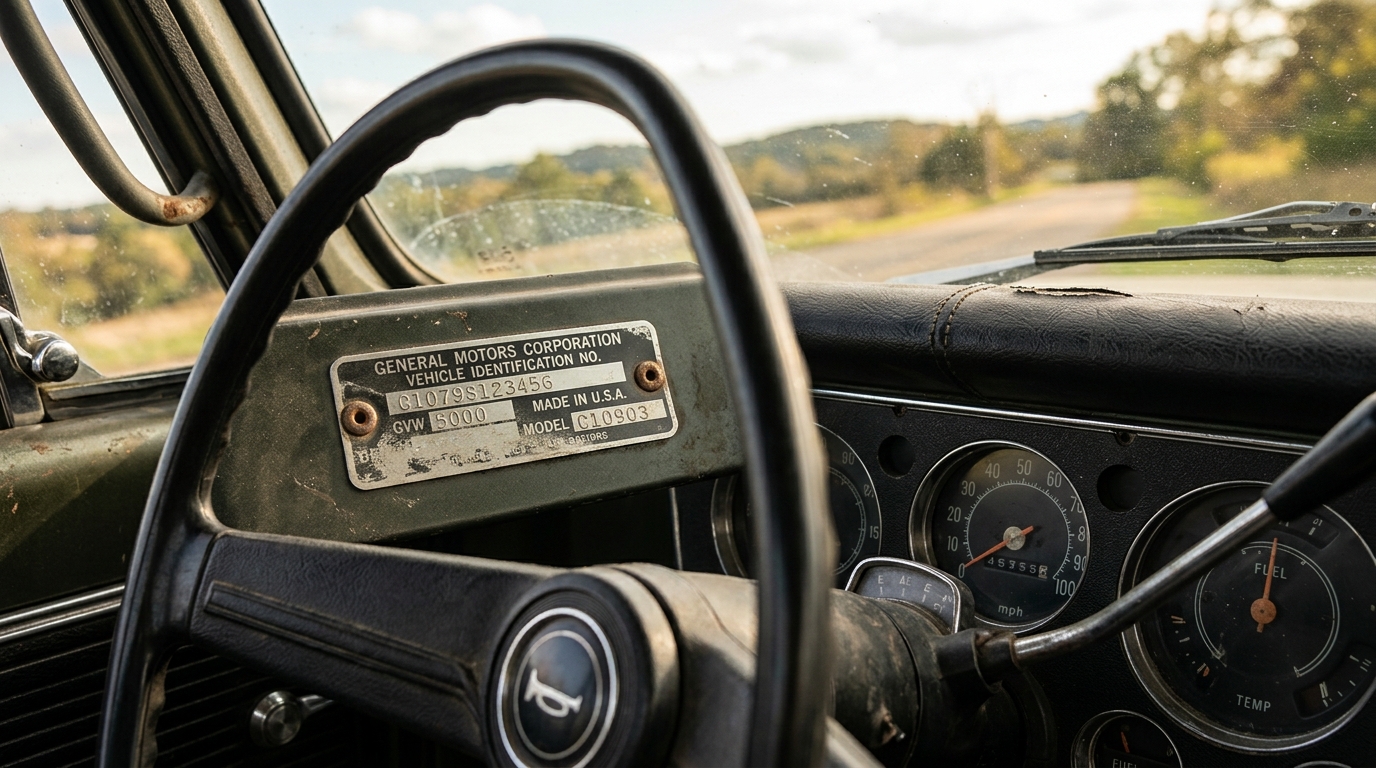
- GM (Chevrolet/GMC): Driver-side door jamb, on the body data plate. Also stamped on the frame near the steering box on some models.
- Ford: Driver-side door jamb, on the warranty plate. Also on the frame on the driver-side rail near the front.
- Mopar (Dodge/Plymouth): Driver-side door jamb, on the body code plate. Also stamped on the frame near the front.
- All manufacturers: The VIN may also appear on the title, registration, and insurance documents.
The VIN encodes basic vehicle identification, but the SPID (Service Parts Identification) label inside the glove box door contains the full option code list (RPO codes). The SPID label is essential for verifying trim level, axle ratio, transmission, and other options — the VIN alone does not encode these on most pre-1981 trucks.
Common Decoding Mistakes
| Mistake | Why It Happens | Correct Approach |
|---|---|---|
| Treating position 1 as country code | Post-1981 17-digit VINs use position 1 for country. Pre-1981 formats use it for series/division. | Use manufacturer-specific positional decoding |
| Assuming a checksum digit exists | 17-digit VINs have a checksum in position 9. Pre-1981 VINs have no checksum. | No checksum validation on pre-1981 VINs |
| Confusing GM and Mopar year codes | Both use letters but the mapping differs. GM "H" = 1978, Mopar "H" = 1977. | Always decode using the correct manufacturer table |
| Ignoring HD vs LD year code variants | Some letters map to different years for heavy-duty vs light-duty trucks. | Check both interpretations and verify with documentation |
| Treating Ford F-series as 13 digits | Ford pre-1981 truck VINs are 11 digits, not 13. | Ford = 11, GM = 13, Mopar = 13 |
These are the five most common errors we see in AI-generated VIN decodings for pre-1981 trucks.
Data Sources & Methodology
This decoder is built on the following public-domain and published sources:
- NHTSA vPIC API — public domain, real-time vehicle data
- Used for post-1981 VIN validation and cross-referencing
- 49 CFR Part 565 — VIN syntax standards
- Federal regulation defining the 17-digit standard effective 1981
- GM Service Manual VIN decoding charts (1973–1980)
- Published manufacturer documentation for positional codes
- Ford Motor Company truck VIN reference (pre-1981)
- Published manufacturer documentation
- Chrysler Corporation parts catalog VIN cross-reference
- Published manufacturer documentation for Mopar trucks
All data used in this decoder is from public-domain sources (NHTSA vPIC, 49 CFR) or published manufacturer documentation. No paid API licensing or factory data licensing is required. This is a permanent, free resource.
Limitations & Caveats
- Some year codes have multiple possible interpretations (HD vs LD trucks). The decoder flags these with warnings — always verify with vehicle documentation.
- Engine codes occasionally varied by plant and model year. If a code seems wrong for your vehicle, cross-reference with the SPID label.
- This decoder covers pre-1981 American cars and trucks from GM (Chevrolet, Pontiac, Oldsmobile, Buick, Cadillac, GMC), Ford (Ford, Mercury, Lincoln), and Chrysler (Dodge, Plymouth, Chrysler, Imperial). Import vehicles (VW, Mercedes, Toyota, etc.) use different formats not covered.
- Canadian-built trucks may use slightly different plant codes. The decoder includes major Canadian plants but may not cover all.
Now that you've decoded your VIN, get an AI-powered valuation based on real auction data.
Value My Vehicle