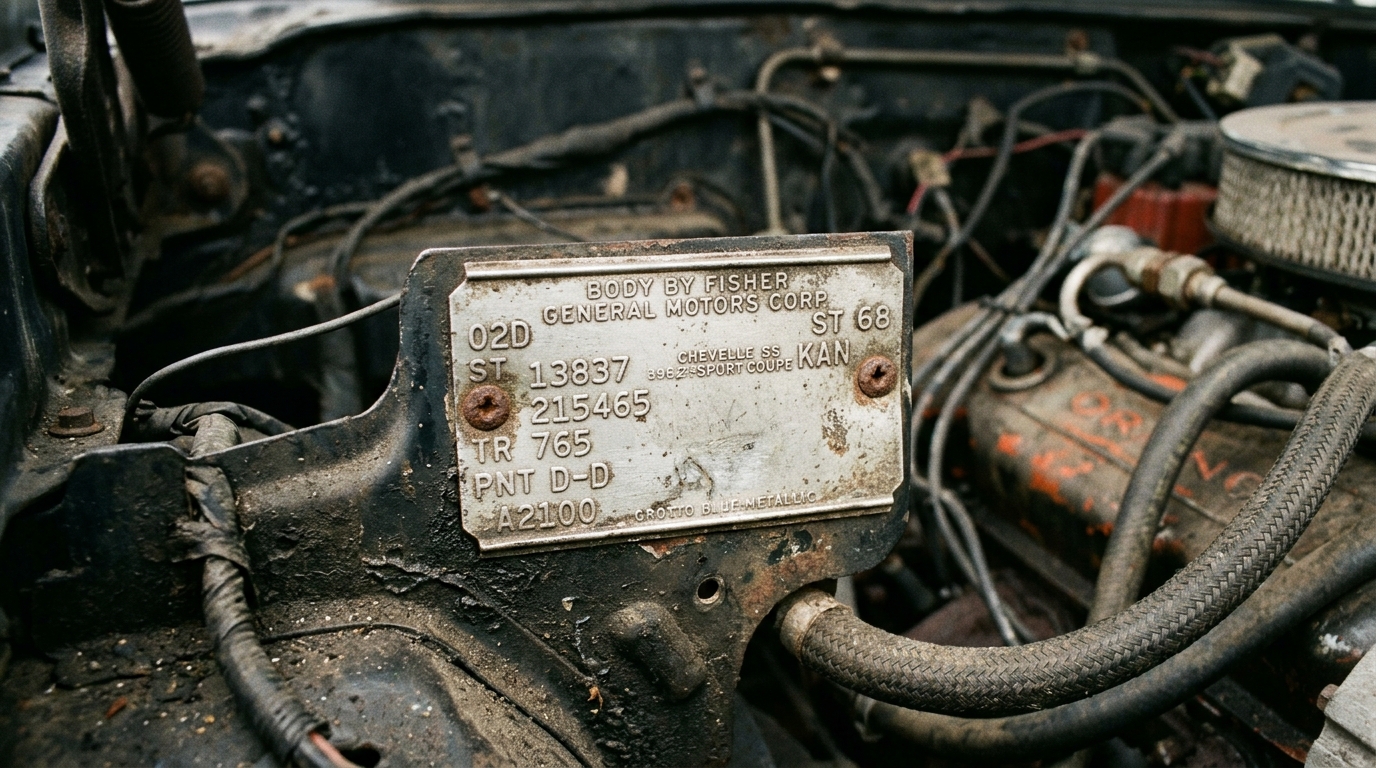
What Is a Cowl Tag?
The cowl tag — also called the body data plate, trim tag, or Fisher Body plate — is a small metal tag riveted to the cowl panel (firewall) in the engine compartment of GM vehicles. It was installed by Fisher Body (GM's body manufacturing division) and contains the original factory specifications for the vehicle's body, interior, paint, and accessories.
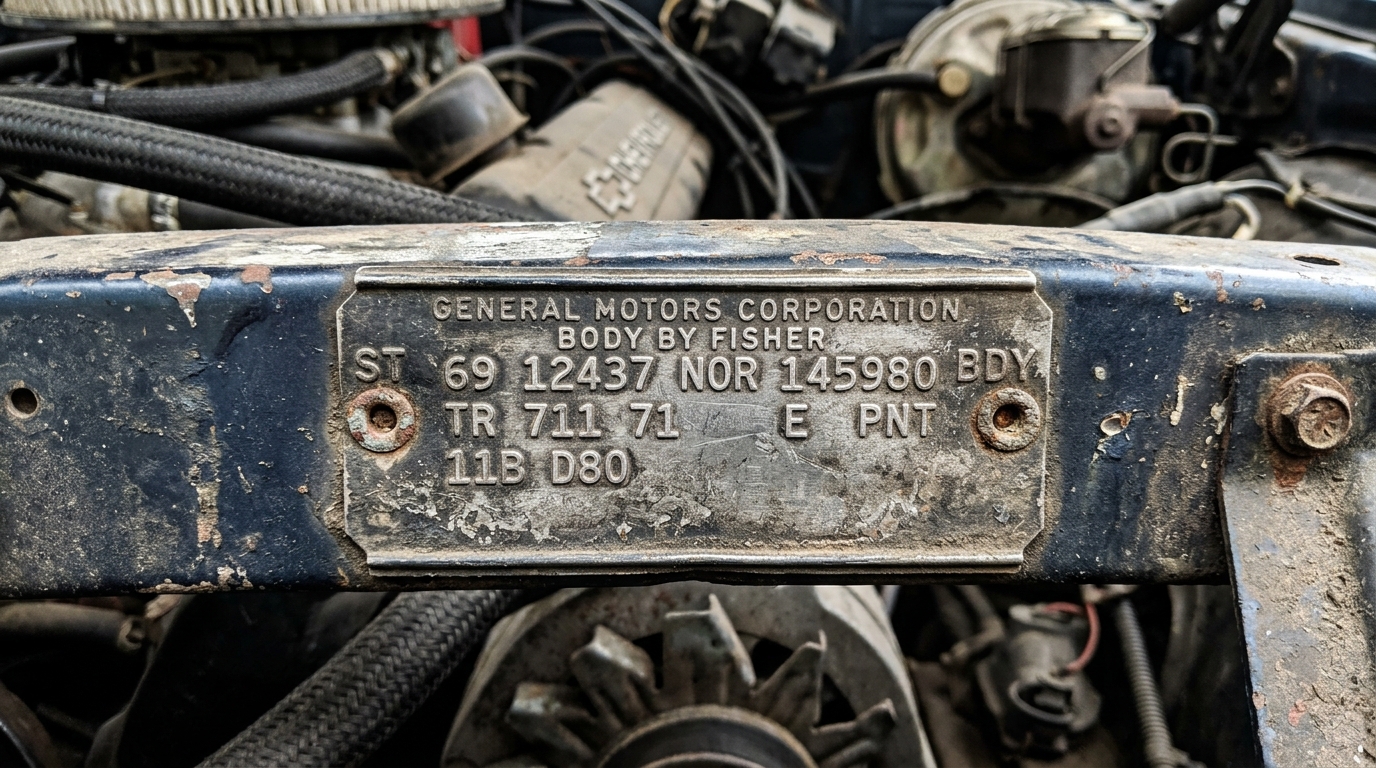
The cowl tag is distinct from the VIN. The VIN identifies the vehicle for legal and registration purposes. The cowl tag identifies the body configuration and original options. Together, they provide a complete picture of how the vehicle left the factory. For authentication and valuation, the cowl tag is often more important than the VIN because it contains the trim level, paint color, and option codes that the VIN does not encode.
The cowl tag is on the firewall and contains body, trim, paint, and basic ACC codes. The SPID (Service Parts Identification) label is inside the glove box door and contains the complete RPO option code list. Both are needed for full authentication. The cowl tag is more durable (metal, riveted) while the SPID label is paper and often missing on older vehicles.
Cowl Tag Layout (GM Fisher Body)
GM cowl tags follow a general layout but vary by year, assembly plant, and vehicle line. The typical layout contains these fields:
GM Cowl Tag Fields
| Code | Name / Description |
|---|---|
BODY | Body Style Code 3-5 character code identifying body configuration (e.g., CT124 = C10 Silverado short bed) |
TR | Trim Code 2-3 character code for interior material and seat type (e.g., 08A = Silverado velour/cloth) |
PNT | Paint Code 2-3 digit code for exterior paint color (e.g., 526 = Red, 71 = Forest Green) |
ACC | Accessory Codes Space-separated 3-character RPO codes (e.g., C60 = A/C, N33 = Tilt wheel, A02 = Tinted glass) |
PLANT | Assembly Plant Single letter for Fisher Body plant (e.g., T = Tarrytown, N = Norwood) |
DATE | Build Date Week/year code (e.g., 06C = 3rd week of June, model year C) |
Why AI Can't Read Cowl Tags
Cowl tags are one of the few remaining identification challenges that AI and computer vision cannot reliably solve. There are three reasons:
- Physical deterioration: Cowl tags are in the engine compartment, exposed to heat, oil, and corrosion for decades. The stamping is often partially illegible, corroded, or painted over.
- AI vision requires clear, well-lit text — engine bay photos rarely meet this standard
- Code format variability: Unlike the standardized 17-digit VIN, cowl tag codes vary by year, plant, and vehicle line. The same code can mean different things on different models.
- Paint code "71" = Forest Green on a 1969 Camaro but something different on a 1975 truck
- Trim code "08A" only applies to Chevrolet trucks, not cars
- Small stamping size: The characters on a cowl tag are typically 3/16" tall — too small for reliable OCR from a standard engine bay photo taken at arm's length.
- Requires macro/close-up photography for any automated reading
- Human experts use magnification and lighting angles to read corroded tags
Because AI can't read cowl tags, every AI-generated classic car valuation is missing the original paint color, interior trim, and factory options. This is a structural blind spot. Our decoder bridges this gap by letting users manually enter the codes from their cowl tag and get instant, accurate decoding.
Where to Find the Cowl Tag
- GM trucks (1973–1991): Riveted to the cowl panel (firewall) on the driver side, visible when you open the hood. Look near the master cylinder area.
- Camaro (1967–1981): Riveted to the firewall, driver side, near the top of the cowl panel. May be partially hidden by the wiper motor.
- Chevelle (1964–1972): Riveted to the firewall, driver side. Similar position to Camaro.
- Nova (1968–1974): Riveted to the cowl panel, driver side, near the master cylinder.
- Corvette (1963–1982): On the driver side inner fender well or firewall, depending on year.
Reproduction cowl tags can be purchased and riveted in place. A tag that looks brand new on a 50-year-old vehicle is a red flag. Compare the tag's patina and rivet style to other known-original vehicles. The tag should show the same aging as surrounding metal. A reproduction tag does not necessarily mean the vehicle is fraudulent — it may be a legitimate replacement for a damaged original — but it reduces authentication confidence.
Common Trim Codes (GM Trucks)
| Code | Trim Level | Seat Type | Floor | Value Impact |
|---|---|---|---|---|
| 01A | Custom Deluxe | Vinyl bench | Vinyl mat | Baseline (lowest) |
| 05A | Custom Deluxe | Standard vinyl | Rubber mat | Baseline |
| 06A | Scottsdale | Cloth/vinyl bench | Carpet | +5–10% |
| 07A | Cheyenne | Cloth/vinyl bench | Full carpet | +10–20% |
| 07B | Cheyenne | Cloth/vinyl buckets | Full carpet + console | +15–22% |
| 08A | Silverado | Velour/cloth bench | Full carpet + woodgrain | +20–35% |
| 08B | Silverado | Velour/cloth buckets | Full carpet + console | +25–38% |
| 08C | Silverado | Leather buckets | Full carpet + console | +30–40% (rare) |
Trim code determines the original interior specification. Mismatched interiors (e.g., Silverado buckets in a truck with a Custom Deluxe cowl tag) reduce authenticity and value.
Common Paint Codes (GM Trucks)
| Code | Color Name | Years | Popularity | Notes |
|---|---|---|---|---|
| 504 | White | 1973–1980 | High | Most common fleet color |
| 526 | Red | 1973–1980 | Very High | Desirable; ages well if maintained |
| 548 | Silver | 1973–1980 | Medium | Metallic; clear coat failure common |
| 551 | Black | 1973–1980 | High | Premium look; shows every flaw |
| 519 | Yellow | 1973–1978 | Medium | Associated with utility/fleet |
| 524 | Orange | 1973–1978 | High | Desirable; evokes performance era |
| 536 | Green | 1973–1980 | Low | Less popular; dated appearance |
| 568 | Two-tone White/Blue | 1977–1980 | High | Most valuable two-tone combo |
| 569 | Two-tone White/Red | 1977–1980 | Very High | Highly sought after |
Original paint color significantly impacts value. Two-tone combinations command 10–15% premiums over equivalent single-color trucks. Original paint (verified by cowl tag) adds value even if the truck has been repainted.
How to Use the Cowl Tag for Authentication
- Read the body style code and verify it matches the vehicle
- A C10 short bed should have a CT104/CT114/CT124 code
- A K10 4WD should start with KT, not CT
- Mismatch = possible cab swap or rebody
- Decode the trim code and check the interior
- An 08A Silverado tag with a vinyl bench interior = interior swap
- Original Silverado interiors had velour/cloth and woodgrain
- Non-matching interior reduces value 5–15%
- Decode the paint code and compare to current color
- If the tag says 526 (Red) but the truck is blue, it's been repainted
- Repaint in original color is acceptable; color change reduces value 5–10%
- Verify paint code against build sheet if available
- Check ACC codes for high-value options
- C60 (A/C) adds $2,000–$4,000 value
- N33 (tilt wheel) adds $500–$1,000
- G80 (positraction) adds $1,000–$2,000
- Missing ACC codes for claimed options = potential fraud
Frequently Asked Questions
- My cowl tag is missing — what do I do?
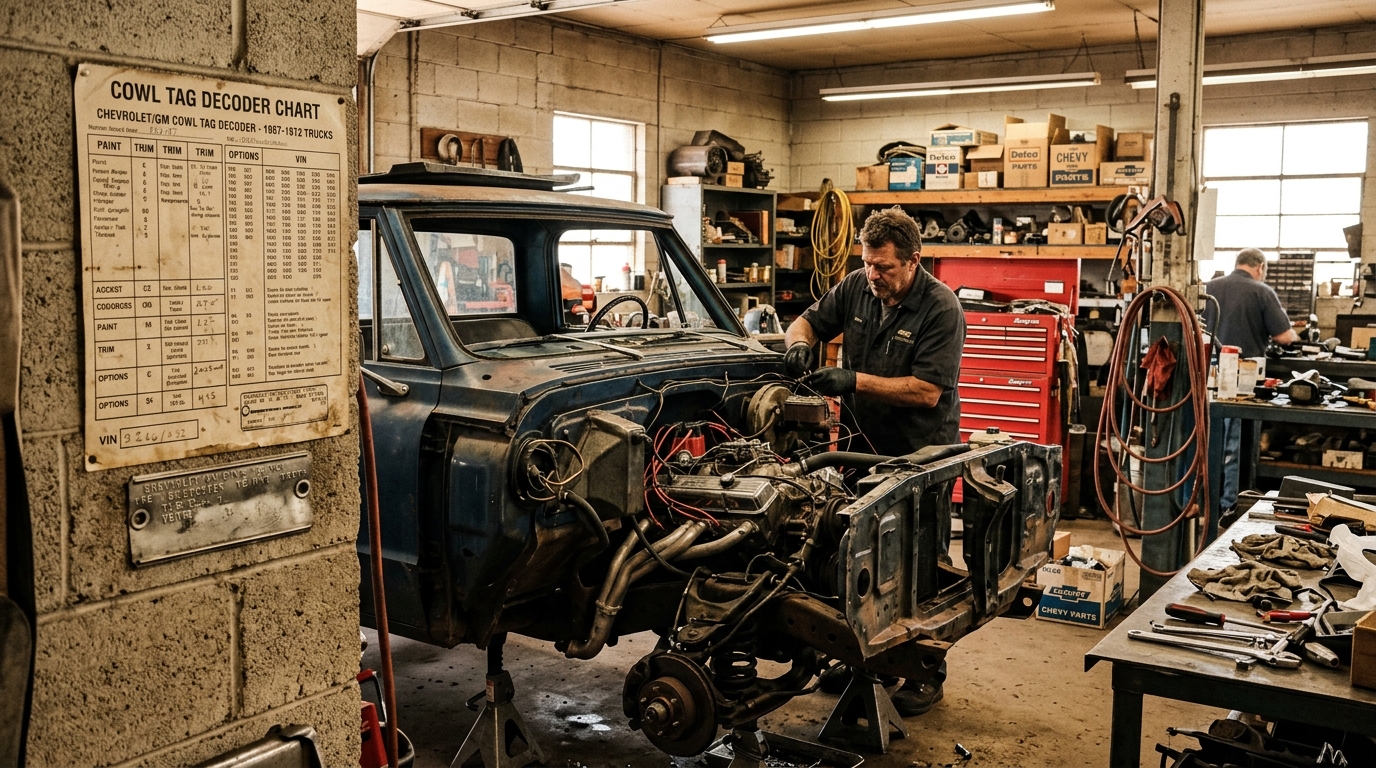
- Cowl tags can fall off or be removed during restoration. Without the tag, original trim level and paint color cannot be definitively verified. The SPID label (glove box) may still have this information. If both are missing, authentication relies on build sheets, window stickers, or dealer documentation.
- Can I get a replacement cowl tag?
- Yes, reproduction tags are available from several suppliers. However, a reproduction tag has no authentication value — it can be stamped with any codes. For show judging, a reproduction tag is typically flagged. For driver-quality vehicles, it's acceptable as long as the codes match the vehicle's known configuration.
- Does the cowl tag match the VIN?
- The cowl tag and VIN share the body style information but encode it differently. The VIN uses a compact format (e.g., CE140) while the cowl tag uses the Fisher Body format (e.g., CT104). They should agree on the body configuration. Disagreement between VIN and cowl tag is a major red flag for rebody or fraud.
- What if my paint code isn't in the database?
- GM used hundreds of paint codes across all divisions and years. This decoder covers the most common Chevrolet truck and car codes. For uncommon codes, consult the GM Heritage Center archive or marque-specific reference books.
Now that you've decoded your cowl tag, get an AI-powered valuation based on your vehicle's original specifications.
Value My VehicleSources & References
- Hagerty Price Guide — Valuation Tools — Independent valuation data for classic cars
- Bring a Trailer — Auction Results — Real-world auction sale prices
- Related: Vin Decoder Pre 1981 — In-depth related guide from our editorial library
- Related: Squarebody C10 Generation Hub — In-depth related guide from our editorial library