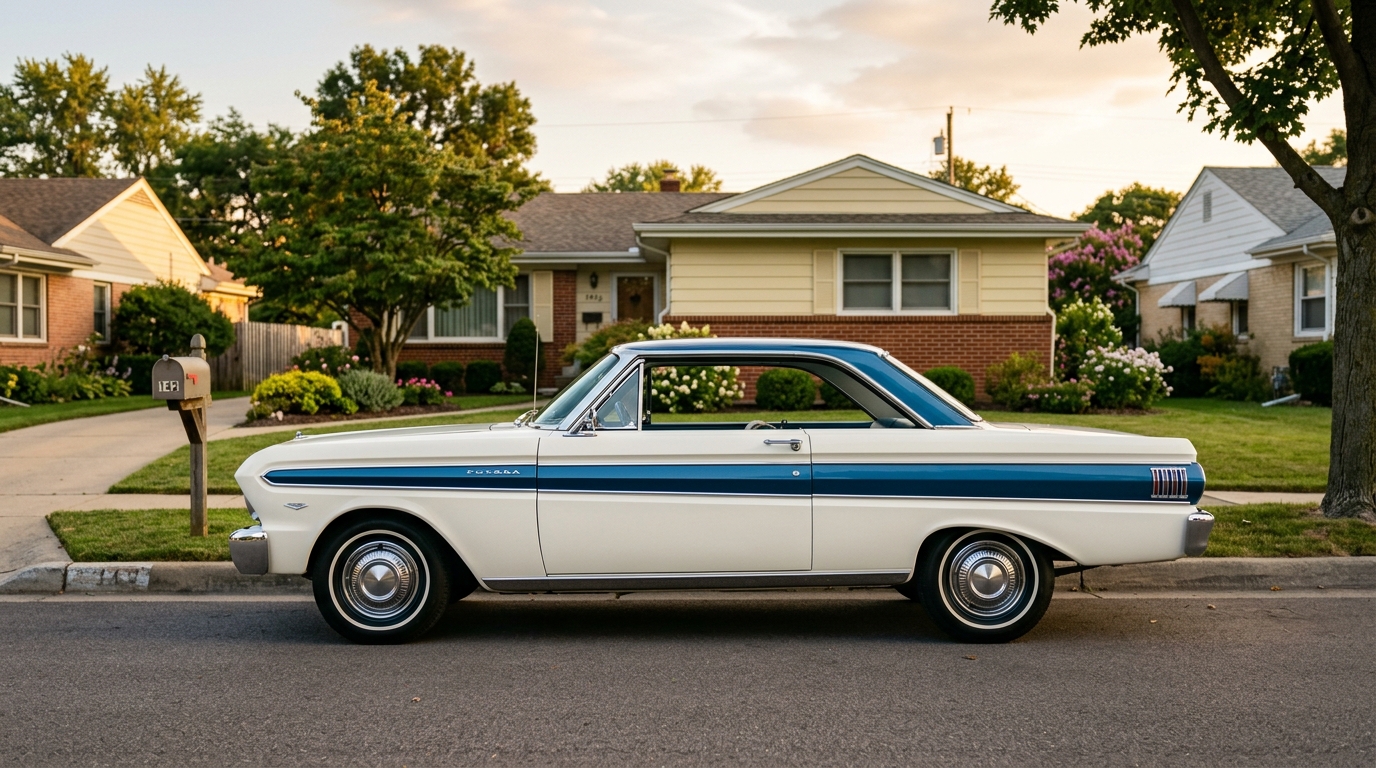
Production Overview: 1960-1970
The Ford Falcon launched on October 3, 1959 as a 1960 model — Detroit's first successful entry in the compact car segment. The Falcon was developed under the "X-car" program led by Robert McNamara, who wanted a simple, lightweight, affordable car to compete with imported European compacts like the Volkswagen Beetle and Rambler American. The formula worked: the Falcon sold over 500,000 units in its first year and transformed Ford's product strategy.
The Falcon's Place in Automotive History
The Falcon is one of the most historically significant American cars of the 20th century. Its platform directly spawned the Ford Mustang (1964.5), which used the Falcon's 108-inch wheelbase, front suspension, steering box, and engine options (170ci I6 and 260ci V8). The Mercury Comet was also Falcon-based. Without the Falcon, there would be no Mustang — and the muscle car era would have looked very different.
The 1964.5 Ford Mustang was essentially a rebodied Falcon. Lee Iacocca's team took the Falcon chassis, added sportier styling, and created the most successful car launch in automotive history. Early Mustangs share over 60% of their mechanical components with the 1963-1964 Falcon.
Generation Breakdown
The Falcon went through three distinct generations during its 11-year run. Each generation reflected changing market demands — from the pure simplicity of the 1960-1962 originals, through the performance era of 1963-1965, to the larger, more luxurious 1966-1970 final generation.
| Generation | Years | Key Changes | Wheelbase | Collectibility |
|---|---|---|---|---|
| 1st Gen | 1960-1962 | Original compact design; 144ci I6 only; 2-door/4-door/wagon | 109.5" | Rising — originality matters |
| 1.5 Gen | 1963-1965 | V8 option (260/289); Sprint package; Futura trim added | 109.9" | Most collectible — V8 + sporty trim |
| 2nd Gen | 1966-1970 | Larger body; 200ci I6 standard; 289/302 V8 optional; Futura Sport Coupe | 110.6" | Good value — best driver quality |
The 1963-1965 "1.5 Gen" Falcons with V8 engines are the most collectible. The Sprint V8 (1963-1964) is the rarest and most valuable. The 1966-1970 Futura Sport Coupe is the best driver-quality buy.
Engine Specifications & Performance
The Falcon started with a single engine — the 144ci "Thriftpower" inline-six producing 90 horsepower. The V8 arrived in 1963 with the 260ci Windsor small-block (164hp), followed by the legendary 289ci (195-271hp depending on tune). By 1966, the 200ci I6 (120hp) was the standard engine, with the 289 and later 302 V8s as options.
| Engine | Displacement | Horsepower | Torque | Years Available | Production Volume |
|---|---|---|---|---|---|
| Thriftpower I6 | 144ci (2.4L) | 90 hp | 137 lb-ft | 1960-1964 | High — base engine |
| Thriftpower I6 | 170ci (2.8L) | 101-105 hp | 158 lb-ft | 1961-1965 | Medium — optional I6 |
| Thriftpower I6 | 200ci (3.3L) | 116-120 hp | 190 lb-ft | 1964-1970 | High — standard from 1966 |
| Windsor V8 | 221ci (3.6L) | 145 hp | 218 lb-ft | 1963 only | Rare — one year only |
| Windsor V8 | 260ci (4.3L) | 164-170 hp | 238-258 lb-ft | 1963-1965 | Medium — Sprint package |
| Windsor V8 | 289ci (4.7L) | 195-271 hp | 258-312 lb-ft | 1963-1968 | Medium — most desirable |
| Windsor V8 | 302ci (4.9L) | 210-220 hp | 290-300 lb-ft | 1969-1970 | Low — final years only |
The 289ci V8 is the most desirable engine — it offers the best performance-to-reliability ratio and shares parts with the Mustang 289. The 260ci V8 is rarer but less powerful. The 302ci arrived late in production and is less common.
Trim Levels & Option Packages
The Falcon's trim hierarchy evolved significantly over its 11-year run. The early cars (1960-1962) were deliberately spartan — the whole point was simplicity. The Futura trim arrived in 1962 as a sporty 2-door hardtop. The Sprint package (1963-1964) added V8 power, bucket seats, and floor-shifted 4-speed. By 1966, the Futura Sport Coupe became the premium offering.
| Trim Package | Years | Key Features | Rarity | Value Premium |
|---|---|---|---|---|
| Standard | 1960-1970 | Base trim, bench seat, column shift, I6 | Common | Baseline |
| Deluxe | 1960-1965 | Upgraded interior, chrome trim, full wheel covers | Common | +5-10% |
| Futura | 1962-1970 | Bucket seats, center console (later), upgraded trim | Medium | +15-25% |
| Futura Sport Coupe | 1966-1970 | V8 standard, sport suspension, premium interior | Medium | +25-40% |
| Sprint V8 | 1963-1964 | 260/289 V8, 4-speed floor shift, bucket seats, tach | Rare (~10K built) | +50-80% |
| Sprint I6 | 1963-1964 | 170ci I6, 4-speed, bucket seats — "economy sport" | Rare | +30-50% |
The Sprint V8 is the holy grail for Falcon collectors — only about 10,000 were built across 2 years. The Futura Sport Coupe is the best daily-driver-quality collector Falcon.
Annual Production Numbers
Falcon production peaked in 1961 at over 485,000 units and declined steadily as the Mustang cannibalized its market. By 1970, the Falcon was a shadow of its former self — only 39,000 units — and was replaced by the Maverick for 1971.
| Year | Total Production | V8 Production (est.) | Notes |
|---|---|---|---|
| 1960 | ~485,000 | 0 | Launch year — I6 only, massive success |
| 1961 | ~485,766 | 0 | Peak production year |
| 1962 | ~395,000 | 0 | Futura introduced; Ranchero joins Falcon line |
| 1963 | ~328,000 | ~15,000 | V8 option arrives (260ci); Sprint package launched |
| 1964 | ~306,000 | ~20,000 | 289ci V8 added; Mustang launches, cannibalizing Falcon |
| 1965 | ~258,000 | ~18,000 | Last year of 1.5 Gen; Sprint discontinued |
| 1966 | ~256,000 | ~25,000 | 2nd Gen launches; larger body, Futura Sport Coupe |
| 1967 | ~183,000 | ~22,000 | Sales decline continues; more luxury-focused |
| 1968 | ~163,000 | ~15,000 | Minor facelift; 302ci V8 joins lineup |
| 1969 | ~89,000 | ~8,000 | Sharp decline; Maverick launched as replacement |
| 1970 | ~39,000 | ~3,000 | Final year — low production, replaced by Maverick |
Production data from Ford Motor Company production records. V8 production estimates based on surviving vehicle registrations and option code analysis. The 1969-1970 Falcons are the rarest but not necessarily the most valuable — the 1963-1965 V8 models command the highest prices.
Market Values by Condition Grade
Falcon values have been steadily appreciating as collectors rediscover the model's historical significance. The 1963-1965 Sprint V8 models lead the market, followed by the 1966-1970 Futura Sport Coupe with the 289 V8. Six-cylinder models remain affordable entry points.
| Model | #1 Concours | #2 Excellent | #3 Good | #4 Fair |
|---|---|---|---|---|
| 1963-1964 Sprint V8 (260/289) | $45,000-$60,000 | $28,000-$40,000 | $16,000-$24,000 | $7,000-$12,000 |
| 1965 Futura V8 (289) | $35,000-$45,000 | $22,000-$30,000 | $12,000-$18,000 | $5,000-$9,000 |
| 1966-1967 Futura Sport Coupe V8 | $30,000-$40,000 | $18,000-$28,000 | $10,000-$16,000 | $4,500-$8,000 |
| 1968-1970 Futura V8 (289/302) | $25,000-$35,000 | $15,000-$22,000 | $8,000-$13,000 | $3,500-$6,500 |
| 1960-1962 Standard I6 (144) | $20,000-$28,000 | $12,000-$18,000 | $6,000-$10,000 | $2,500-$5,000 |
| 1963-1965 Standard I6 (170/200) | $15,000-$22,000 | $8,000-$14,000 | $4,500-$8,000 | $2,000-$4,000 |
| Falcon Ranchero (1962-1970) | $25,000-$35,000 | $14,000-$22,000 | $7,000-$12,000 | $3,000-$5,500 |
Values based on Hagerty Price Guide data, Bring a Trailer auction results, and Mecum sales data (2024-2026). The Sprint V8 commands a 50-80% premium over comparable Futura V8 models. The Ranchero (Falcon-based pickup) is a niche collector market with steady appreciation.
Investment Outlook & Appreciation Forecast
The Falcon is in the early-to-mid stage of collector appreciation. It has been overshadowed by the Mustang for decades, but collectors are increasingly recognizing the Falcon's historical importance as the platform that made the Mustang possible. V8 models are appreciating 12-18% annually. The Sprint V8 is appreciating 15-22% annually with limited supply.
| Year | Est. Value (#3 Futura V8) | Appreciation | Notes |
|---|---|---|---|
| 2024 | $11,000 | — | Pre-surge baseline |
| 2025 | $13,000 | +18% | Collectors discovering Falcon significance |
| 2026 | $15,000 | +15% | Current market — 60th anniversary of 1960 launch |
| 2028 (est) | $20,000 | +12%/yr avg | Mustang connection drives interest |
| 2030 (est) | $28,000 | +10%/yr avg | Mature collector market for 1960s compacts |
Forecast based on 1960s compact car appreciation trajectories (Chevy II, Rambler American). The Sprint V8 values are 60-100% higher and appreciating faster. Past performance does not guarantee future results.
What to Look For When Buying
- Engine authenticity
- The 289ci V8 is the most desirable — verify block casting numbers match the year
- The 260ci V8 (1963-1965) is rarer but less powerful — check for 289 swaps
- The 200ci I6 is bulletproof and cheap to maintain — great for entry-level collectors
- Rust areas
- Floor pans and rocker panels — common on all 1960s Fords
- Rear quarter panels behind the wheel opening
- Lower fender edges and cowl area
- Frame rails — check carefully, especially on wagons
- Sprint V8 verification
- Sprint V8s have unique VIN prefixes and data plate codes
- Check for factory bucket seats, floor-shifted 4-speed, and tachometer
- Many standard Falcons have been "cloned" to Sprint spec — verify with Marti Report
- Futura identification
- Futura trim code on the data plate
- Bucket seats were standard on Futura (not bench)
- 1966+ Futura Sport Coupe has unique roofline and trim
Frequently Asked Questions
- What is the most valuable Ford Falcon?
- The 1963-1964 Falcon Sprint V8 with the 260ci or 289ci engine, 4-speed manual, and bucket seats. Only about 10,000 Sprint V8s were built. In #2 Excellent condition, they're worth $28,000-$40,000. In #1 Concours, $45,000-$60,000.
- Is the Ford Falcon related to the Mustang?
- Yes — directly. The 1964.5 Mustang was built on the Falcon platform. They share the same 108-inch wheelbase, front suspension, steering box, rear axle, and engine options (170ci I6 and 260ci V8). Early Mustangs share over 60% of their mechanical components with the 1963-1964 Falcon.
- How much is a Ford Falcon worth?
- Values range from $2,000 (parts car) to $60,000 (#1 Concours Sprint V8). The average #3 Good (driver quality) Futura V8 is $10,000-$16,000. Six-cylinder models are $4,500-$10,000. The Sprint V8 is $16,000-$40,000 depending on condition. The Ranchero pickup variant is $7,000-$22,000.
- Are Ford Falcons reliable?
- Yes — the Falcon was designed to be simple and reliable, and it delivered. The 200ci I6 is legendary for durability (200,000+ miles common). The 289ci V8 shares parts with the Mustang 289 and is one of the most reliable small-block V8s ever built. Parts availability is excellent through Drake Automotive Group and Dearborn Classics.
- Will Ford Falcons appreciate in value?
- Yes — V8 models are appreciating 12-18% annually. The Sprint V8 is appreciating 15-22% annually. The Falcon is benefiting from the "Mustang halo effect" — as Mustang prices rise, collectors are discovering the Falcon as a more affordable alternative with the same mechanicals. 5-year forecast: $20,000-$28,000 for #3 Good Futura V8.
Get an instant AI-powered valuation for your Ford Falcon — see what it's worth in today's market.
Value My FalconSources & References
- Hagerty Price Guide — Ford Falcon Valuation Tools — Independent valuation data for Ford Falcon models by condition grade #1-#4
- Bring a Trailer — Ford Falcon Auction Results — Real-world auction sale prices for Ford Falcon sedans, coupes, and Rancheros
- Ford Mustang Boss & Mach 1 Generation Hub (1969-1973) — The Falcon's most famous platform-mate — the Ford Mustang
- Ford Maverick Generation Hub (1970-1977) — The Falcon's direct replacement in the Ford compact lineup
- Best Classic Cars Under $20K (2026) — Budget-friendly classics including six-cylinder Falcons