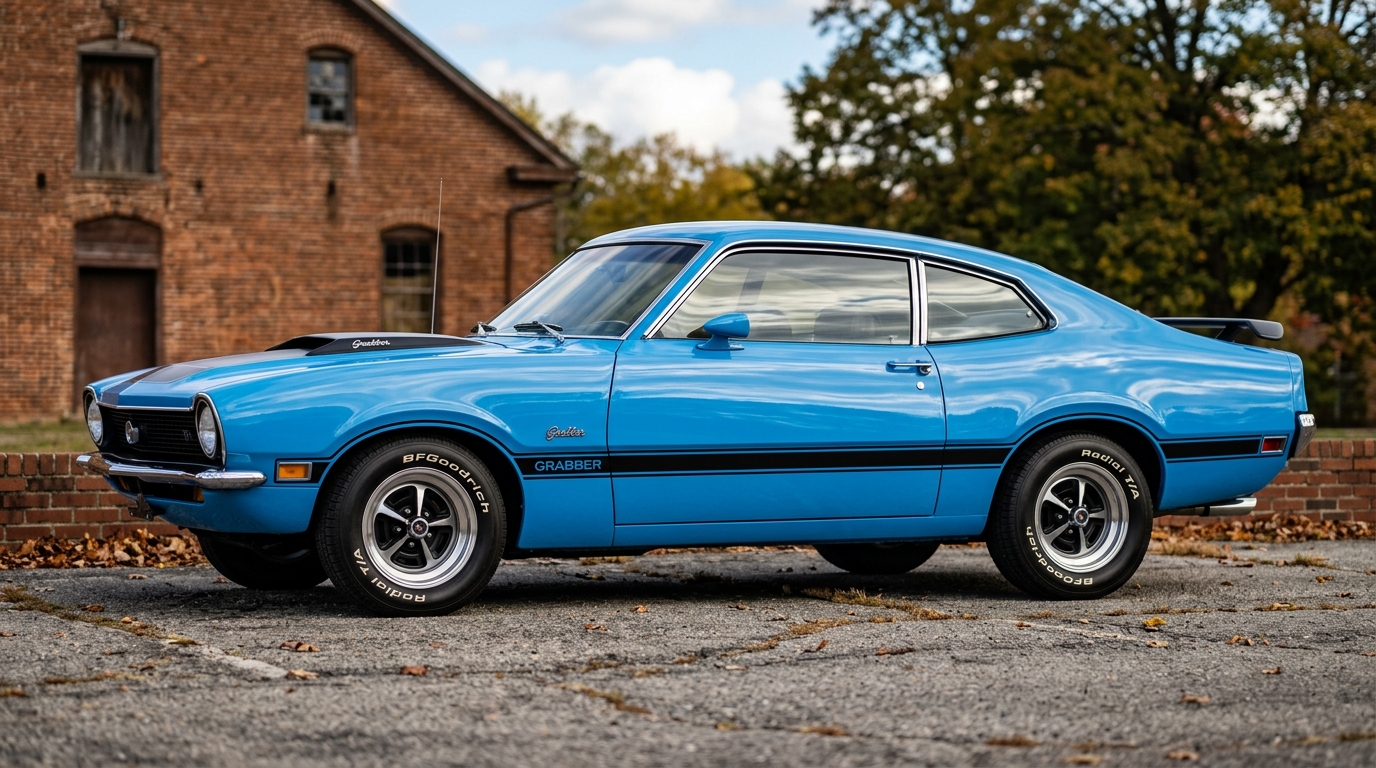
Production Overview: 1970–1977
The Ford Maverick launched on April 17, 1969 as a 1970 model — exactly five years after the Mustang. It was designed as a budget alternative to imported compacts, with a base price of $1,995. The Maverick was an instant success, selling 579,000 units in its first (partial) year. The car was simple: a Falcon-derived unibody, a 170ci Thriftpower inline-six, drum brakes, and a 3-speed manual. But it was light (~2,500 lbs) and could be optioned with the 302 V8 for genuine performance.
Total Maverick production exceeded 2.1 million units across 8 years. The Maverick was replaced by the Ford Fairmont in 1978. Today, the Maverick is one of the most affordable entry points into classic Ford ownership — a running, driving 302 V8 Grabber can be found for under $20,000.
Engine Options: Thriftpower Six to Windsor V8
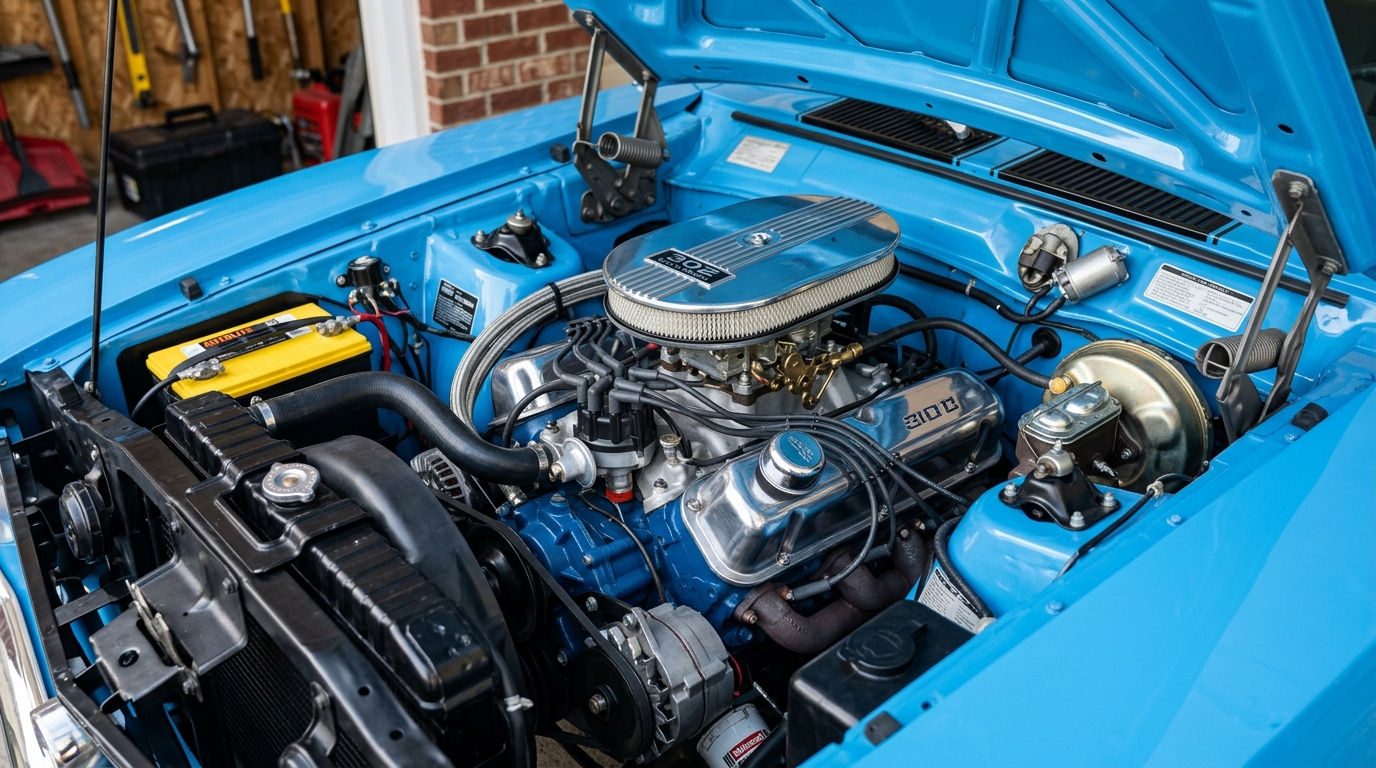
The Maverick's engine range was simple — three Thriftpower inline-sixes (170ci, 200ci, 250ci) and the 302ci Windsor V8. The 302 V8 (210hp, 295 lb-ft) was the performance option, available from 1971 onwards. In a car weighing just 2,500 lbs, the 302 provided genuine muscle car performance — 0-60 in 7.5 seconds and the quarter-mile in 15.8 seconds. The 250ci I6 (155hp) was the premium six-cylinder option and is the best choice for a reliable daily driver.
| Engine | Years | Displacement | HP | Torque | Notes |
|---|---|---|---|---|---|
| 170ci Thriftpower I6 | 1970–1972 | 170ci | 105hp | 156 lb-ft | Base engine; adequate but slow |
| 200ci Thriftpower I6 | 1971–1977 | 200ci | 133–155hp | 194–204 lb-ft | Most common six; reliable and cheap to maintain |
| 250ci Thriftpower I6 | 1971–1977 | 250ci | 155hp | 204 lb-ft | Premium six; best for daily driving |
| 302ci Windsor V8 | 1971–1977 | 302ci | 210–250hp | 295–335 lb-ft | Performance option; Grabber package |
The 302 Windsor V8 is the engine to have for performance. The 200/250 I6 is the best choice for a reliable, cheap-to-run classic.
Maverick Grabber: The Performance Package
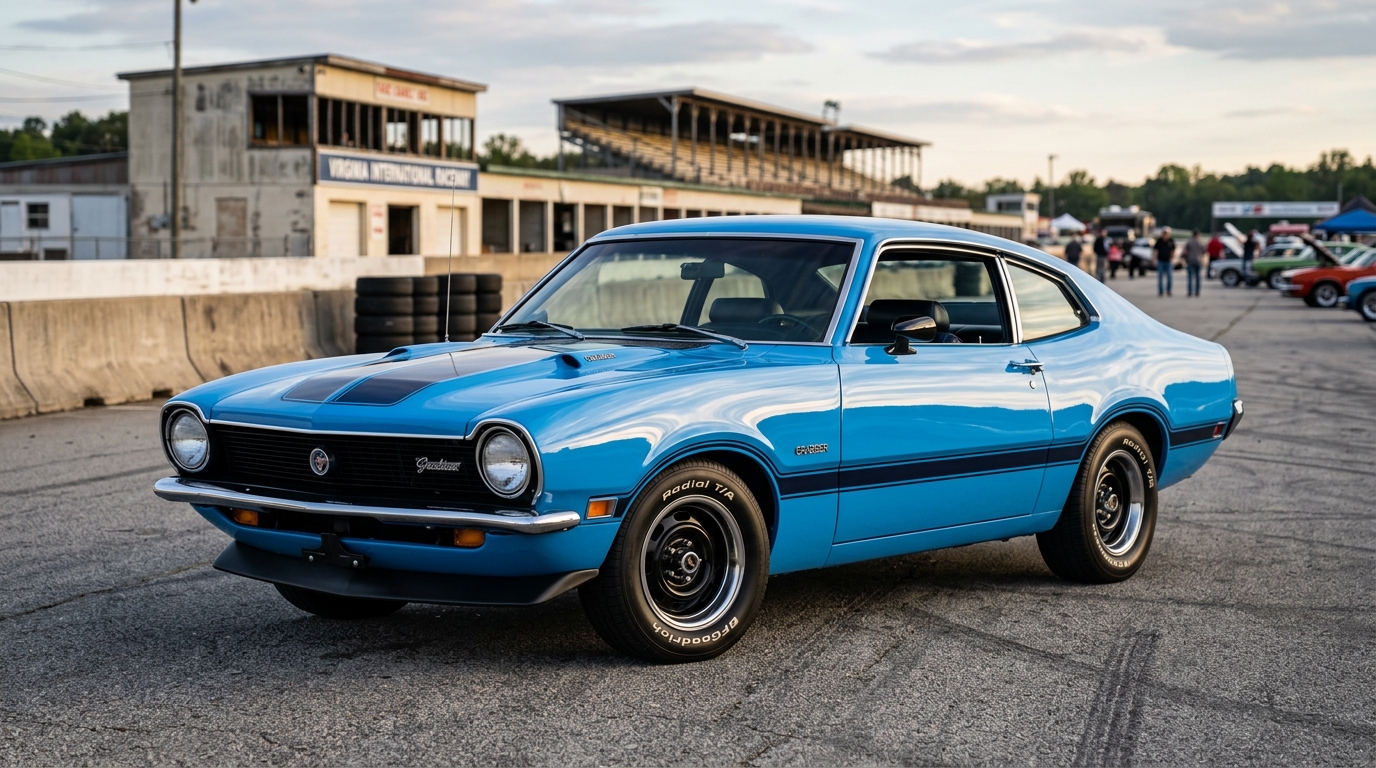
The Maverick Grabber package (1971–1975) was the performance and appearance upgrade — it added the 302 V8, sport stripes, a blackout grille, dual racing mirrors, and 14-inch sport wheels. The Grabber was not a separate model but an option package (code 099), which makes production numbers difficult to pin down — estimates suggest ~20,000–30,000 Grabber-equipped Mavericks were built across all years. The 1971 Grabber is the most collectible (first year, highest compression 302).
The Grabber package was available 1971–1975. Key features: 302 V8, dual exhaust, F70x14 tires, sport stripes, blackout grille. The 1971 model has the highest-power 302 (250hp, 9.0:1 compression); later years dropped to 210hp.
Special Editions: Sprint and LDO
The Maverick Sprint (1972–1975) was a luxury-themed Maverick with upgraded interior, vinyl roof, and special badging — it was not a performance model. The Luxury Decor Option (LDO, 1972+) added bucket seats, center console, and woodgrain trim. The 1976 Stallion was a rare appearance package with special paint and stripes — only available for one year.
- What is the most valuable Maverick?
- The 1971 Maverick Grabber with the 302 V8 (250hp) in Grabber Blue with documentation. These trade at $18,000–$30,000 in #2 condition. The 1976 Stallion is rarer but less desirable.
- Is the Maverick a good first classic car?
- Yes — it's one of the cheapest V8 classics you can buy. A running 302 Grabber starts at $15,000, and base 200 I6 models can be found for $8,000. Parts are shared with the Mustang and Falcon, so availability is excellent.
- How does the Maverick compare to the Nova?
- The Nova is more collectible and more expensive (40-60% premium). The Maverick offers similar 302 V8 performance in a lighter package for significantly less money. The Maverick is the smart buy for budget Ford enthusiasts.
- Can I swap a 351W or 5.0L HO into a Maverick?
- Yes — the Maverick engine bay accepts the 351W with minor modifications. The 5.0L HO from a Fox Body Mustang is a near bolt-in swap. This makes the Maverick an excellent restomod platform — light weight + V8 power = modern performance on a budget.
Get an AI-powered valuation for your Ford Maverick — free, instant, based on real auction data.
Value My CarSources & References
- Hagerty Price Guide — Valuation Tools — Independent valuation data by condition grade #1-#4
- Bring a Trailer — Auction Results — Real-world auction sale prices for market comparison
- Related: Nova Generation Hub 1962 1974 — In-depth related guide from our editorial library
- Related: Fox Body Mustang Generation Hub — In-depth related guide from our editorial library
- Related: Ford Mustang Boss Mach1 Generation Hub 1969 1973 — In-depth related guide from our editorial library