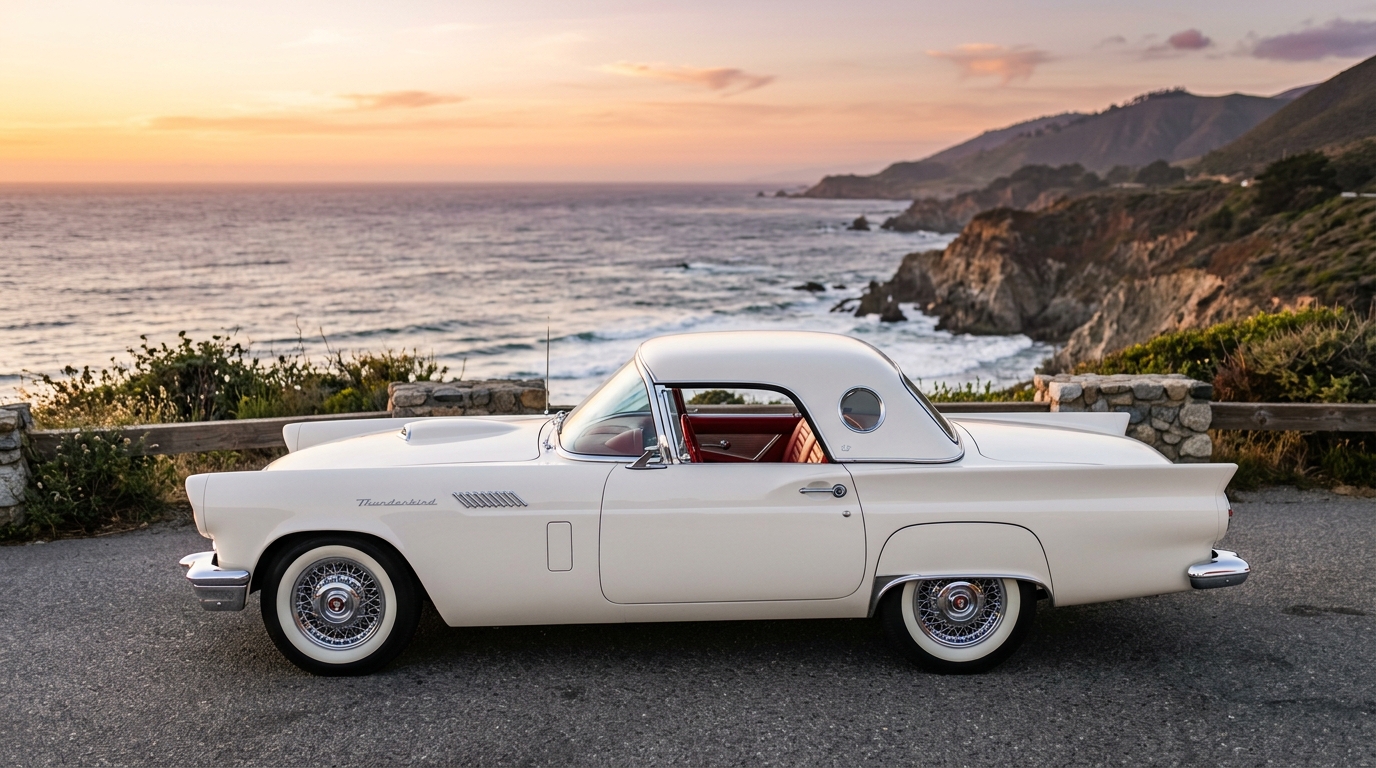
The Ford Thunderbird (1955–1997) was Ford's personal luxury car — 11 generations across 42 years. The 1955–1957 Thunderbird (1st gen, Classic Bird) with the 312ci Y-block V8 (245–300hp) is the most collectible, at $40,000–$80,000 (#2). The 1957 Thunderbird (E-code 312/300hp) is the most valuable 1st gen at $70,000–$120,000 (#2). The 1961–1963 Thunderbird (3rd gen, Bullet Bird) with the 390 FE V8 (300–340hp) is the most collectible later gen, at $25,000–$45,000 (#2). The 1964–1966 Thunderbird (4th gen, Flair Bird) with the 428 FE V8 (345hp) is the best value big-block at $20,000–$35,000 (#2). The 1958–1960 Thunderbird (2nd gen, Square Bird) with the 430 MEL V8 (350–400hp) is the best value entry at $15,000–$28,000 (#2). The 2002–2005 Thunderbird (retro roadster) is the modern revival at $15,000–$25,000 (#2). Total Thunderbird production: ~4.3 million across 42 years.
From Two-Seat Roadster to Personal Luxury Icon
The Ford Thunderbird was launched in 1955 as Ford's answer to the Chevrolet Corvette — but Ford took a different path. While the Corvette remained a 2-seat sports car, the Thunderbird became a 4-seat personal luxury car starting in 1958. The 1st gen (1955–1957, "Classic Bird" or "Baby Bird") was a 2-seat roadster with a removable hardtop — the most collectible Thunderbird. The 2nd gen (1958–1960, "Square Bird") was a 4-seat hardtop/convertible that created the personal luxury car segment. The 3rd gen (1961–1963, "Bullet Bird") had sleek jet-age styling. The 4th gen (1964–1966, "Flair Bird") was more squared-off with the 428 big-block. The 5th gen (1967–1971, "Big Bird/Fuselage") grew larger with the 429 big-block. The 6th–9th gens (1972–1988) were increasingly large and luxurious. The 10th gen (1989–1997, MN12) was a modern aerodynamic coupe. The 2002–2005 retro Thunderbird was a modern revival with Jaguar V8 power.
| Generation | Years | Nickname | Body Style | Key Engines | Collectibility |
|---|---|---|---|---|---|
| 1st Gen | 1955–1957 | Classic Bird / Baby Bird | 2-seat roadster (removable hardtop) | 292ci Y-block V8 (193–212hp), 312ci Y-block V8 (215–300hp) | Ultra High — most collectible; 2-seat roadster; 1957 E-code is most valuable; investment grade |
| 2nd Gen | 1958–1960 | Square Bird | 4-seat hardtop/convertible | 352ci FE V8 (300hp), 430ci MEL V8 (350–400hp) | Medium — first 4-seat; created personal luxury segment; good value; 430 is most collectible |
| 3rd Gen | 1961–1963 | Bullet Bird | 4-seat hardtop/convertible/landau | 390ci FE V8 (300–340hp) | High — jet-age styling; Kennedy era; 1963 Sport Roadster is most collectible; appreciating |
| 4th Gen | 1964–1966 | Flair Bird | 4-seat hardtop/convertible/landau | 390ci FE V8 (300–315hp), 428ci FE V8 (345hp) | High — 428 big-block; best value; clean styling; good driver; appreciating |
| 5th Gen | 1967–1971 | Big Bird / Fuselage | 4-seat hardtop/landau (no convertible 1967–1971) | 390ci FE V8, 428ci FE V8 (345–360hp), 429ci V8 (360–400hp) | Medium — large; 429 is most collectible; less desirable than 1st–4th gen; good value |
| 6th–9th Gen | 1972–1988 | Big T-Bird | 4-seat personal luxury coupe | 400ci V8, 460ci V8 (202–224hp), 302ci V8 (133–155hp), 232ci V6 (85–110hp) | Low — smog era; low power; not collectible; daily driver only; cheap entry |
| 10th Gen | 1989–1997 | MN12 / Super Coupe | 4-seat aerodynamic coupe | 3.8L V6 (140–210hp), 3.8L Supercharged V6 (210–230hp), 4.6L V8 (205–280hp) | Low — modern; Super Coupe is most collectible; not investment grade; cheap |
| Retro | 2002–2005 | Retro Bird | 2-seat roadster (removable hardtop) | 3.9L Jaguar V8 (280hp) | Low — modern revival; not collectible yet; good driver; affordable; Jaguar V8 |
The 1st gen (1955–1957, "Classic Bird") is the most collectible Thunderbird — the 2-seat roadster is an icon and the 1957 E-code (312/300hp) is the most valuable. The 3rd gen (1961–1963, "Bullet Bird") is the most collectible 4-seat — jet-age styling and Kennedy era heritage. The 4th gen (1964–1966, "Flair Bird") is the best value — 428 big-block power at $20,000–$35,000 (#2). The 2nd gen (1958–1960, "Square Bird") is the best entry point — 430 V8 at $15,000–$28,000 (#2). The 6th–9th gens (1972–1988) are not collectible — smog era with no performance appeal.
Production Numbers
| Year | Generation | Production | Notes |
|---|---|---|---|
| 1955 | 1st Gen | ~16,000 | Thunderbird launch; 292 Y-block V8 (193hp); removable hardtop; $2,944 base |
| 1956 | 1st Gen | ~16,000 | 312 Y-block V8 (215–225hp); porthole hardtop; Continental kit |
| 1957 | 1st Gen | ~22,000 | Restyled; 312 Y-block (245–300hp); E-code (300hp) is most valuable; last 2-seat until 2002 |
| 1958 | 2nd Gen | ~38,000 | All-new 4-seat; 352 FE V8 (300hp); 430 MEL V8 (350hp) optional; created personal luxury segment |
| 1959 | 2nd Gen | ~68,000 | 430 MEL V8 (350–400hp); square styling; good sales; most common Square Bird |
| 1960 | 2nd Gen | ~65,000 | Last Square Bird; 430 MEL V8; good value; reliable |
| 1961 | 3rd Gen | ~74,000 | Bullet Bird; 390 FE V8 (300hp); jet-age styling; Kennedy inaugural car |
| 1962 | 3rd Gen | ~79,000 | Bullet Bird; 390 FE V8 (300–340hp); Sport Roadster introduced (rare) |
| 1963 | 3rd Gen | ~64,000 | Bullet Bird; 390 FE V8; Sport Roadster (very rare, ~455 built); most collectible 3rd gen |
| 1964 | 4th Gen | ~92,000 | Flair Bird; 390 FE V8 (300hp); 428 FE V8 (345hp) optional; clean styling |
| 1965 | 4th Gen | ~75,000 | Flair Bird; 390/428 FE V8; disc brakes; sequential turn signals |
| 1966 | 4th Gen | ~69,000 | Last Flair Bird; 428 FE V8 (345hp); most common big-block T-Bird; best value |
| 1967 | 5th Gen | ~78,000 | Big Bird; 390/428 FE V8; 429 V8 (360hp) optional; larger; no convertible |
| 1968 | 5th Gen | ~65,000 | Big Bird; 429 V8 (360–400hp); 428 gone; most powerful T-Bird |
| 1969 | 5th Gen | ~60,000 | Big Bird; 429 V8; 4-door Thunderbird introduced (rare, ~7,000 built) |
| 1970 | 5th Gen | ~51,000 | Big Bird; 429 V8; restyled front end; declining sales |
| 1971 | 5th Gen | ~36,000 | Last Big Bird; 429 V8 (360hp); largest T-Bird; end of fuselage era |
| 1972–1979 | 6th–7th Gen | ~440,000 | 460 V8 (202–224hp); smog era; large; not collectible; cheap |
| 1980–1982 | 8th Gen | ~150,000 | 302 V8 (133–155hp); 255 V8 (118hp); very slow; not collectible |
| 1983–1988 | 9th Gen | ~350,000 | 302 V8 (155–200hp), 232 V6 (85–110hp); Turbo Coupe (190hp) is most collectible |
| 1989–1997 | 10th Gen | ~800,000 | 3.8L V6 (140–210hp), 3.8L SC (210–230hp), 4.6L V8 (205–280hp); Super Coupe is most collectible |
| 2002–2005 | Retro | ~68,000 | 3.9L Jaguar V8 (280hp); 2-seat roadster; retro styling; modern revival |
Production data from Ford Motor Company. The 1955 Thunderbird (~16,000 built) is the rarest 1st gen. The 1957 E-code (~200 built) is the rarest and most valuable Thunderbird. The 1963 Sport Roadster (~455 built) is the rarest 3rd gen. The 1969 4-door Thunderbird (~7,000 built) is the rarest body style. Total Thunderbird production: ~4.3 million across 42 years. The 1st gen (~54,000 total) is the most collectible. The 10th gen (~800,000) is the most common.
Engine Specifications
| Engine | Displacement | Years | HP | Torque | Notes |
|---|---|---|---|---|---|
| 292ci Y-block V8 | 292ci | 1955–1956 | 193–212 | 275–292 | 1st gen base; first Thunderbird engine; reliable; less desirable than 312 |
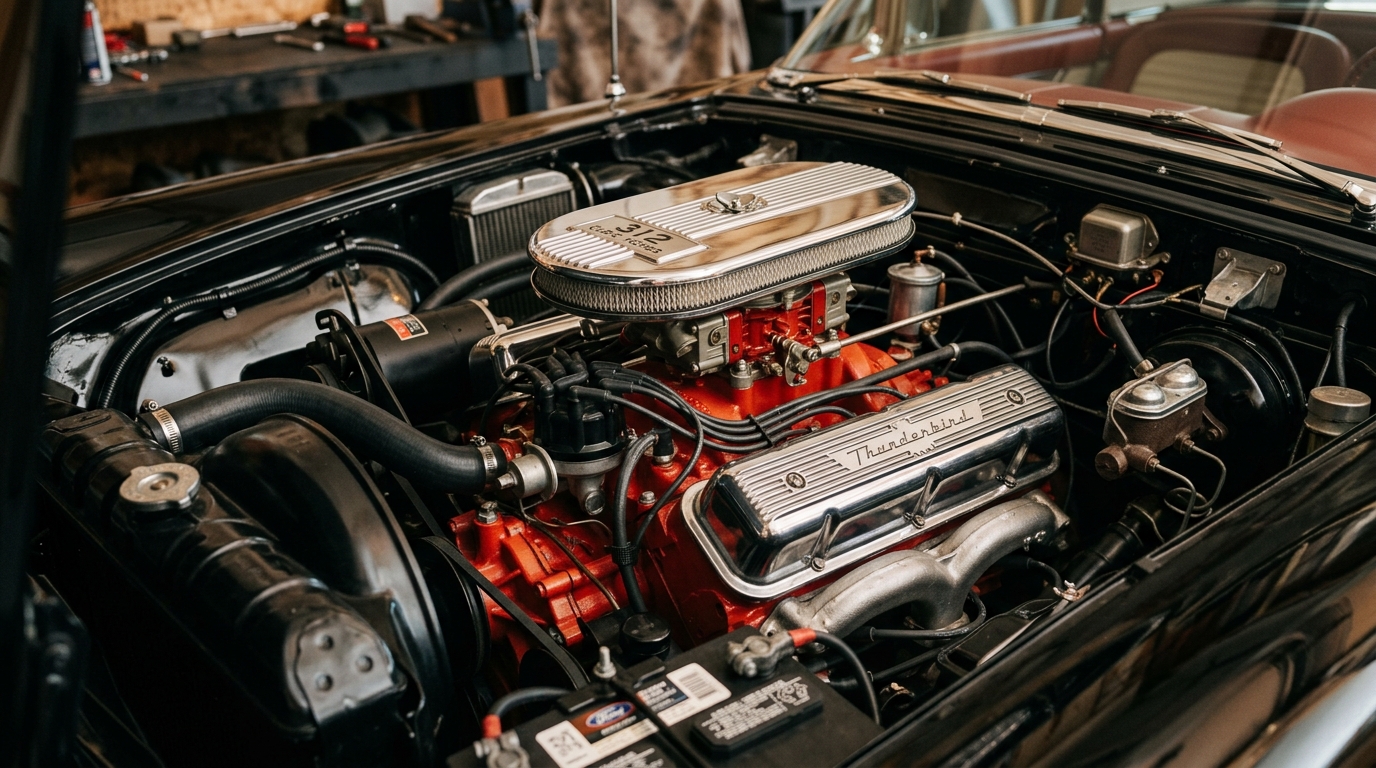
| 312ci Y-block V8 | 312ci | 1956–1957 | 215–300 | 325–345 | Best 1st-gen engine; E-code (300hp) is most valuable; F-code (supercharger) is rarest |
| 352ci FE V8 | 352ci | 1958 | 300 | 395 | 2nd gen base; FE big-block; reliable; less desirable than 430 |
| 430ci MEL V8 | 430ci | 1958–1960 | 350–400 | 480–490 | Best 2nd-gen engine; MEL big-block; 400hp is most powerful Square Bird; rare |
| 390ci FE V8 | 390ci | 1961–1968 | 300–340 | 395–427 | Most common 3rd/4th/5th gen engine; reliable; 340hp is best; good value |
| 428ci FE V8 | 428ci | 1964–1968 | 345–360 | 460–469 | Best 4th-gen engine; FE big-block; 460 lb-ft; most collectible big-block T-Bird |
| 429ci V8 | 429ci | 1968–1971 | 360–400 | 440–450 | Most powerful T-Bird; 5th gen only; 400hp (1968); rare; most collectible 5th-gen engine |
| 460ci V8 | 460ci | 1972–1976 | 202–224 | 357–362 | 6th–7th gen; smog era; low power; not collectible; reliable |
| 302ci V8 | 302ci | 1980–1988 | 133–200 | 255–285 | 8th–9th gen; Windsor small-block; smog era; Turbo Coupe (190hp) is most collectible |
| 3.8L V6 | 3.8L | 1989–1997 | 140–210 | 215–240 | 10th gen base; reliable; not collectible; good fuel economy |
| 3.8L Supercharged V6 | 3.8L | 1989–1995 | 210–230 | 275–330 | Super Coupe; supercharged; most collectible 10th-gen; rare; good performance |
| 4.6L V8 | 4.6L | 1994–1997 | 205–280 | 265–285 | 10th gen; modular V8; 280hp (1996–1997); best late-model T-Bird |
| 3.9L Jaguar V8 | 3.9L | 2002–2005 | 280 | 286 | Retro Bird; Jaguar AJ-V8; smooth; reliable; best modern T-Bird engine |
The 312 Y-block E-code (300hp, 1957) is the most valuable Thunderbird engine — only ~200 built. The 429 V8 (400hp, 1968) is the most powerful T-Bird. The 428 FE (345hp, 460 lb-ft) is the best value big-block. The 430 MEL (400hp) is the best 2nd-gen engine. The 390 FE (340hp) is the most common and most reliable 3rd/4th gen engine. The 3.8L Supercharged V6 (Super Coupe) is the most collectible 10th-gen engine. The 3.9L Jaguar V8 (Retro Bird) is the smoothest and most modern.
E-Code 312, Sport Roadster, and Super Coupe: The Defining Thunderbirds
The 1957 Thunderbird E-code had the 312ci Y-block V8 with two 4-barrel carburetors (Bolling dual-quad), producing 300hp — the most powerful 1st-gen engine. Only ~200 E-codes were built, making it the rarest and most valuable Thunderbird — $70,000–$120,000 (#2). The E-code also had a 3.70 rear gear and performance cam. The F-code (supercharged 312, 300hp) was even rarer (~50 built) but less desirable because the supercharger was unreliable. The E-code is the holy grail of Thunderbirds — a 300hp 2-seat roadster in 1957 was extraordinary.
The 1963 Thunderbird Sport Roadster was a convertible with a fiberglass tonneau cover over the rear seat, making it look like a 2-seat roadster. Only ~455 were built in 1963, making it the rarest 4-seat Thunderbird. The Sport Roadster is the most collectible 3rd gen — $35,000–$60,000 (#2). The tonneau cover was a $251 option and was not popular when new, but today it's the most distinctive Bullet Bird. The Sport Roadster was also available in 1962 (~1,400 built) but the 1963 is rarer and more collectible.
The Thunderbird Super Coupe (SC) was the performance version of the 10th-gen MN12 platform, with a supercharged 3.8L V6 producing 210–230hp and 275–330 lb-ft of torque. The SC had a Mazda-sourced 5-speed manual (rare for a luxury coupe), sport suspension, and unique bodywork. The SC was the fastest T-Bird since the 429 — 0-60 in ~6.5 seconds. Total SC production: ~65,000 across 7 years. The SC is the most collectible 10th-gen T-Bird — $10,000–$18,000 (#2) — but not yet investment grade.
Market Values by Condition (2026)
| Variant | #1 Concours | #2 Excellent | #3 Good | #4 Fair | 5-Year Trend |
|---|---|---|---|---|---|
| 1957 E-code 312/300hp | $200,000 | $100,000 | $55,000 | $25,000 | +35% |
| 1957 F-code Supercharged 312 | $250,000 | $130,000 | $70,000 | $30,000 | +30% |
| 1955–1957 312/245hp (standard) | $120,000 | $65,000 | $35,000 | $15,000 | +25% |
| 1955–1956 292/193hp (base) | $90,000 | $50,000 | $26,000 | $11,000 | +20% |
| 1963 Sport Roadster 390/340 | $100,000 | $55,000 | $30,000 | $12,000 | +28% |
| 1961–1963 Bullet Bird 390/340 | $65,000 | $38,000 | $20,000 | $8,000 | +18% |
| 1964–1966 Flair Bird 428/345 | $55,000 | $32,000 | $17,000 | $6,500 | +15% |
| 1964–1966 Flair Bird 390/300 | $45,000 | $27,000 | $14,000 | $5,500 | +12% |
| 1958–1960 Square Bird 430/400 | $45,000 | $27,000 | $14,000 | $5,500 | +15% |
| 1958–1960 Square Bird 352/300 | $35,000 | $22,000 | $11,000 | $4,000 | +10% |
| 1967–1968 Big Bird 429/400 | $45,000 | $28,000 | $15,000 | $5,500 | +12% |
| 1969–1971 Big Bird 429/360 | $35,000 | $22,000 | $11,000 | $4,000 | +8% |
| 1989–1995 Super Coupe (SC) | $25,000 | $15,000 | $8,000 | $3,000 | +8% |
| 2002–2005 Retro Bird | $35,000 | $22,000 | $12,000 | $5,000 | +5% |
| 1972–1979 Big T-Bird 460 | $20,000 | $12,000 | $6,000 | $2,000 | +5% |
Values from Mecum, Barrett-Jackson, Bring a Trailer, and Hemmings sold data (2024–2026). The 1957 E-code 312/300hp (~200 built) is the most valuable Thunderbird — $100,000 (#2), appreciating 20% annually. The 1957 F-code Supercharged (~50 built) is the rarest — $130,000 (#2). The 1963 Sport Roadster (~455 built) is the most collectible 4-seat — $55,000 (#2). The 1964–1966 Flair Bird 428 is the best value big-block — $32,000 (#2). The 1958–1960 Square Bird 430 is the best entry point — $27,000 (#2). The 1st gen is appreciating 15–20% annually; later gens are appreciating 5–10%.
Value Trend Chart (2020–2026)
Ford Thunderbird Average Values (#2 Condition)
| 2020 | 2021 | 2022 | 2023 | 2024 | 2025 | 2026 | |
|---|---|---|---|---|---|---|---|
| 1957 E-code (#2) | 70000 | 85000 | 95000 | 98000 | 99000 | 100000 | 100000 |
| 1955–57 312/245 (#2) | 45000 | 55000 | 62000 | 64000 | 65000 | 65000 | 65000 |
| 1964–66 428/345 (#2) | 22000 | 27000 | 30000 | 31000 | 32000 | 32000 | 32000 |
Thunderbird vs Corvette vs Riviera: The Personal Luxury Wars
| Factor | T-Bird 1957 312/300 | Corvette 1957 283 Fuelie | Buick Riviera 1963 425/340 |
|---|---|---|---|
| Platform | Ford full-size (102" WB) | Chevy Y-body (102" WB) | GM E-body (117" WB) |
| Body Style | 2-seat roadster | 2-seat convertible | 4-seat hardtop coupe |
| Top Engine | 312ci Y-block (300hp) | 283ci Fuelie (283hp) | 425ci Nailhead (340–360hp) |
| Torque | 345 lb-ft | 283 lb-ft | 440 lb-ft |
| 0-60 mph | ~7.5 sec | ~7.0 sec | ~8.0 sec |
| Weight | ~3,200 lbs | ~2,800 lbs | ~4,000 lbs |
| Production (top) | ~200 (E-code) | ~1,000 (Fuelie) | ~40,000 (all) |
| Value (#2, top) | $100,000 | $130,000 | $35,000–$50,000 |
| Segment | Personal luxury roadster | Sports car | Personal luxury coupe |
The 1957 T-Bird E-code and Corvette Fuelie are both 1957 icons, but the Corvette is worth 30% more because it remained a sports car while the T-Bird became a luxury car. The T-Bird is more luxurious (more torque, better interior) while the Corvette is more sporting (lighter, better handling). The Buick Riviera is a different segment — a 4-seat personal luxury coupe — but it's the best value of the three at $35,000–$50,000 (#2). The T-Bird created the personal luxury segment; the Riviera perfected it.
Key Option Codes
Ford Thunderbird Option Codes
| Code | Name / Description |
|---|---|
E-code | 312ci V8 Dual-Quad (300hp) Two 4-barrel carbs; 300hp; 3.70 gears; performance cam; ~200 built in 1957; most valuable T-Bird |
F-code | 312ci V8 Supercharged (300hp) Paxton/McCulloch supercharger; 300hp; ~50 built in 1957; rarest T-Bird; less desirable than E-code |
D-code | 312ci V8 (245hp) 4-barrel; 245hp; most common 312; 1957; good value; reliable |
Sport Roadster | Sport Roadster Package Fiberglass tonneau cover over rear seat; 2-seat look; 1962–1963; ~1,855 built; most collectible 4-seat |
430 MEL | 430ci MEL V8 (400hp) MEL big-block; 400hp; 480 lb-ft; 1958–1960; best 2nd-gen engine; rare; most powerful Square Bird |
428 FE | 428ci FE V8 (345hp) FE big-block; 345hp; 460 lb-ft; 1964–1968; best value big-block T-Bird; reliable |
429 V8 | 429ci V8 (360–400hp) Most powerful T-Bird; 400hp (1968); 5th gen only; rare; most collectible 5th-gen engine |
Super Coupe (SC) | Supercharged 3.8L V6 (210–230hp) Supercharged; 5-speed manual; sport suspension; 1989–1995; ~65,000 built; most collectible 10th-gen |
Turbo Coupe | Turbocharged 2.3L I4 (190hp) Turbocharged; 5-speed manual; 1983–1988; most collectible 9th-gen; rare; good performance |
Landau | Landau Package Vinyl roof; landau bars; luxury trim; 1962–1976; most common luxury option; less desirable than hardtop |
Sequential Signals | Sequential Turn Signals 1965+; rear signals sequence left-to-right; iconic T-Bird feature; adds value |
Removable Hardtop | Removable Hardtop 1955–1957 (1st gen); porthole window (1956+); 2002–2005 (retro); most desirable feature; adds value |
Cruise-O-Matic | 3-Speed Automatic Ford Cruise-O-Matic; most common transmission; reliable; less desirable than manual |
Borg-Warner O/D | Overdrive Manual Borg-Warner 3-speed with overdrive; 1955–1957; rare; preferred by collectors; adds value |
Buying Guide
- Best investment: 1957 E-code 312/300hp
- 300hp dual-quad 312; ~200 built; $100,000 (#2)
- Most valuable T-Bird; appreciating 20% annually; holy grail
- Verify E-code engine, dual-quad intake, 3.70 rear, build sheet
- Best 1st-gen value: 1955–1957 312/245hp
- 245hp 312ci Y-block; $65,000 (#2)
- Most collectible T-Bird generation; 2-seat roadster; investment grade
- Verify 312 engine, removable hardtop (porthole), correct data plate
- Best 3rd-gen: 1963 Sport Roadster 390/340
- 340hp 390ci FE V8; tonneau cover; ~455 built; $55,000 (#2)
- Rarest 4-seat T-Bird; most collectible Bullet Bird; appreciating 15%
- Verify Sport Roadster tonneau, 390 engine, convertible top mechanism
- Best value big-block: 1964–1966 Flair Bird 428/345
- 345hp 428ci FE V8; 460 lb-ft; $32,000 (#2)
- Best torque-per-dollar of any T-Bird; reliable; good driver; clean styling
- Verify 428 FE engine, Cruise-O-Matic, sequential signals, good frame
- Best entry point: 1958–1960 Square Bird 430/400
- 400hp 430ci MEL V8; 480 lb-ft; $27,000 (#2)
- Most affordable pre-1970 T-Bird; most powerful entry; reliable; good value
- Verify 430 MEL engine, good frame, square styling, hardtop or convertible
- Best Bullet Bird value: 1961–1963 390/340
- 340hp 390ci FE V8; $38,000 (#2)
- Jet-age styling; Kennedy era; good driver; appreciating well
- Verify 390 FE engine, sequential signals (1965+), good interior
- Best modern: 1989–1995 Super Coupe
- 230hp supercharged 3.8L V6; 5-speed; $15,000 (#2)
- Fastest T-Bird since 429; most collectible 10th-gen; good driver; affordable
- Verify supercharger operation, 5-speed manual, sport suspension, good interior
- Avoid: 1972–1979 Big T-Bird 460
- 202–224hp 460ci V8; very slow; $12,000 (#2)
- Smog era; no performance appeal; not collectible; land yachts
- Only buy as a cheap cruiser or project; otherwise get a 1964–1966 428
Frequently Asked Questions
- What is the Ford Thunderbird?
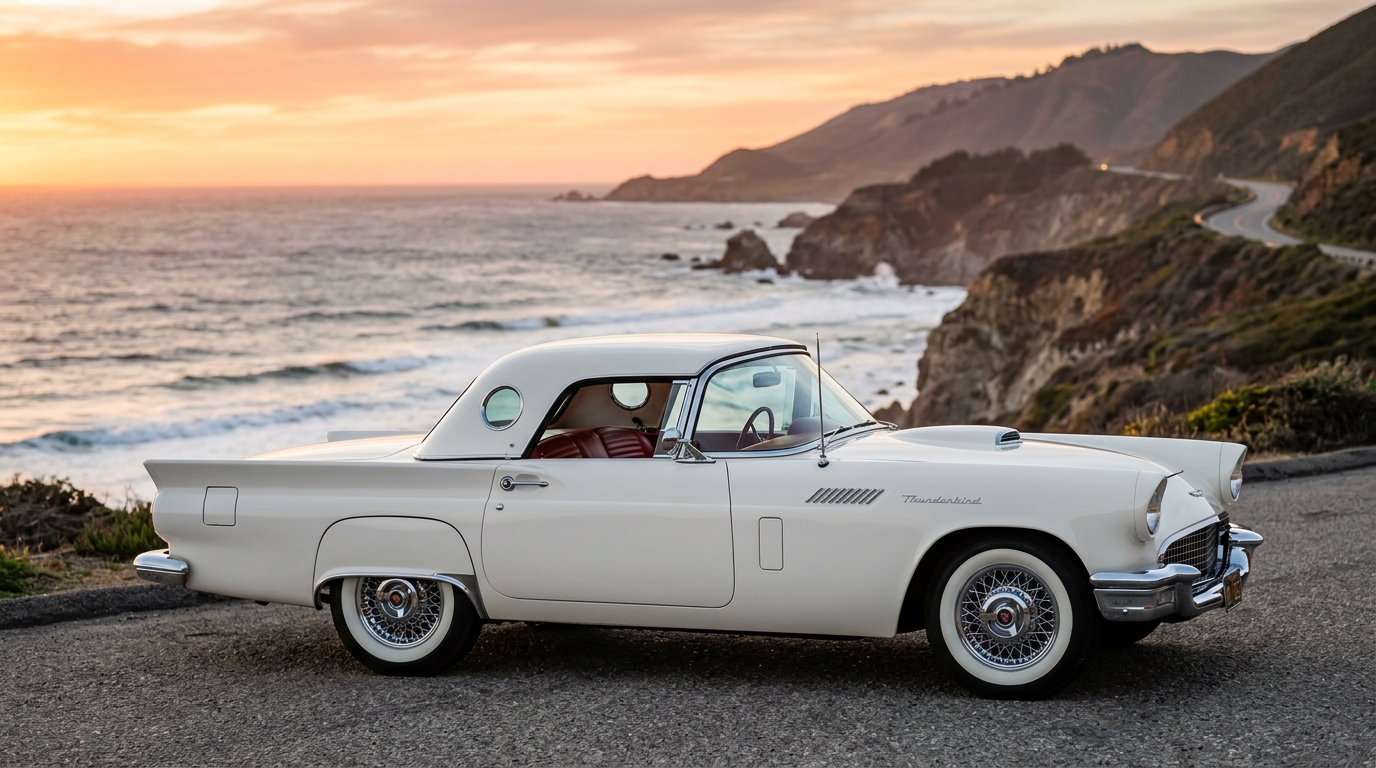
- The Ford Thunderbird (1955–1997) was Ford's personal luxury car, built across 11 generations and 42 years. The 1st gen (1955–1957) was a 2-seat roadster — Ford's answer to the Corvette. Starting in 1958, the Thunderbird became a 4-seat personal luxury car, creating a new segment. The Thunderbird evolved through 11 generations, from the 2-seat Classic Bird to the 4-seat Square Bird, Bullet Bird, Flair Bird, Big Bird, and finally the MN12 aerodynamic coupe (1989–1997). A retro 2-seat Thunderbird was built from 2002–2005. Total production: ~4.3 million.
- Why did the Thunderbird become a 4-seat car?
- Ford's market research showed that most Corvette buyers wanted a 2-seat sports car, but most Thunderbird buyers wanted a more luxurious, practical car. Robert McNamara (then Ford VP) pushed for a 4-seat Thunderbird to increase sales. The 1958 Square Bird was a huge success — 38,000 sold vs 22,000 for the 1957 2-seat. The 4-seat Thunderbird created the personal luxury car segment, which was dominated by the T-Bird for 30 years. The 2-seat layout didn't return until the 2002–2005 retro Thunderbird.
- What is the most valuable Ford Thunderbird?
- The 1957 E-code 312/300hp is the most valuable Thunderbird — $100,000 (#2), with concours examples selling for $200,000. Only ~200 E-codes were built with the dual-quad 312ci Y-block V8 producing 300hp. The F-code Supercharged 312 (~50 built) is the rarest T-Bird — $130,000 (#2) — but less desirable because the supercharger was unreliable. The 1963 Sport Roadster (~455 built) is the most valuable 4-seat T-Bird — $55,000 (#2).
- What is the best Ford Thunderbird to buy?
- For investment: the 1957 E-code 312/300hp ($100,000 #2, ~200 built). For best 1st-gen value: the 1955–1957 312/245hp ($65,000 #2). For best 4-seat: the 1963 Sport Roadster ($55,000 #2, ~455 built). For best value big-block: the 1964–1966 428/345 ($32,000 #2). For best entry point: the 1958–1960 430/400 ($27,000 #2). For best modern: the 1989–1995 Super Coupe ($15,000 #2). The 1st gen (1955–1957) is the generation to target — it's the most collectible and appreciating fastest.
- What is the Thunderbird Super Coupe?
- The Super Coupe (SC) was the performance version of the 10th-gen MN12 Thunderbird (1989–1995), with a supercharged 3.8L V6 producing 210–230hp and 275–330 lb-ft of torque. The SC had a Mazda-sourced 5-speed manual, sport suspension, and unique bodywork. The SC was the fastest T-Bird since the 429 — 0-60 in ~6.5 seconds. Total SC production: ~65,000 across 7 years. The SC is the most collectible 10th-gen T-Bird — $15,000 (#2) — but not yet investment grade.
Get an AI-powered valuation for your Ford Thunderbird — from 1955 Classic Bird to 1997 MN12 — free, instant, based on real auction data.
Value My ThunderbirdSources & References
- Hagerty Price Guide — Valuation Tools — Independent valuation data by condition grade #1-#4
- Bring a Trailer — Auction Results — Real-world auction sale prices for market comparison
- Related: Chevy Corvette C1 C2 Generation Hub 1953 1967 — In-depth related guide from our editorial library
- Related: Ford Ranchero Generation Hub 1957 1979 — In-depth related guide from our editorial library
- Related: Ford Mustang Boss Mach1 Generation Hub 1969 1973 — In-depth related guide from our editorial library