How Restoration Costs Break Down
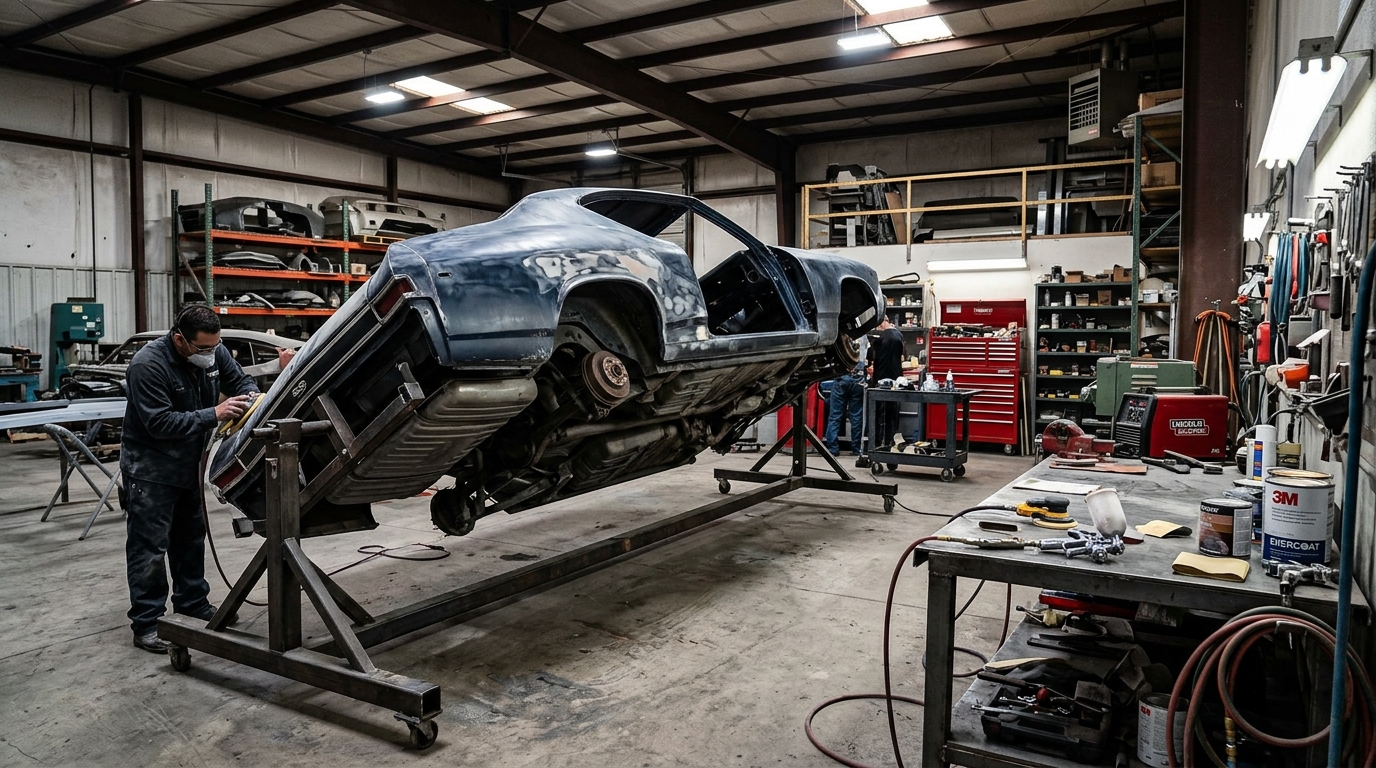
Classic car restoration costs are driven by two factors: labor hours and parts cost. Labor is the larger component — typically 55–65% of total cost at standard shop rates. Parts represent 35–45%, but this ratio shifts toward parts for restomod builds (crate engines, aftermarket suspension, EFI systems) and toward labor for concours restorations (color sanding, detail correctness, hand-fitting).
Labor Rate Tiers Explained
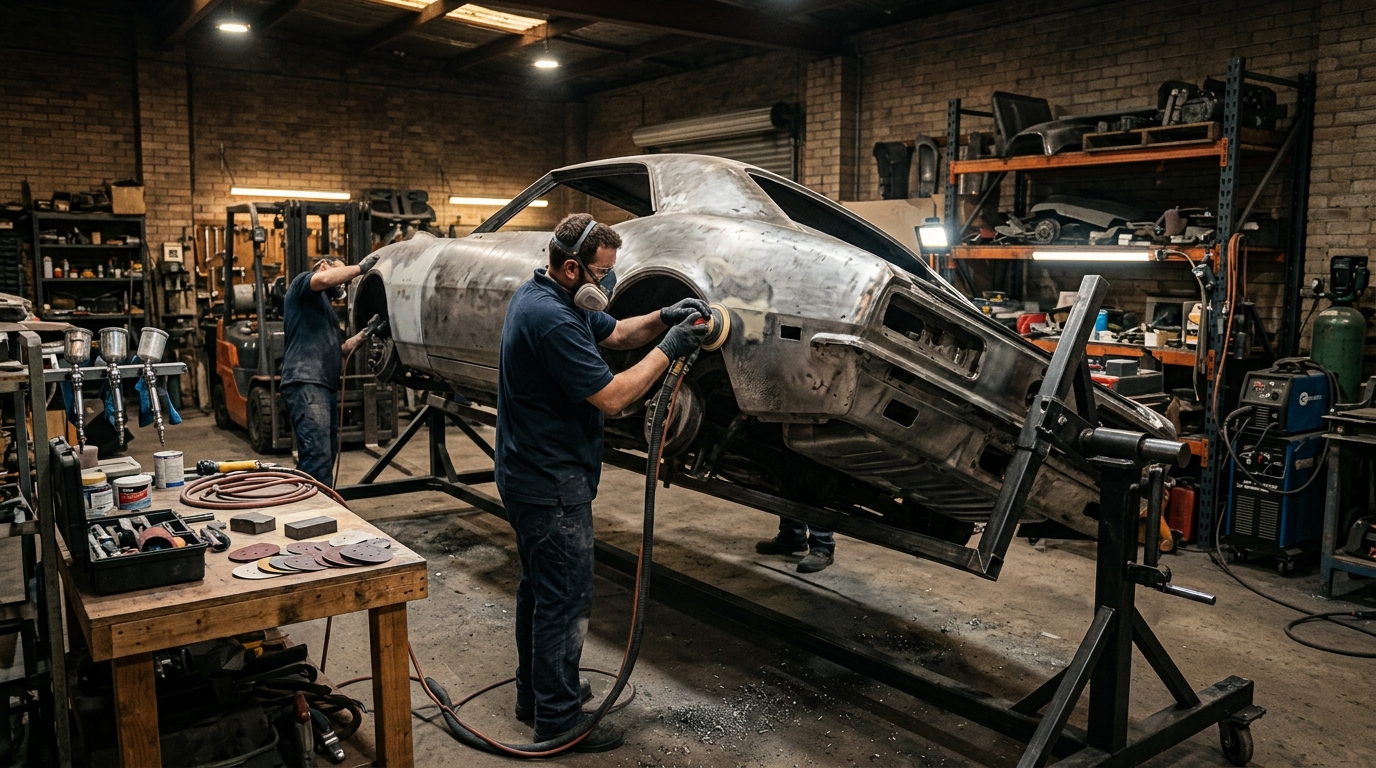
Shop labor rates vary dramatically by region, reputation, and specialization. The calculator includes four tiers:
| Tier | Rate | Shop Type | Best For |
|---|---|---|---|
| Budget | $65/hr | DIY-friendly shop, small town, part-time | Driver-quality builds, mechanical work only |
| Standard | $95/hr | Established restoration shop, 3–5 employees | Most restorations, good quality/cost ratio |
| Premium | $125/hr | Specialized shop, marque expertise, 5–15 employees | Show quality, rare vehicles, matching numbers |
| Concours | $150/hr | Award-winning shop, national reputation | Concours, investment-grade, museum quality |
Rates are national averages for 2025–2026. Coastal urban areas (CA, NY) trend 20–30% higher. Rural and Midwest areas trend 10–20% lower.
If you plan to do some work yourself, your labor isn't $0 — it's your opportunity cost. A skilled professional earning $50/hr who spends 200 hours on bodywork has $10,000 in opportunity cost. The calculator uses shop rates because that's the market benchmark. If you DIY, subtract your hours at the shop rate and add your parts cost.
Cost by Restoration Category
The calculator includes 12 cost categories. Below are the benchmark ranges for each, based on a standard truck restoration at a $95/hr shop:
| Category | Labor Hours | Parts Range | Total Range | Key Cost Driver |
|---|---|---|---|---|
| Bodywork & Rust | 80–160 | $1,500–$6,000 | $7,700–$21,200 | Extent of rust — cab corners, floors, rockers |
| Paint & Finish | 60–135 | $800–$3,500 | $6,500–$16,250 | Quality level — single-stage vs base/clear vs concours |
| Engine Rebuild | 40–80 | $2,000–$12,000 | $5,800–$19,600 | Stock rebuild vs performance vs crate swap |
| Transmission | 15–35 | $800–$4,500 | $2,200–$7,800 | Rebuild vs overdrive conversion |
| Rear Axle | 10–20 | $500–$2,500 | $1,400–$4,400 | Rebuild vs gear change vs limited-slip |
| Suspension | 25–55 | $800–$5,000 | $3,100–$10,400 | Stock vs drop kit vs full restomod |
| Brakes | 12–27 | $400–$3,000 | $1,500–$5,900 | Drum rebuild vs disc conversion |
| Interior | 30–68 | $1,000–$6,000 | $3,800–$12,500 | Kit vs custom leather, bench vs buckets |
| Electrical | 18–40 | $400–$2,500 | $2,100–$6,300 | Repair vs full rewire with modern fuse box |
| Exhaust & Fuel | 12–27 | $500–$3,000 | $1,600–$5,600 | Stock exhaust vs headers + EFI conversion |
| Chrome Plating | 6–14 | $800–$5,000 | $1,300–$6,700 | Number of pieces; bumpers are most expensive |
| Glass & Seals | 8–21 | $600–$2,500 | $1,300–$4,500 | Windshield + all glass + weatherstrip kit |
Ranges reflect driver-quality (low end) through concours-quality (high end) at $95/hr. Parts costs are retail; wholesale/supplier discounts can reduce parts by 10–20%.
The ROI Question: Is Restoration Worth It?
The most common question we hear: "Will I get my money back if I restore this car?" The honest answer for 90% of vehicles is no — at least not financially. Here's the math:
- Financially profitable: Only if you bought the vehicle for significantly under market value AND the restoration cost is below the value gap. Example: Buy a $15,000 project C10, spend $35,000 on driver-quality restoration, sell for $55,000 = $5,000 profit. This is rare.
- Works best with vehicles you already own at low cost basis
- Requires doing some labor yourself to reduce costs
- Break-even: Buy at market, restore at market cost, sell at market value. You lose money on transaction costs (sales tax, auction fees, transport).
- Break-even requires the vehicle to appreciate during the restoration period
- Most restorations take 1–2 years; appreciation is not guaranteed
- Financial loss, emotional gain: Most restorations. You spend $50,000 on a truck worth $40,000 when done. The $10,000 difference is the "hobby tax" — the cost of the enjoyment, pride, and memories.
- This is the most common outcome and it's perfectly valid
- Compare to other hobbies: boats, RVs, country clubs — all have "hobby tax"
No calculator can predict hidden damage. When a shop disassembles a vehicle, they often find: frame rust behind body mounts ($3,000–$8,000), structural cracks in stress areas ($2,000–$5,000), previous poor repairs hiding under filler ($3,000–$10,000), and corroded fasteners that require extraction ($500–$2,000). Budget a 15–20% contingency on top of the calculator estimate.
Cost-Saving Strategies
- Do the disassembly yourself
- Saves 20–40 labor hours at shop rate ($1,900–$3,800)
- Label and bag all hardware — shops charge extra to sort mixed fasteners
- Take photos before disassembly for reassembly reference
- Source your own parts
- Aftermarket parts suppliers (LMC Truck, Classic Industries, CTP) are 20–40% cheaper than shop-sourced
- Buy patch panels in kits rather than individually
- Watch for sales — LMC and Classic Industries run 10–15% off promotions quarterly
- Choose driver quality over show quality
- Driver quality costs 25% less than show quality
- The visual difference is subtle at 10 feet
- You can always upgrade later — you can't downgrade a concours restoration
- Keep the original engine
- Matching-numbers engines add 20–30% to vehicle value
- A stock rebuild ($2,000–$5,000) is cheaper than a crate engine swap ($8,000–$15,000)
- If the original engine is gone, a period-correct replacement is less expensive than modern LS swap
- Negotiate a package deal
- Shops may offer 5–10% discount for a complete restoration vs individual jobs
- Get everything in writing — scope, timeline, payment schedule, change order process
- Never pay more than 30% upfront; tie payments to milestones
Restoration Cost vs. Vehicle Value
Before starting a restoration, compare the estimated cost to the vehicle's potential finished value. Use the calculator above, then check current market values:
| Vehicle | Project Cost | Restoration Cost (Driver) | Finished Value | ROI |
|---|---|---|---|---|
| C10 Short Bed (350 V8) | $10,000–$20,000 | $30,000–$45,000 | $40,000–$65,000 | −$5,000 to +$15,000 |
| C10 Long Bed | $5,000–$12,000 | $30,000–$45,000 | $25,000–$40,000 | −$10,000 to −$25,000 |
| Camaro (1969 RS/SS) | $25,000–$50,000 | $40,000–$70,000 | $75,000–$120,000 | −$5,000 to +$45,000 |
| Nova (1968-1972) | $12,000–$25,000 | $30,000–$50,000 | $35,000–$60,000 | −$15,000 to +$10,000 |
| F-100 (1953-1956) | $15,000–$30,000 | $35,000–$55,000 | $40,000–$70,000 | −$15,000 to +$15,000 |
ROI ranges assume professional restoration at standard shop rates ($95/hr). DIY labor improves ROI by $5,000–$15,000. Values are 2026 market estimates for #2–#3 condition.
Frequently Asked Questions
- How accurate is this calculator?
- The calculator provides ±25% accuracy for most vehicles. It's based on 2024–2026 shop survey data and auction results. Actual costs depend on your specific vehicle's condition, your location, and the shop you choose. Always get a written estimate before committing.
- Should I restore or buy already restored?
- In most cases, buying an already-restored vehicle is cheaper. Someone else has already absorbed the "hobby tax." A $45,000 restored C10 typically cost $55,000–$65,000 to build. However, you don't get to choose the color, trim, or quality level — and you inherit any shortcuts the previous restorer took.
- What's the most expensive part of a restoration?
- Bodywork and paint combined account for 35–45% of total cost. This is because rust repair is labor-intensive (grinding, welding, metal finishing) and paint requires a dust-free environment with expensive materials. Engine work is second at 20–30%.
- Can I restore a car for $10,000?
- Yes, but only if: (1) the vehicle is already in driver condition with minimal rust, (2) you do most of the labor yourself, (3) you use budget parts, and (4) you accept driver-quality results. A $10,000 budget for a true project car will not produce a roadworthy vehicle.
- How long does a restoration take?
- Driver-quality: 3–8 months. Show-quality: 8–18 months. Concours: 18–36 months. These assume the shop is working on your vehicle consistently. Many shops juggle 3–5 projects, which extends real-world timelines by 50–100%.
Before you start a restoration, check what your vehicle is worth — both now and when finished.
Get AI ValuationSources & References
- Hagerty Price Guide — Valuation Tools — Independent valuation data for classic cars by condition grade
- Bring a Trailer — Auction Sales Data — Real-world auction results and sale prices
- NHTSA — Vehicle Safety Standards — Federal safety recall and compliance data
- Related: Nada Classic Values Cross Reference — In-depth related guide from our editorial library
- Related: Squarebody C10 Generation Hub — In-depth related guide from our editorial library
- Related: Cowl Tag Decoder Gm — In-depth related guide from our editorial library