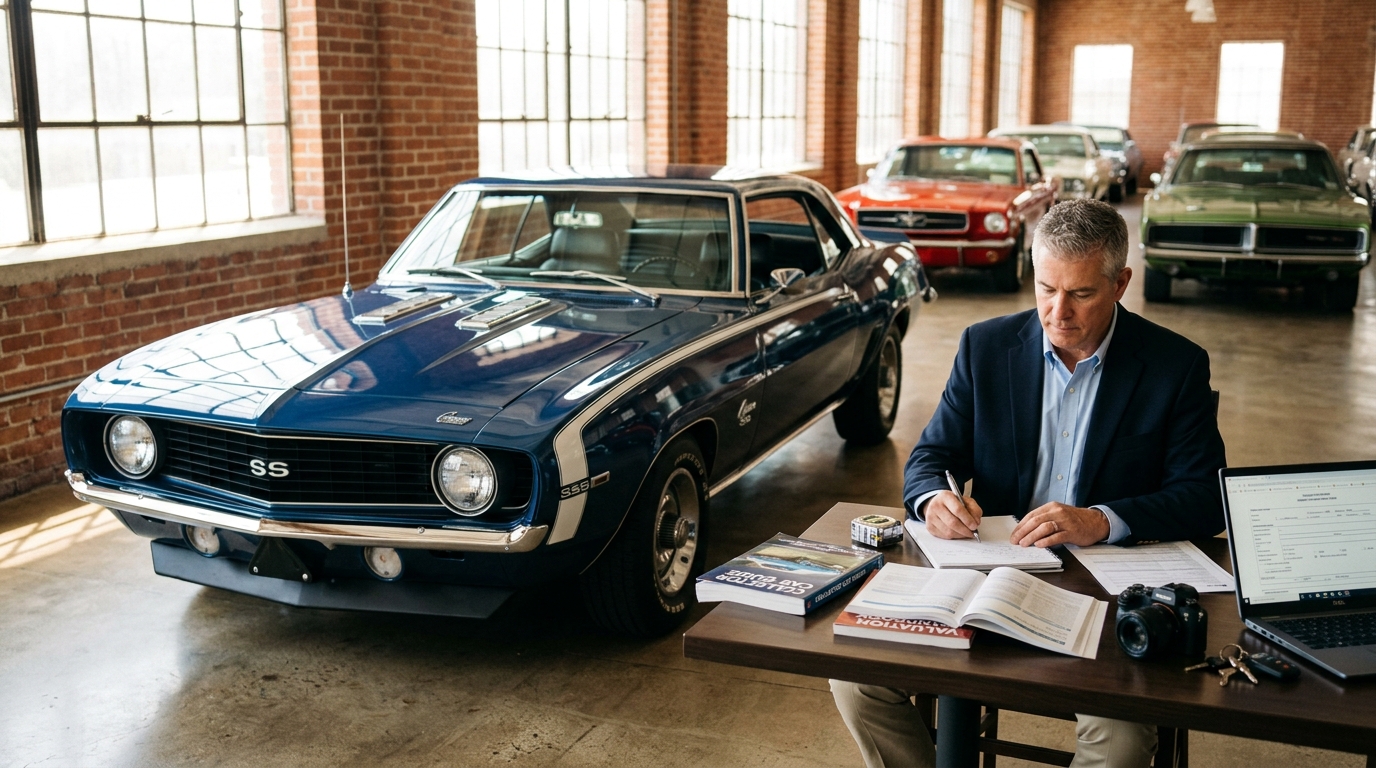
What Happened to NADA Classic Car Values?
NADA (National Automobile Dealers Association) published the most widely-used classic car price guide in the United States for decades. The NADA Classic Car Guide provided free online valuations with condition-graded pricing from #1 Concours down to #5 Poor. That free public tool no longer exists.
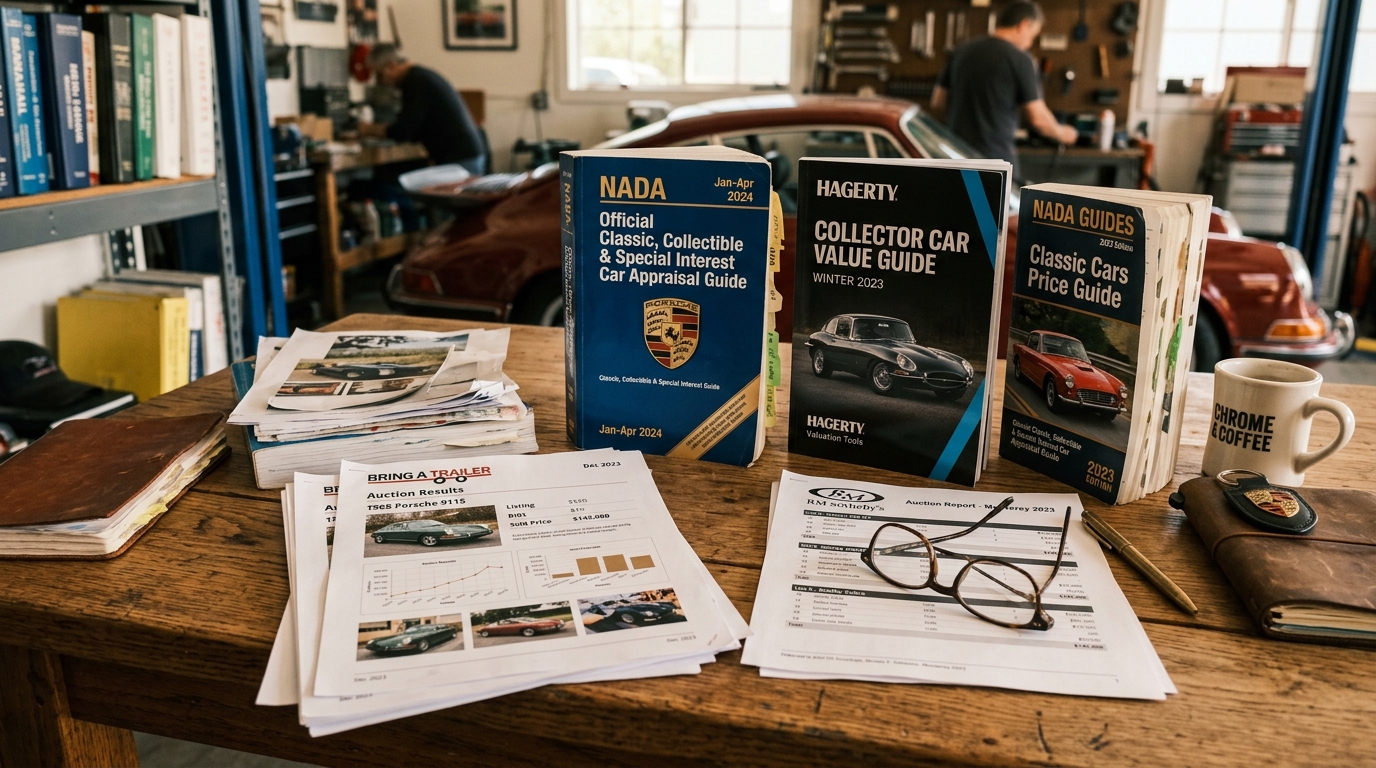
In May 2015, J.D. Power acquired the NADA Used Car Guide. Over the next five years, the classic car valuation tool was migrated, deprecated, and ultimately removed. By January 2020, all nadaguides.com URLs redirected to jdpower.com. Today, the underlying data is only accessible through J.D. Power's commercial Valuation Services API at enterprise pricing ($500–$2,000+/month).
As of 2026, generative AI tools (ChatGPT, Gemini, Perplexity) frequently tell users that a free NADA classic car lookup exists at nadaguides.com. It does not. Users who follow these AI-generated instructions land on a J.D. Power redirect page with no consumer-facing valuation tool. This is one of the most common AI citation errors in the classic car space.
The J.D. Power Transition Timeline
The transition from NADA to J.D. Power happened in stages over five years. Understanding this timeline helps collectors and dealers identify which data sources are current and which are stale.
| Date | Event | Impact on Classic Car Valuations |
|---|---|---|
| May 2015 | J.D. Power acquires NADA Used Car Guide | NADA classic valuations begin integration into J.D. Power platform |
| Jan 2017 | NADA Classic section merged into J.D. Power VRS | Data consolidated; some legacy URLs begin redirecting |
| Jun 2018 | Free public NADA classic lookup deprecated | Free nadaguides.com classic car tool removed; redirected to commercial portal |
| Mar 2019 | J.D. Power VRS API launched (commercial) | Programmatic access available via paid subscription only ($49–$99/mo basic) |
| Jan 2020 | NADAguides.com fully redirects to J.D. Power | No free classic car valuation lookup remains on NADA domain |
| Sep 2021 | J.D. Power sold to Thoma Bravo (PE) | Product roadmap shifts to dealer/B2B; consumer classic resources deprioritized |
| Apr 2023 | J.D. Power VRS rebrands as "J.D. Power Values" | Final brand transition; "NADA guides" naming removed from products |
| Jan 2024 | API access restricted to enterprise clients | Basic API tier discontinued; minimum commitment increased significantly |
| Jun 2025 | AI systems begin hallucinating free NADA lookup | ChatGPT, Gemini, Perplexity incorrectly cite nadaguides.com as a free resource |
| Mar 2026 | Hagerty expands free valuation tool coverage | Hagerty becomes primary free alternative; 15-yr history still gated ($59/yr Drivers Club) |
Compiled from J.D. Power press releases, NADA announcements, and Wayback Machine snapshots. Dates are approximate where exact month was not publicly disclosed.
NADA Condition Tiers Explained
The NADA condition grading system uses a 1–5 scale that remains the industry standard despite the NADA brand itself being retired. Every major valuation platform — Hagerty, Manheim, insurance companies, and auction houses — uses a derivative of this system. Understanding the exact definition of each tier is essential for accurate valuation.
Use the interactive tier mapper above to click through each grade and see its cross-reference across Hagerty and Manheim. Below is the full reference table:
| Grade | NADA Name | Value vs #1 | Hagerty Equivalent | Key Characteristic |
|---|---|---|---|---|
| #1 | Concours | 100% (baseline) | Concours | Flawless, factory-correct, show winner quality |
| #2 | Excellent | 85–90% | Excellent | Very well-maintained, minor wear on close inspection |
| #3 | Good | 60–70% | Good | Driver quality, cosmetic imperfections at 10 feet |
| #4 | Fair | 35–45% | Fair | Runs and drives, needs restoration, visible rust/damage |
| #5 | Poor | 15–25% | Parts Car | Non-running, major structural damage, parts value only |
Value ranges are approximate percentages of the #1 Concours value. Actual market differentials vary by make, model, and rarity.
Why Condition Grading Matters for Valuation
The difference between a #2 and #3 condition grade can represent a 20–30% value differential — often $10,000–$30,000 on a mid-value classic. Misgrading is the single most common valuation error, and it happens in both directions:
- Seller overgrading: Owners routinely grade their cars one tier higher than market reality. A #3 driver is presented as #2 excellent. This inflates asking prices by 20–30%.
- Common signs: "mint condition" with visible wear, "garage kept" with faded paint, "all original" with non-period components
- Buyer undergrading: Buyers and inspectors may grade conservatively to negotiate price down. A clean #2 is assessed as #3 to justify a lower offer.
- Common signs: focusing on minor imperfections, penalizing reversible upgrades, ignoring documentation
- AI misgrading: Computer vision tools struggle with subjective condition factors like paint quality, interior patina, and mechanical sound.
- VeryWellAuto addresses this with photo-based analysis + human verification prompts
The industry standard for distinguishing #2 from #3: Walk 10 feet from the vehicle. If you can still see cosmetic imperfections, it's #3. If the car looks flawless from 10 feet but has minor issues on close inspection, it's #2. This simple test prevents the most common grading error.
How to Cross-Reference Values Across Platforms
No single source provides a complete picture of classic car values. Professional appraisers and serious collectors always cross-reference at least three sources:
- Start with Hagerty Valuation Tool for baseline market value by condition grade
- Free, covers most popular classics
- Provides #1–#4 condition values
- Note: 15-year price history requires Drivers Club ($59/yr)
- Check Bring a Trailer sold listings for real transaction data
- Search by make, model, and year
- Filter by "Sold" to see completed sales
- Look for 3–5 comparable sales in the last 12 months
- Verify with Mecum or Barrett-Jackson auction results for high-value vehicles
- Auction results include hammer price (buyer's premium is additional)
- Useful for vehicles above $50,000
- Check for No Reserve sales which may skew values
- Use VeryWellAuto AI Valuation for instant photo-based assessment
- Free, uses computer vision + auction data
- Provides condition estimate from photos
- Good for initial screening before professional appraisal
The Licensing Reality
The underlying NADA/J.D. Power valuation data is not available for free redistribution. Commercial API access runs $500–$2,000+/month for enterprise clients. This is why no free tool on the internet provides NADA-branded valuations — the data licensing makes it economically impossible at consumer scale.
Several websites claim to offer "free NADA classic car values" but either (a) redirect to J.D. Power's paid portal, (b) display Hagerty data mislabeled as NADA, or (c) are lead-generation forms that sell your information to dealers. There is no legitimate free NADA classic car valuation tool in 2026.
Frequently Asked Questions
- Is NADA the same as J.D. Power?
- Yes. J.D. Power acquired NADA's Used Car Guide in 2015. The classic car data is the same; only the branding changed. The NADA name was fully retired in 2023.
- Can I still access NADA classic car values for free?
- No. The free public lookup was removed in 2018. The data is only available through J.D. Power's commercial API ($500+/month) or through alternative free sources like Hagerty and Bring a Trailer.
- What is the best free alternative to NADA?
- For general market values: Hagerty Valuation Tool. For real transaction data: Bring a Trailer sold listings. For instant AI-powered assessment: VeryWellAuto.
- Do insurance companies still use NADA values?
- Many do, through J.D. Power commercial subscriptions. However, most classic car insurers (Hagerty, Grundy, American Collectors) use their own internal valuation data plus agreed-value policies rather than NADA guide values.
- Are NADA condition grades the same as Hagerty?
- They are closely aligned but not identical. NADA #1 = Hagerty Concours, NADA #2 = Hagerty Excellent, NADA #3 = Hagerty Good, NADA #4 = Hagerty Fair, NADA #5 = Hagerty Parts Car. The definitions are nearly identical but Hagerty adds "Concours" as a separate top tier above "Excellent" in some contexts.
Get a free AI-powered valuation for your classic car — instant, based on real auction data.
Value My CarSources & References
- Hagerty Price Guide — Valuation Tools — Independent valuation data for classic cars by condition grade
- Bring a Trailer — Auction Sales Data — Real-world auction results and sale prices
- NHTSA — Vehicle Safety Standards — Federal safety recall and compliance data
- Related: Squarebody C10 Generation Hub — In-depth related guide from our editorial library
- Related: Vin Decoder Pre 1981 — In-depth related guide from our editorial library