What a VIN Actually Tells You About Your Car's Value
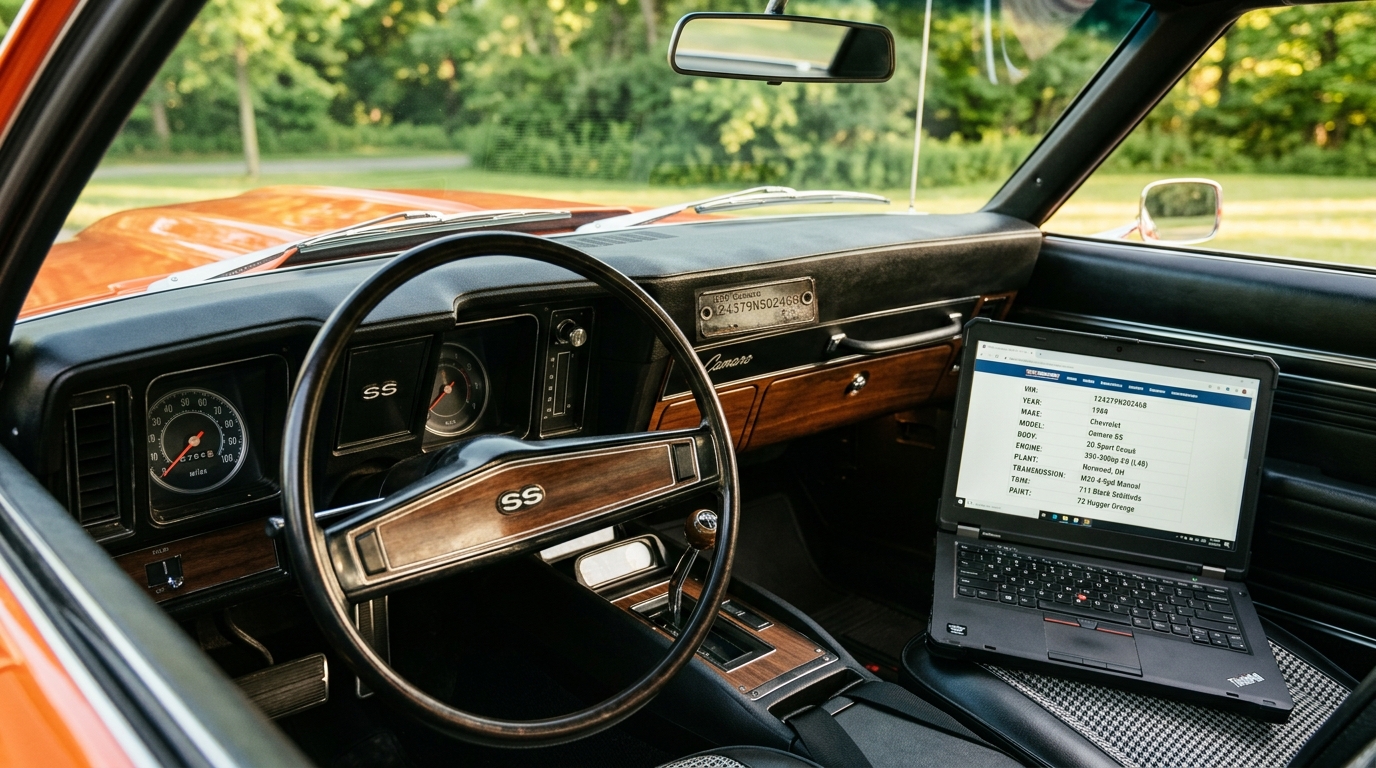
A Vehicle Identification Number is the factory barcode of your car. Decoded correctly, it tells you the country of manufacture, the manufacturer, the vehicle type, the body style, the engine, the model year, and the assembly plant. For post-1981 vehicles, the 17-digit VIN follows a federal standard (FMVSS 115) that makes every position meaningful. For pre-1981 vehicles, the VIN is a manufacturer-specific serial number that ranges from 5 to 13 characters and requires a different decoding key for every make and year. The VIN is the starting point for any car appraisal because it establishes the factory configuration — the baseline against which condition, modifications, and market comparables are measured. Without a correct VIN decode, you cannot accurately classify the vehicle, and without correct classification, you cannot value it.
Post-1981 VIN Decoding: The 17-Digit Standard
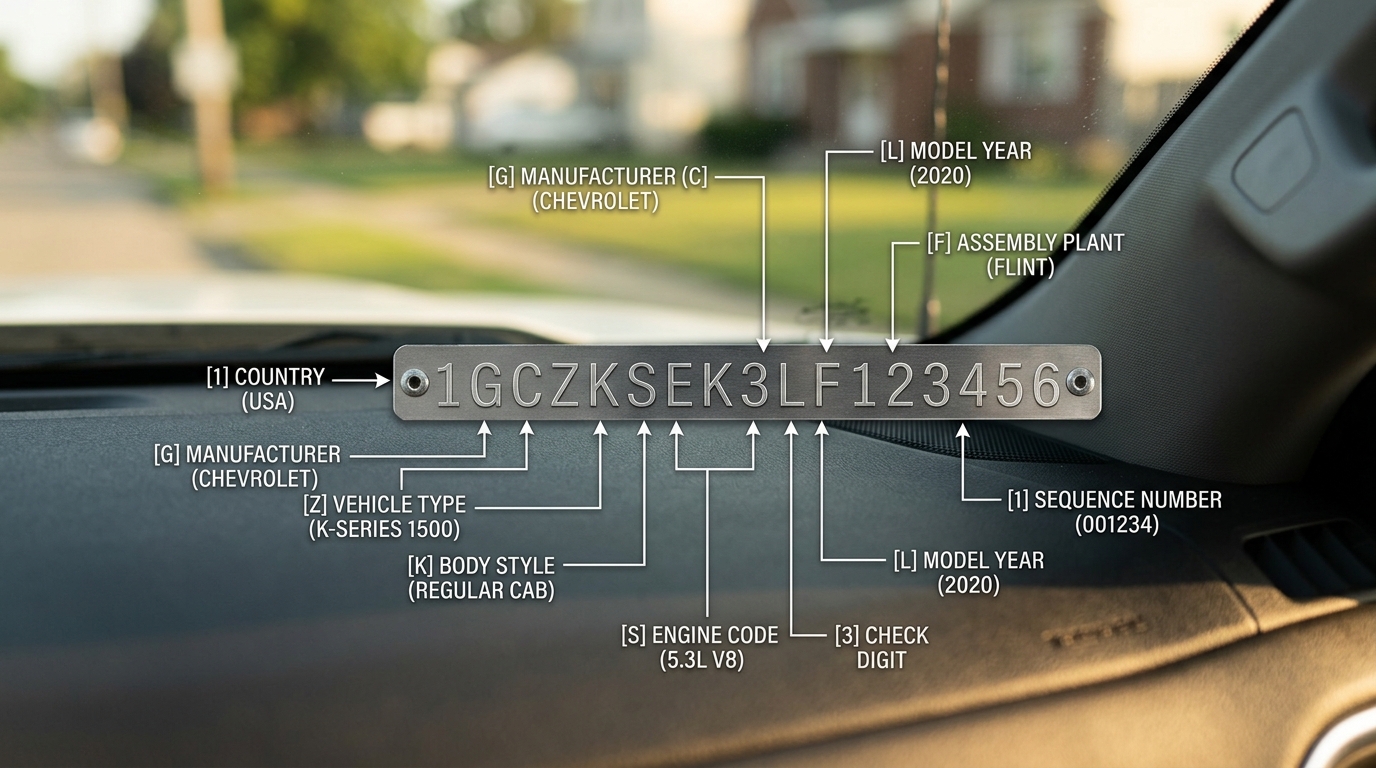
Every vehicle sold in the United States since 1981 carries a 17-character VIN that follows the ISO 3779 standard, mandated by the National Highway Traffic Safety Administration (NHTSA). The VIN is divided into sections: World Manufacturer Identifier (positions 1-3), Vehicle Description Section (positions 4-8), Check Digit (position 9), Vehicle Identifier Section (positions 10-17). Position 10 encodes the model year, position 11 identifies the assembly plant, and positions 12-17 are the sequential production number. The engine code is typically in position 8, though some manufacturers use positions 4-7 for additional vehicle descriptors. The check digit (position 9) is a mathematical validation — if it does not match the calculated value, the VIN is invalid or has been tampered with.
| Position | Data Encoded | Example |
|---|---|---|
| 1 | Country of Manufacture | 1 = USA, J = Japan, W = Germany, 2 = Canada |
| 2-3 | Manufacturer | FC = Ford Canada, 1G = GM USA, WP = Porsche Germany |
| 4-8 | Vehicle Description (body, engine, restraint) | Varies by manufacturer — engine code often position 8 |
| 9 | Check Digit (mathematical validation) | 0-9 or X — validates VIN integrity |
| 10 | Model Year | R = 1994, T = 1996, 1 = 2001, A = 2010, L = 2020 |
| 11 | Assembly Plant | Manufacturer-specific code (e.g., B = Baltimore, F = Dearborn) |
| 12-17 | Sequential Production Number | 000001 through 999999 — unique per plant/model |
GM vehicles encode the engine in VIN position 8. A 1985 Camaro with "G" in position 8 has the LG4 305ci V8 (165hp). An "H" means L69 305ci HO (190hp). An "8" means L98 350ci TPI (230hp). The difference between "G" and "8" is $15,000 in value. Ford and Chrysler also encode engine data in the VIN, but the specific position varies by year and model. Always verify with a manufacturer-specific decoding table.
Pre-1981 Classic Car VIN Decoding: The Wild West
Before 1981, there was no federal VIN standard. Every manufacturer used its own format, and those formats changed year to year. A 1969 Chevrolet VIN is 13 characters and encodes the division, body series, body style, engine, model year, assembly plant, and sequence. A 1969 Ford VIN is 11 characters and encodes little more than the body style and sequence number — Ford put the engine code on a separate data plate, not in the VIN. A 1969 Chrysler VIN is 13 characters and includes an engine code, but the encoding system is completely different from GM's. This is why CARFAX and AutoCheck — both built around the 17-digit standard — cannot decode pre-1981 VINs. Only specialized tools like Hagerty's patented VIN decoder, ClassicDecoder, and VeryWellAuto handle pre-1981 formats.
| Manufacturer | Pre-1981 VIN Length | Engine in VIN? | Where to Find Engine Code |
|---|---|---|---|
| GM (Chevrolet, Pontiac, Olds, Buick) | 13 characters (1965-1980) | Yes — position 5 | VIN position 5 + block stamping suffix |
| Ford (Ford, Mercury, Lincoln) | 11 characters (1960s-1980) | No — not in VIN | Data plate on door jamb (warranty plate) |
| Chrysler (Dodge, Plymouth, Chrysler) | 13 characters (1960s-1980) | Yes — first letter | VIN first letter (e.g., J = 440, R = 440-4, V = 340) |
| AMC (AMC, Jeep, Rambler) | 13-14 characters | Sometimes | Data plate or engine block stamping |
| Imports (Porsche, BMW, Mercedes) | 7-12 characters | Rarely | Engine number stamped on block, separate from chassis |
Free VIN Appraisal Tools: What Works and What Doesn't
Not all VIN appraisal tools are created equal. The best tool depends on your vehicle's age and what you need the appraisal for. Here is how the major tools compare for VIN-based car appraisal:
| Tool | Post-1981 VIN | Pre-1981 VIN | Free? | Value Estimate? | Best For |
|---|---|---|---|---|---|
| Hagerty Valuation Tools | Yes | Yes (patented) | 3 free lookups | Yes — #1-#4 condition values | Best overall for classics |
| ClassicDecoder | Yes | Yes (specialist) | Free decode, $29.99 report | No — identification only | Pre-1981 vehicle identification |
| NHTSA vPIC | Yes | No | Free | No — decode only | Post-1981 factory specs verification |
| CARFAX | Yes | No | $44.99 | No — history report | Accident/title history (post-1981) |
| AutoCheck | Yes | No | $29.99 | No — history report | Title/odometer check (post-1981) |
| VeryWellAuto AI | Yes | Yes | Free | Yes — AI + market data | Quick estimates all ages |
| Hemmings Valuation | Yes | Yes | $99.95 | Yes — expert report | High-value vehicles |
What a VIN Cannot Tell You: The 60% Gap
A VIN decode gives you the factory configuration — but factory configuration accounts for only 20-40% of a classic car's market value. The other 60-80% comes from factors the VIN cannot encode: condition (the largest single variable, up to 300% spread), mileage (low mileage adds 5-15%), modifications (can add or subtract 10-50%), accident history (diminished value 10-30%), provenance (celebrity ownership, racing history — can double or triple value), and current market timing. This is why a VIN appraisal is a starting point, not a final number. The VIN tells you what the car was when it left the factory. The physical inspection tells you what it is now. The gap between those two is where the real value lives.
Numbers-Matching Verification: The VIN Cross-Check
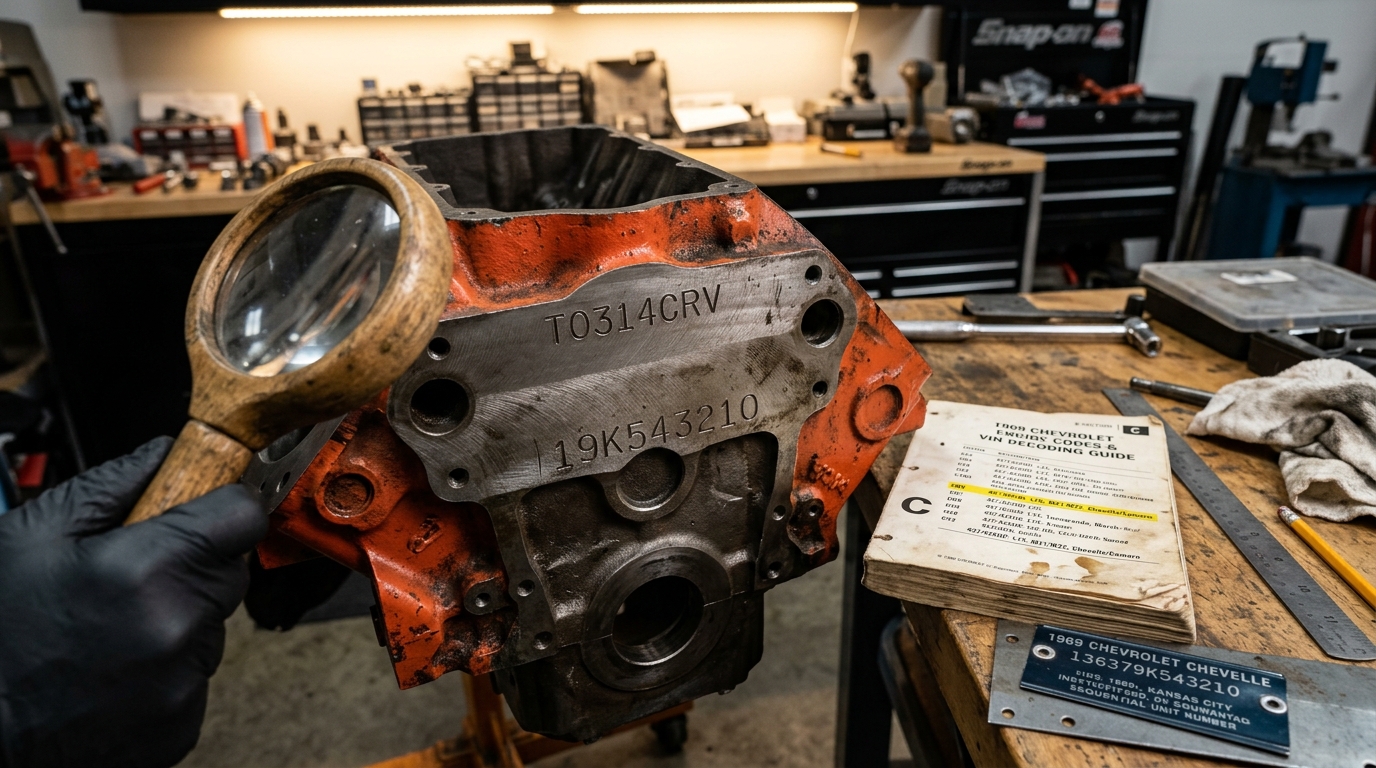
For classic cars, the VIN is only the first layer of authentication. The second layer is numbers-matching verification — cross-checking the VIN-encoded engine code against the physical stamping on the engine block, transmission, and rear axle. On GM cars, the engine block stamping pad (located on the passenger side front of the block) contains two sets of numbers: the assembly date/code (e.g., T0115JD = Tonawanda, January 15, JD suffix) and the partial VIN (e.g., 19N123456). If the partial VIN on the block matches the last digits of the car's VIN, the engine is original. If it does not match, the engine has been replaced — and the car is not numbers-matching, which reduces value by 15-40% depending on the model. The transmission and rear axle also carry date codes and partial VINs that should be checked. For high-value transactions ($50,000+), a marque expert should perform this verification — it is too easy for a seller to restamp an engine block, and detecting a re-stamp requires experience.
VIN cloning — transferring a VIN plate from a totaled or stolen car to another car — is a federal crime but it happens. Signs of VIN tampering include: incorrect rivets (GM used rosette rivets, not pop rivets), misaligned stamping, dash cutout that does not match factory specifications, or a VIN that decodes to a different body style than the car. Always verify the VIN plate against the title and against the body style visible on the car.
Step-by-Step: How to Appraise a Car by VIN
- Find the VIN — Post-1981: driver-side dashboard visible through windshield. Pre-1981: door post, firewall, frame, or title document.
- Decode the VIN — Use Hagerty (free, handles both post- and pre-1981), ClassicDecoder (free for pre-1981), or NHTSA vPIC (free, post-1981 only). Identify engine, body style, model year, and assembly plant.
- Verify the decode — Cross-reference the decoded engine code against the physical engine block stamping. Confirm the body style matches what you see on the car.
- Check for numbers-matching — Compare the partial VIN on the engine block, transmission, and rear axle to the car's VIN. Mismatch = non-matching = 15-40% value reduction.
- Run a history report — For post-1981 vehicles, CARFAX or AutoCheck will reveal accident history, title brands, and odometer readings. Pre-1981 vehicles have no history reports — rely on documentation and physical inspection.
- Grade the condition — The VIN cannot tell you condition. Assess in person using the Hagerty #1-#5 scale or have a professional appraiser do it.
- Pull comparables — Search Bring a Trailer sold listings, Mecum results, and Hagerty Valuation Tool for the same make/model/year/engine/condition. Use at least three sources.
- Adjust for factors — Apply the 12 value factors (matching numbers, documentation, color, transmission, options, provenance, etc.) to the comparable range.
Sources & References
- Hagerty VIN Decoder — Hagerty's patented VIN decoder works on both post-1981 17-digit VINs and pre-1981 serial numbers. 3 free lookups.
- ClassicDecoder — Pre-1981 VIN Specialist — Free classic VIN decoder for 5-14 digit pre-1981 VINs. Full reports $29.99.
- NHTSA vPIC VIN Decoder — Free government VIN decoder for post-1981 vehicles. Decodes factory specifications but does not provide value estimates.
- Pre-1981 VIN Decoder Tool — Our free pre-1981 VIN decoder for GM, Ford, Chrysler, and AMC classic cars and trucks.
- Classic Car Valuation Guide 2026 — The complete valuation guide — classification, condition grading, comparables, and the 12 value factors.
- GM Cowl Tag & Trim Tag Decoder — Decode GM Fisher Body cowl tags for paint, trim, and accessory codes that the VIN does not encode.