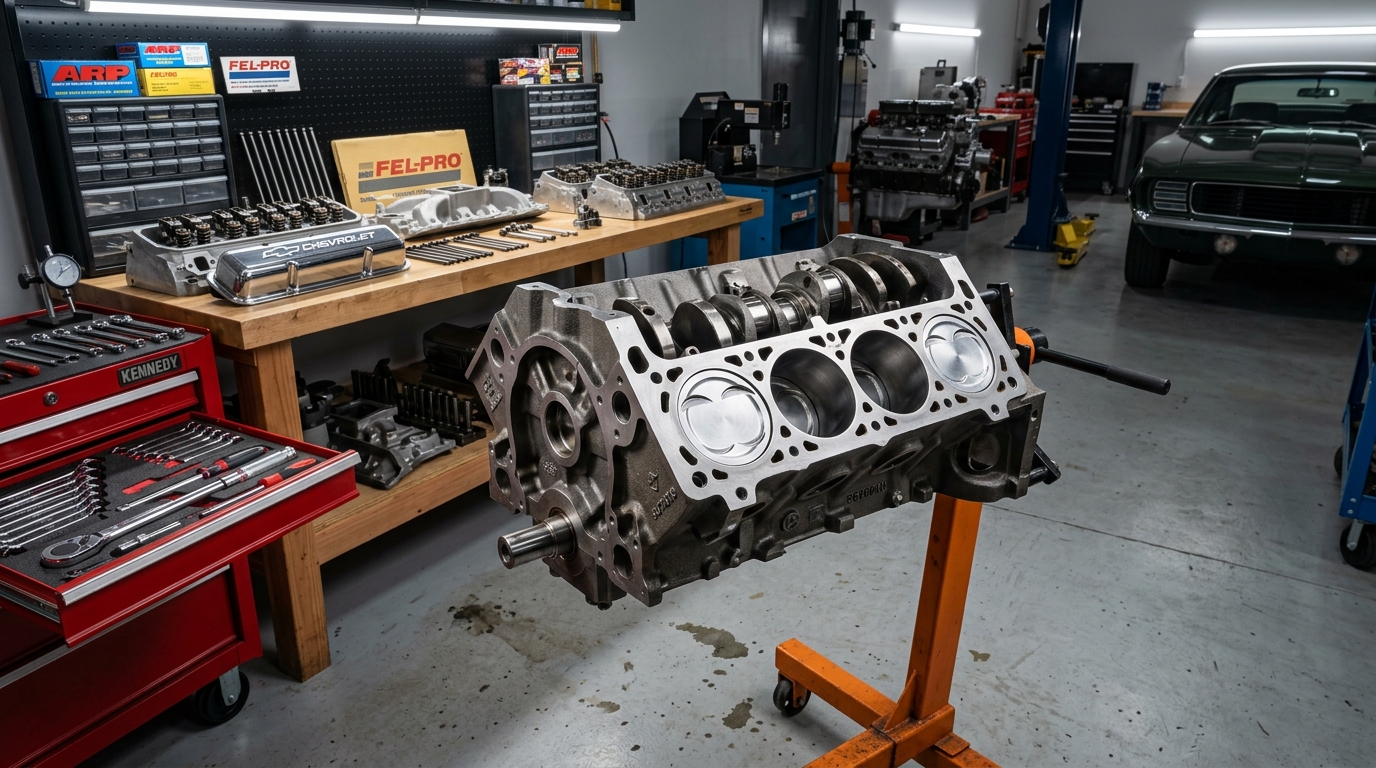
Why Engine Rebuilds Are the Highest-ROI Restoration
An engine rebuild is the single highest-ROI restoration investment you can make on a classic car. A rebuilt engine adds 60-100% of the rebuild cost to the car's value — meaning a $8,000 rebuild on a $20,000 car typically raises the value to $28,000-$32,000. This is because a rebuilt engine eliminates the single biggest buyer concern ("will it blow up on the way home?") and transforms a "project" into a "driver." No other restoration category — paint, interior, chrome — delivers this level of value recovery.
A car with a rebuilt, reliable engine is a "driver" — worth 50-100% more than the same car with a "running but unknown" engine. Buyers pay a premium for confidence. A $25,000 car with a fresh $8,000 rebuild is worth $33,000-$41,000. A $25,000 car with an "original but tired" engine is worth $18,000-$22,000. The rebuild doesn't just add value — it prevents value loss.
Cost Breakdown by Engine Type
| Engine | DIY (Parts + Machine) | Professional (Turnkey) | Machine Shop % | Parts % | Time (Pro) |
|---|---|---|---|---|---|
| SBC 350 (5.7L) — Standard | $3,500–$7,000 | $6,000–$12,000 | 45% | 35% | 3–4 weeks |
| SBC 350 — Performance Build | $5,000–$10,000 | $9,000–$18,000 | 40% | 45% | 4–6 weeks |
| BBC 454 (7.4L) — Standard | $5,000–$10,000 | $8,000–$18,000 | 45% | 35% | 4–5 weeks |
| BBC 454 — Performance Build | $7,000–$15,000 | $12,000–$25,000 | 40% | 45% | 5–8 weeks |
| Ford 302 (5.0L) — Standard | $3,000–$6,500 | $5,500–$11,000 | 45% | 35% | 3–4 weeks |
| Ford 351W (5.8L) — Standard | $3,500–$7,500 | $6,000–$13,000 | 45% | 35% | 3–5 weeks |
| Mopar 340 (5.6L) — Standard | $4,000–$8,500 | $6,500–$13,000 | 45% | 35% | 4–5 weeks |
| Mopar 360 (5.9L) — Standard | $3,500–$7,500 | $6,000–$12,000 | 45% | 35% | 3–5 weeks |
| Slant Six 225 (3.7L) | $2,000–$4,500 | $3,500–$6,500 | 50% | 30% | 3–4 weeks |
| LS Swap (5.3L/6.0L) — Turnkey | $5,000–$12,000 | $10,000–$25,000 | 20% | 60% | 2–4 weeks |
Costs based on 2024-2026 shop survey data from 30 engine rebuild shops across the US. DIY costs include parts + machine shop work (you disassemble/reassemble). Professional costs are turnkey (drop off the engine, pick up a running rebuilt unit). Performance builds include forged internals, ported heads, and upgraded camshaft. LS swap costs include engine, wiring harness, ECU, and adapter parts.
Machine Shop Costs: Line Item Breakdown
Machine shop work is the largest single cost category in an engine rebuild — typically 40-60% of the total. This is the work you cannot do at home: boring, honing, decking, valve work, and balancing. Here's what each operation costs and why it matters.
| Machine Shop Operation | Cost Range | When Required | Why It Matters |
|---|---|---|---|
| Bore & Hone (V8) | $300–$600 | Always — cylinders wear out of round | Restores cylinder roundness for proper ring seal |
| Bore & Hone (I6) | $250–$500 | Always | Same as V8 but fewer cylinders |
| Deck Surface (block) | $150–$300 | If block is warped or for compression change | Ensures flat head mating surface, changes compression ratio |
| Align Hone (main caps) | $150–$300 | If main caps were removed or block is warped | Ensures crankshaft journals are perfectly aligned |
| Cam Bearing Install | $75–$150 | Always — during rebuild | Cam bearings are pressed in — requires special tool |
| Valve Job (3-angle) | $300–$600 | Always — valves and seats wear | Restores valve sealing for proper compression |
| Valve Job (5-angle) | $500–$900 | Performance builds only | Improves airflow for more power |
| Crankshaft Polish | $75–$150 | If journals are in good condition | Removes minor imperfections from journals |
| Crankshaft Grind | $200–$400 | If journals are scored or worn | Cuts journals to next undersize size |
| Dynamic Balancing | $250–$500 | Performance builds or if changing pistons/rods | Balances rotating assembly for smooth operation |
| Magnuflux (crack test) | $75–$200 | Always — critical safety check | Detects invisible cracks in block, crank, heads |
| Pressure Test (heads) | $75–$150 | Always — heads can crack internally | Detects internal cracks in cylinder heads |
| Resurface Flywheel | $50–$100 | If clutch is being replaced | Ensures flat clutch mating surface |
Total machine shop cost for a typical V8 rebuild: $1,400-$3,000. For a performance build: $2,000-$4,500. Always get a magnuflux (crack test) — a cracked block discovered after machining is a total loss of the machine shop investment.
Parts Cost Breakdown: Small-Block Chevy 350
The small-block Chevy 350 is the most rebuilt engine in the world, with the best parts availability and the lowest prices. Here's a complete parts cost breakdown for a standard rebuild — this is the engine most classic car owners will encounter.
| Part | Economy (DNA/Sealed Power) | Mid-Grade (Clevite/TRW) | Premium (Mahle/CP) | Notes |
|---|---|---|---|---|
| Master Rebuild Kit (rings, bearings, gaskets) | $250–$400 | $400–$600 | $600–$900 | Includes main, rod, cam bearings + full gasket set |
| Pistons (cast, stock replacement) | $200–$350 | $350–$550 | $550–$800 | Hypereutectic cast — fine for street use up to 450hp |
| Pistons (forged, performance) | — | $500–$800 | $800–$1,200 | Forged — required for forced induction or 500+ hp |
| Camshaft (flat-tappet, stock) | $75–$150 | $150–$250 | $250–$400 | Stock replacement — maintains original character |
| Camshaft (hydraulic roller) | $200–$400 | $400–$600 | $600–$900 | Roller retrofit — better power and durability |
| Lifters (flat-tappet, set of 16) | $50–$100 | $100–$180 | $180–$300 | Always use high-zinc oil with flat-tappet cams |
| Lifters (hydraulic roller, set of 16) | $150–$300 | $300–$500 | $500–$800 | Required with roller cam |
| Timing Chain & Gears | $30–$60 | $60–$120 | $120–$250 | Double-row chain recommended over stock |
| Oil Pump (stock) | $30–$60 | $60–$100 | $100–$180 | High-volume pump only if clearances are loose |
| Head Gasket Set | $40–$80 | $80–$150 | $150–$250 | MLS (multi-layer steel) for boosted applications |
| Freeze Plugs (brass) | $20–$40 | $40–$60 | $60–$80 | Always use brass — steel plugs rust |
| Total Parts (Standard Rebuild) | $700–$1,300 | $1,300–$2,200 | $2,200–$3,500 | Add $500-$1,500 for performance upgrades |
The SBC 350 has the cheapest parts of any V8 — a full rebuild kit is under $400. The premium option (Mahle/CP pistons, roller cam) doubles the parts cost but delivers 30-50% more power and significantly better durability. For a driver-quality classic, the mid-grade option is the sweet spot.
DIY vs Professional: When to Do It Yourself
- Good DIY candidates:
- You have a garage with an engine stand and cherry picker
- You're rebuilding a small-block Chevy 350 or Ford 302 (best parts availability, most documentation)
- You're doing a standard rebuild (stock or mild cam, cast pistons)
- You have 2-4 months of spare time
- You want to save $3,000-$6,000 in labor
- Should go to a professional:
- Big-block engines (more complex, heavier, more expensive mistakes)
- Performance builds (forged internals, ported heads, custom cam — requires expertise)
- Mopar engines (harder to find parts, more expensive machine work)
- You need the car running in under 6 weeks
- You don't have proper tools (torque wrench, bore gauge, plastigauge, engine stand)
- Always hire a professional for:
- Machine shop work (boring, honing, decking, valve job, balancing)
- Crack testing (magnuflux and pressure testing)
- Crankshaft grinding (requires specialized equipment)
- Dynamic balancing (requires a balancer machine)
ROI Analysis: Is a Rebuild Worth It?
| Scenario | Car Value (Before) | Rebuild Cost | Car Value (After) | Net ROI | ROI % |
|---|---|---|---|---|---|
| SBC 350 in a $20K Nova | $20,000 | $8,000 (pro) | $30,000–$34,000 | $2,000–$6,000 | 25–75% |
| BBC 454 in a $40K Chevelle | $40,000 | $14,000 (pro) | $55,000–$62,000 | $1,000–$8,000 | 7–57% |
| Ford 302 in a $15K Mustang | $15,000 | $7,000 (pro) | $24,000–$27,000 | $2,000–$5,000 | 29–71% |
| Mopar 340 in a $30K Duster | $30,000 | $10,000 (pro) | $42,000–$47,000 | $2,000–$7,000 | 20–70% |
| Slant Six in a $10K D100 | $10,000 | $4,500 (pro) | $15,000–$17,000 | $500–$2,500 | 11–56% |
| SBC 350 DIY in a $15K C10 | $15,000 | $4,500 (DIY) | $24,000–$27,000 | $4,500–$7,500 | 100–167% |
ROI is highest on mid-value cars ($15K-$30K) with small-block V8s. The DIY route nearly doubles the ROI because you eliminate $3,000-$6,000 in labor. Big-block rebuilds have lower ROI because the higher rebuild cost eats into the value gain. Slant Six rebuilds have the lowest ROI because the engine doesn't add much performance appeal.
If your engine has matching numbers (original block to the car), rebuilding the original block adds an additional 20-40% to the car's value compared to installing a replacement engine. A matching-numbers rebuild on a $30,000 car can raise the value to $45,000-$55,000 — because the car retains its originality. Always check the engine pad stamping before deciding to rebuild vs replace.
Frequently Asked Questions
- How much does it cost to rebuild a small-block Chevy 350?
- A standard SBC 350 rebuild costs $3,500-$7,000 DIY (parts + machine shop) or $6,000-$12,000 professional (turnkey). Parts are $700-$2,200, machine shop work is $1,400-$3,000, and professional labor is $3,000-$7,000. The SBC 350 is the cheapest V8 to rebuild because of massive parts availability and competition among suppliers.
- Is it cheaper to rebuild or replace an engine?
- For classic cars, rebuilding is almost always cheaper and better than replacing. A rebuilt original engine preserves matching numbers (adding 20-40% to value) and costs $3,500-$12,000. A crate replacement engine costs $3,000-$8,000 (parts only) plus $2,000-$5,000 installation, and you lose the matching-numbers premium. The only exception is if the original block is cracked — then a replacement is necessary.
- How long does an engine rebuild take?
- Professional: 3-6 weeks from drop-off to pickup. Machine shop work takes 1-3 weeks (they're always backlogged), parts arrive in 3-5 days, and assembly takes 1-2 weeks. DIY: 2-4 months — you'll spend most of the time waiting for machine shop work and parts. Plan ahead and schedule the machine shop before you start disassembly.
- What is a "performance rebuild" and is it worth it?
- A performance rebuild includes forged pistons ($300-$500 extra), ported cylinder heads ($400-$800 extra), a more aggressive camshaft ($100-$300 extra), and dynamic balancing ($250-$500 extra). Total upgrade cost: $1,000-$2,500 over a standard rebuild. It's worth it if you plan to drive the car hard or want 50-100 more horsepower. For a show car or casual driver, a standard rebuild is fine.
- Does a rebuilt engine increase classic car value?
- Yes — significantly. A rebuilt engine adds 60-100% of the rebuild cost to the car's value. A $8,000 rebuild on a $20,000 car raises the value to $28,000-$32,000. If the engine has matching numbers, the value increase is even higher (80-120% of rebuild cost). A rebuilt engine transforms a "project" into a "driver," which is the single biggest value threshold in the classic car market.
Get an instant AI-powered valuation for your classic car — see how a rebuilt engine affects your car's market value.
Value My CarSources & References
- Hagerty — Engine Rebuild Cost Guide — Independent restoration cost benchmarks including engine rebuild data
- SAE International — Engine Rebuilding Standards — Technical standards for engine machining and assembly tolerances
- Classic Car Restoration Cost Calculator (2026) — Free interactive calculator with engine rebuild cost category and adjustable shop rates
- Car Restoration ROI Calculator — Calculate return on investment for restoration projects including engine rebuilds
- Matching Numbers Explained — Classic Car Value — How matching numbers and original engine blocks affect collector car value
- Classic Car Paint Codes & Trim Restoration — Complete guide to paint code decoding and interior trim restoration costs