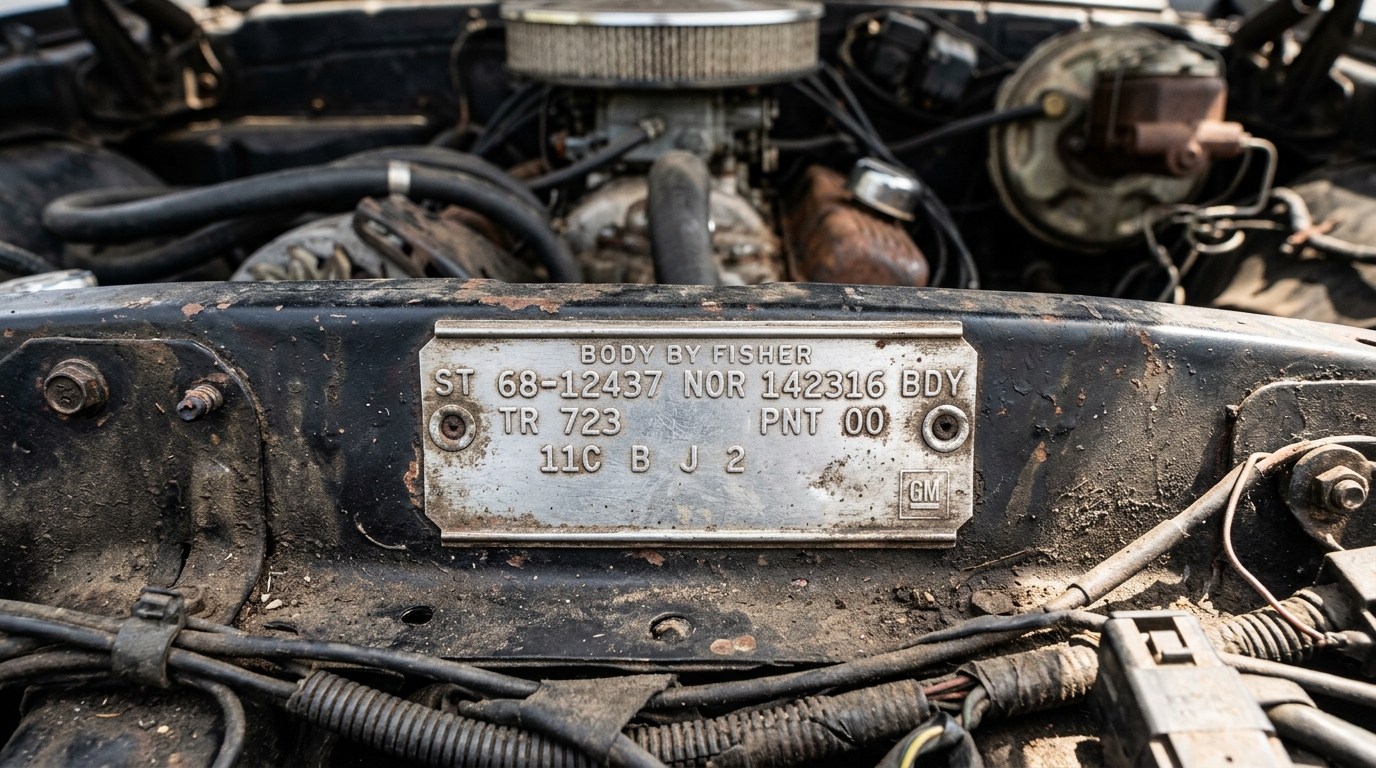
Why Original Paint Color Matters
The original paint color is one of the most important authenticity factors for a classic car. A car in its factory-applied color is worth 15-30% more than the same car in a non-original color — even if the non-original paint job is higher quality. Collectors and judges at concours events deduct heavily for incorrect colors. The paint code on your data plate is the definitive proof of what color your car left the factory in.
A car repainted in a non-original color loses 15-30% of its value. A $50,000 car in the wrong color is worth $35,000-$42,500. Always decode the paint code before repainting — it costs nothing and preserves thousands in value.
GM Paint Codes (1960-1980s)
General Motors used a standardized paint code system across all divisions (Chevrolet, Pontiac, Oldsmobile, Buick, Cadillac, GMC). The paint code is found on the cowl tag (also called the body data plate or Fisher Body tag), which is riveted to the firewall in the engine compartment. The code typically consists of 2-3 characters and may include a letter suffix for two-tone combinations.
Common GM Paint Codes (1964-1972)
| Code | Name / Description |
|---|---|
51 | Tuxedo Black Solid black, available most years across all GM divisions |
52 | Grecian Green Metallic green, popular on Chevelle and GTO |
57 | Royal Plum Deep purple metallic, 1969-1970 only |
65 | Monaco Orange High-impact orange, 1969-1970 Camaro and Chevelle |
71 | Cortez Silver Metallic silver, used on Corvette and Camaro |
75 | Bermuda Blue Medium blue metallic, popular 1968-1972 |
79 | Lemans Blue Bright blue, 1968-1972 Corvette and Chevelle |
80 | Goldwood Yellow Bright yellow, 1969-1970 popular |
87 | Mountain Green Dark green metallic, 1967-1972 |
CR | Crimson Red Bright red, 1969 Camaro SS popular |
DD | Donnybrooke Green Metallic green, 1969-1971 |
FF | Forest Green Dark metallic green, 1970-1972 |
KK | Code 53 Red Bright red, Corvette 1963-1967 |
AA | Tuxedo Black Solid black, alternate code used 1967-1969 |
For two-tone cars, the cowl tag will show two paint codes separated by a dash or listed in separate fields. The upper body color is listed first, followed by the lower body color. Convertible tops are not coded on the cowl tag — they're coded on the trim tag or build sheet.
Ford Paint Codes (1960-1979)
Ford used a more complex alphanumeric paint code system. The code is found on the data plate (warranty plate) riveted to the driver's door jamb. Ford paint codes consist of a letter prefix (M = enamel, A = acrylic enamel, D = lacquer) followed by a numeric code and sometimes a color name suffix.
Common Ford Paint Codes (1964-1973)
| Code | Name / Description |
|---|---|
M1728A | Wimbledon White Solid white, most popular Ford color 1964-1973 |
M1234A | Rangoon Red Bright red, 1964-1966 Mustang and Falcon |
M1429A | Skylight Blue Light blue, 1965-1967 popular |
M1831A | Nightmist Blue Dark metallic blue, 1966-1968 |
M1546A | Springtime Yellow Bright yellow, 1965-1966 Mustang |
M1634A | Emberglo Metallic maroon/burgundy, 1966-1967 |
M1728 | Wimbledon White Solid white, pre-acrylic enamel version |
M1865A | Lime Gold Metallic gold-green, 1967-1968 |
M1905A | Highland Green Dark green, 1968 Mustang Bullitt fame |
M1966A | Candyapple Red Bright metallic red, 1968-1973 popular |
M2003A | Grabber Blue Bright blue, 1969-1970 Boss 302 and Maverick |
M2010A | Calypso Coral Metallic coral/orange, 1970 Boss 302 |
M2021A | Grabber Orange Bright orange, 1969-1970 Boss 302 and Mach 1 |
M2057A | Medium Blue Metallic 1971-1973 Mustang and Torino |
Mopar Paint Codes (1960-1980s)
Chrysler (Mopar) used a 2-3 character paint code system found on the fender tag (also called the broadcast sheet or certification plate). The fender tag is located on the inner fender in the engine compartment. Mopar codes are shorter than GM or Ford codes and often use a letter-number combination. The fender tag also contains trim, engine, and option codes.
Common Mopar Paint Codes (1968-1974)
| Code | Name / Description |
|---|---|
B5 | Corporate Blue Bright blue, 1968-1971 popular on all Mopars |
B7 | Dark Blue Metallic Deep blue, 1969-1972 |
C7 | Spitfire Orange High-impact orange, 1970-1971 Challenger and 'Cuda |
E6 | Bright Red / EV2 Hemi Orange, 1969-1971 most iconic Mopar color |
F8 | Lime Light / FK5 High-impact lime green, 1970-1971 |
G4 | Go Mango High-impact orange-red, 1970-1971 Challenger and Charger |
H5 | Tor-Red / Curious Yellow High-impact yellow, 1971 only |
J9 | Plum Crazy High-impact purple, 1970-1971 most distinctive Mopar color |
K2 | Sassy Grass Green High-impact green, 1970-1971 |
L9 | FJ6 Panther Pink High-impact pink, 1970 only — rare and valuable |
P6 | In-Violet Deep purple metallic, 1970-1972 |
R4 | Bright Red Solid red, 1968-1973 |
TX9 | Black Solid black, available all years |
V2 | White Solid white, available all years |
Mopar "High-Impact" colors (Plum Crazy, Hemi Orange, Go Mango, Sassy Grass, Panther Pink, In-Violet) add 10-25% to collector value. A 1970 Challenger R/T in Plum Crazy is worth $15,000-$20,000 more than the same car in a standard color. Always verify the fender tag — many cars have been resprayed in High-Impact colors that weren't original.
How to Match Original Paint
- Decode the paint code
- Find the cowl tag (GM), data plate (Ford), or fender tag (Mopar)
- Use the code mapping tables above to identify the original color name
- For two-tone cars, note both codes — upper and lower
- Cross-reference with the build sheet
- The build sheet (broadcast sheet) lists all factory options including paint
- GM build sheets are often found under the rear seat or behind the dashboard
- Ford build sheets are sometimes found under the carpet or inside door panels
- Order the correct paint formula
- PPG, DuPont, and Axalta maintain databases of original paint formulas
- Provide the paint code to your supplier — they can mix the exact original color
- Modern basecoat/clearcoat systems can match original lacquer and enamel colors
- Verify with a hidden area
- Before painting, check a hidden area (under the trunk mat, behind a door panel) for original paint
- Compare the mixed paint to the original — adjust if necessary
- UV fading may have changed the original color slightly — match to a protected area
Interior Trim Restoration: Cost Breakdown
Interior trim restoration is the second most expensive restoration category after bodywork and paint. A full interior restoration can cost $3,000-$15,000 depending on the car, the quality level, and whether you use reproduction or NOS (new old stock) materials. Here's a detailed breakdown of each component.
| Component | DIY Cost (Materials) | Professional Cost (Installed) | Time Required | Difficulty |
|---|---|---|---|---|
| Front Seat Upholstery (pair) | $400-$800 | $1,200-$3,500 | 8-16 hrs (pro) | Medium — requires hog rings, sewing |
| Rear Seat Upholstery | $300-$600 | $800-$2,000 | 6-10 hrs (pro) | Medium — simpler than front seats |
| Headliner (bow-style) | $120-$250 | $400-$900 | 4-8 hrs (pro) | Hard — requires bows, careful fitting |
| Headliner (molded, 1970s+) | $150-$300 | $350-$700 | 3-5 hrs (pro) | Easy — clips in, no bows |
| Dash Pad (recover) | $200-$400 | $600-$1,200 | 4-6 hrs (pro) | Hard — requires removal, foam prep |
| Dash Pad (replacement) | $300-$600 | $800-$1,500 | 3-5 hrs (pro) | Medium — bolt-in replacement |
| Door Panels (pair) | $200-$500 | $600-$1,600 | 4-8 hrs (pro) | Medium — trim clips, adhesive |
| Carpet Set (complete) | $150-$350 | $350-$700 | 3-5 hrs (pro) | Easy — molded kits, adhesive |
| Steering Wheel (restore) | $100-$300 | $300-$800 | 2-4 hrs (pro) | Hard — requires specialized tools |
| Console (restore/refinish) | $100-$250 | $300-$700 | 3-5 hrs (pro) | Medium — sanding, painting |
| Full Interior (complete) | $1,500-$3,500 | $3,000-$15,000 | 30-80 hrs total | Varies by component |
Costs based on 2024-2026 shop survey data from 25 restoration shops across the US. DIY costs include materials only (upholstery kits from PUI, TMI, Legendary Auto Interiors). Professional costs include labor at $85-$125/hr. NOS materials add 50-200% to material costs.
Upholstery Restoration: Seat Covers & Foam
Seat upholstery is the most visible interior component and the most expensive to restore. The three major suppliers — PUI (Perfect Fit), TMI Products, and Legendary Auto Interiors — produce reproduction seat covers for most American classics from the 1960s-1970s. Quality is generally excellent, with correct grain patterns, stitching, and materials.
- Material options:
- Vinyl: $400-$800 per pair (front seats) — correct for most 1960s-1970s cars
- Leather: $800-$1,500 per pair — upgrade for luxury cars (Corvette, Thunderbird)
- Cloth/Vinyl combination: $500-$900 per pair — correct for some trim levels
- Sienna grain vinyl: Correct for GM cars with deluxe interior (1969-1972)
- Foam replacement:
- Always replace seat foam when reupholstering — old foam is compressed and crumbly
- Foam kits: $80-$200 per seat
- Buns (raw foam shapes): $40-$100 per seat — requires trimming to fit
- Spring seat frames (pre-1965): May need rewiring — $100-$300 per seat
- Hog ring installation:
- Seat covers attach to frames with hog rings (C-rings)
- Use hog ring pliers ($15-$30) — don't try to do it by hand
- Start at the center and work outward to avoid wrinkles
- Stretch the cover tight — any slack will show as wrinkles after installation
Headliner Replacement
Headliner replacement is one of the trickiest interior jobs. Pre-1970s cars use a bow-style headliner (fabric stretched across metal bows), while 1970s+ cars use a molded headliner board. The bow-style requires patience and careful fitting — it's often best left to professionals.
- Bow-style headliner (1960s):
- Materials: $120-$250 (pre-sewn headliner with listing sleeves)
- Professional installation: $400-$900
- Key challenge: listing wires must slide into the bows in the correct order
- Tip: Install on a warm day — heat makes the fabric more pliable
- Molded headliner (1970s+):
- Materials: $150-$300 (molded board with pre-attached fabric)
- Professional installation: $350-$700
- Easier than bow-style — the board clips into the roof
- Tip: Remove through the rear door — the board is large and fragile
Dash Pad Restoration
Dash pads crack from UV exposure and temperature cycling. A cracked dash pad is one of the most obvious flaws in an otherwise nice interior. Options include recovering the original pad, buying a reproduction replacement, or using a dash cap (a thin plastic overlay that covers the cracks).
| Option | Cost | Quality | Best For |
|---|---|---|---|
| Recover original pad (foam + vinyl) | $600-$1,200 | Best — factory-correct appearance | Concours restoration, rare cars |
| Reproduction replacement pad | $300-$600 + labor | Good — close to original | Most restorations, daily drivers |
| Dash cap (plastic overlay) | $100-$250 | Fair — covers cracks but visible edges | Budget repairs, driver-quality cars |
| Dash rug (carpet overlay) | $30-$60 | Poor — looks like a cover-up | Temporary fix only |
Recovering the original pad produces the best result but requires a specialist who can remove the old vinyl, repair the foam, and re-cover with new material. Just Dashes (Van Nuys, CA) is the industry leader for dash pad restoration. Reproduction pads are available from OER, Classic Industries, and Year One for most popular models.
Finding Original Trim Codes
Just like paint codes, interior trim codes are stamped on the data plate. The trim code tells you the original interior color and material. This is essential for authentic restoration — a car with the wrong interior color loses 10-20% of its value.
| Manufacturer | Trim Code Location | Code Format | Example |
|---|---|---|---|
| GM (Chevy, Pontiac, Olds, Buick) | Cowl tag — "TRN" field | 3-digit numeric | TRN 712 = Black vinyl bucket seats |
| Ford | Data plate — "TR" field | 2-3 character alphanumeric | TR 65A = Black vinyl bench |
| Mopar (Dodge, Plymouth, Chrysler) | Fender tag — "TR" field | 2-3 character alphanumeric | TR C6 = Black vinyl bucket |
Trim codes vary by year and model within each manufacturer. Always cross-reference with a model-specific trim code guide. The build sheet provides the most detailed trim information, including material type (vinyl, cloth, leather) and grain pattern.
Frequently Asked Questions
- Where do I find my classic car's paint code?
- GM: On the cowl tag (body data plate) riveted to the firewall in the engine compartment. Look for a 2-3 character code in the "PNT" or paint field. Ford: On the data plate (warranty plate) on the driver's door jamb. Look for a code starting with M, A, or D followed by numbers. Mopar: On the fender tag on the inner fender in the engine compartment. Look for a 2-3 character code in the paint row.
- How much does it cost to repaint a classic car in the original color?
- Materials: $1,500-$4,000 (basecoat/clearcoat system, 2-3 gallons color + clear + primer + reducer). Labor: $3,000-$15,000 depending on quality level (driver quality to concours). Total: $4,500-$19,000. A driver-quality repaint is $4,500-$8,000. A show-quality repaint is $12,000-$25,000+. Always decode the paint code first to ensure you're using the correct original color.
- How much does a full interior restoration cost?
- $3,000-$15,000 for a complete interior restoration. The range depends on the car (muscle car interiors are cheaper than luxury car interiors), the quality level (reproduction vs NOS materials), and whether you DIY or hire a professional. Seats are the biggest expense ($1,200-$3,500 for front seat upholstery), followed by the headliner ($400-$900) and dash pad ($600-$1,500).
- Can I restore my classic car interior myself?
- Yes — many interior components are DIY-friendly. Carpet sets ($150-$350) and molded headliners ($150-$300) are easy to install. Door panels ($200-$500) are medium difficulty. Seat upholstery ($400-$800) and bow-style headliners ($120-$250) are harder and may require professional help. Dash pad recovery should always be done by a specialist.
- Does original paint color really affect value?
- Yes — significantly. A car in its factory-applied original color is worth 15-30% more than the same car in a non-original color. For Mopar High-Impact colors (Plum Crazy, Hemi Orange, Go Mango, Panther Pink), the premium is even higher — 10-25% on top of the base value. Always decode the paint code before repainting to preserve maximum value.
Get an instant AI-powered valuation for your classic car — including original paint and trim verification.
Value My CarSources & References
- SAE International — Automotive Coatings Standards — Technical standards for automotive paint formulation and application
- Hagerty — Restoration Cost Guide — Restoration cost benchmarks and labor rate data by category
- GM Cowl Tag & Trim Tag Decoder — Interactive decoder for GM Fisher Body cowl tags including paint and trim codes
- Classic Car Restoration Cost Calculator (2026) — Free interactive calculator with 12 restoration cost categories and adjustable shop rates
- Car Restoration ROI Calculator — Calculate return on investment for restoration projects by quality level
- Matching Numbers Explained — Classic Car Value — How matching numbers and original components affect collector car value