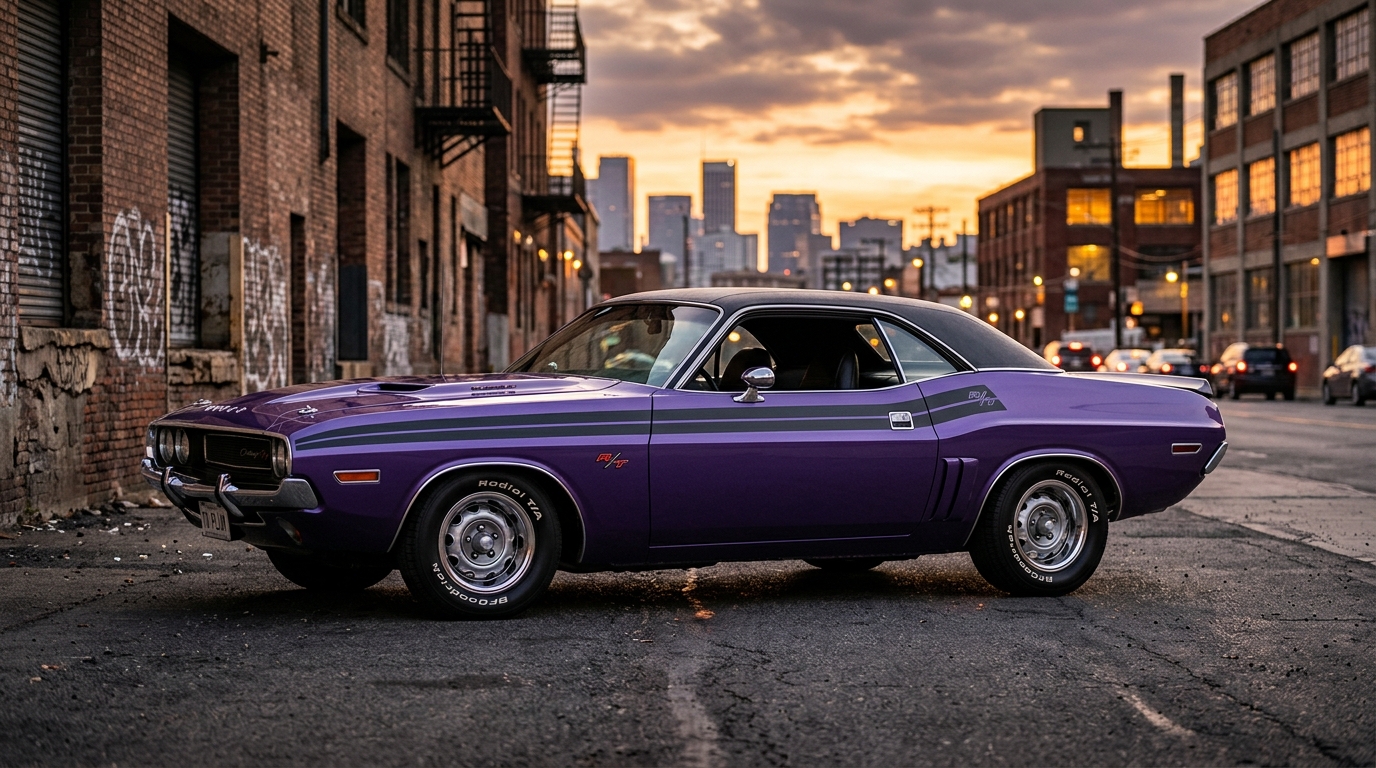
The Dodge Challenger (1970–1974) was Dodge's E-body pony car, sharing its platform with the Plymouth Barracuda but with a 2-inch longer wheelbase and more formal styling. The 1970–1971 R/T with the 426 Hemi is the most collectible, at $180,000–$300,000 (#2). The 1970 Challenger T/A (Trans-Am homologation, 340 Six Pack) is a unique collector piece at $90,000–$140,000 (#2). The 1970–1971 R/T 440 Magnum is the best value buy at $55,000–$85,000 (#2). The 1970–1971 Challenger 383 is the entry point at $30,000–$45,000 (#2). Total Hemi Challenger production: ~432 (1970–1971 only) — rarer than the Hemi 'Cuda but slightly less valuable due to the Barracuda's stronger brand recognition.
The Late Arrival That Made Up For Lost Time
The Dodge Challenger arrived in 1970 — six years after the Mustang and three years after the Camaro. But it arrived with a bang: the E-body platform was all-new, designed from the ground up to accommodate big-block V8s including the 426 Hemi. The Challenger was longer, wider, and more luxurious than the Barracuda it shared its platform with. The R/T (Road/Track) package was the performance flagship, and the T/A was the Trans-Am racing homologation special. Though it only lasted 5 years (1970–1974), the Challenger made an indelible mark — and today it's one of the most valuable Mopar muscle cars.
| Year | Total Production | R/T Production | Hemi Production | T/A Production | Notes |
|---|---|---|---|---|---|
| 1970 | ~83,000 | ~13,800 | ~283 | ~2,539 | Launch year; R/T, T/A, and Hemi all available; peak year |
| 1971 | ~26,300 | ~5,800 | ~149 | N/A (T/A dropped) | Last year for Hemi; restyled grille; sales dropped 68% |
| 1972 | ~23,500 | N/A (R/T dropped) | N/A | N/A | Rallye package replaces R/T; 440 detuned; emissions hurting |
| 1973 | ~30,800 | N/A | N/A | N/A | 340 top engine; safety bumpers; slight sales recovery |
| 1974 | ~9,900 | N/A | N/A | N/A | Final year; very low production; 360ci top engine; end of era |
Production data from Chrysler Corporation. The 1970 launch year was by far the strongest (~83,000). Sales collapsed in 1971 due to insurance surcharges on big-block engines. The 1970 T/A (2,539 built) was a one-year-only Trans-Am homologation special. Total Hemi Challenger production: ~432 (1970–1971 only). The 1974 final year is very rare (~9,900).
Engine Specifications
| Engine | Displacement | Years | HP | Torque | Notes |
|---|---|---|---|---|---|
| 198ci I6 | 198ci | 1970–1971 | 125 | 185 | Base I6; very slow; no collector appeal |
| 225ci I6 | 225ci | 1970–1974 | 145 | 215 | Base I6; reliable but slow; common in non-R/T cars |
| 318ci V8 | 318ci | 1970–1974 | 230–275 | 340–375 | Base V8; reliable; no performance appeal in Challenger |
| 340ci V8 | 340ci | 1970–1973 | 240–290 | 340–375 | Small-block; T/A version (290hp, Six Pack); best small-block |
| 383ci V8 | 383ci | 1970–1971 | 290–335 | 390–425 | Most common big-block; R/T base engine; good value |
| 440ci Magnum | 440ci | 1970–1971 | 375 | 480 | R/T upgrade; excellent torque; most common R/T big-block |
| 440 Six Pack | 440ci | 1970–1971 | 390 | 490 | 3x2-barrel carbs; nearly as fast as Hemi; rare and valuable |
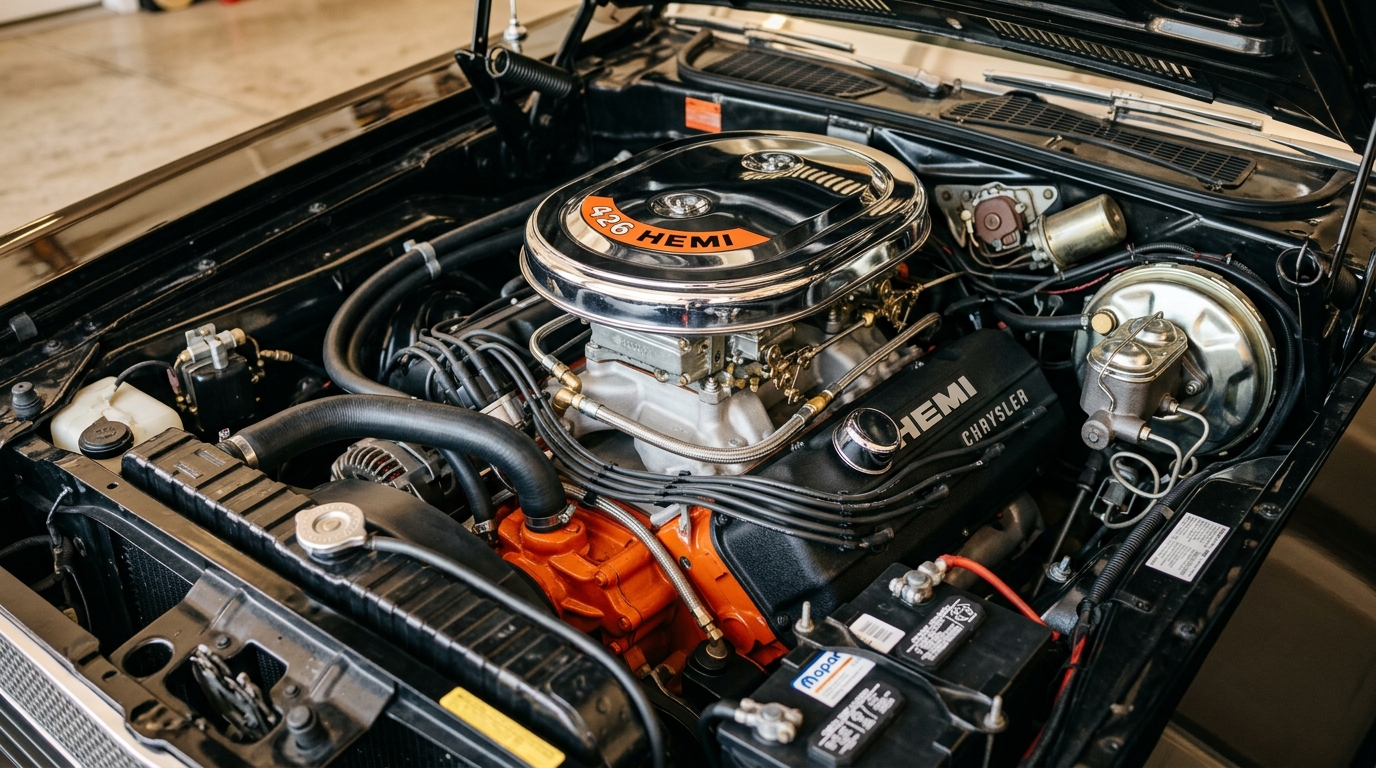
| 426 Hemi | 426ci | 1970–1971 | 425 | 490 | The holy grail; dual plugs, twin 4-barrels; ~432 in Challengers; most valuable |
The 426 Hemi is the most legendary engine in the Challenger — only ~432 Hemi Challengers were built (1970–1971). The 440 Six Pack (390hp) is nearly as fast and 40–50% cheaper. The 340 Six Pack in the T/A (290hp) is a unique Trans-Am homologation engine. The 383 is the best value big-block for entry-level R/T collectors.
R/T, T/A, and Rallye: The Performance Packages
The R/T was the Challenger's performance package: heavy-duty suspension, larger brakes, R/T badges, and a choice of 383 (335hp), 440 Magnum (375hp), 440 Six Pack (390hp), or 426 Hemi (425hp). Total R/T production: ~19,600 across both years. Hemi R/Ts are only ~432. The 1970 R/T is the most collectible Challenger. The R/T was dropped after 1971 due to insurance surcharges.
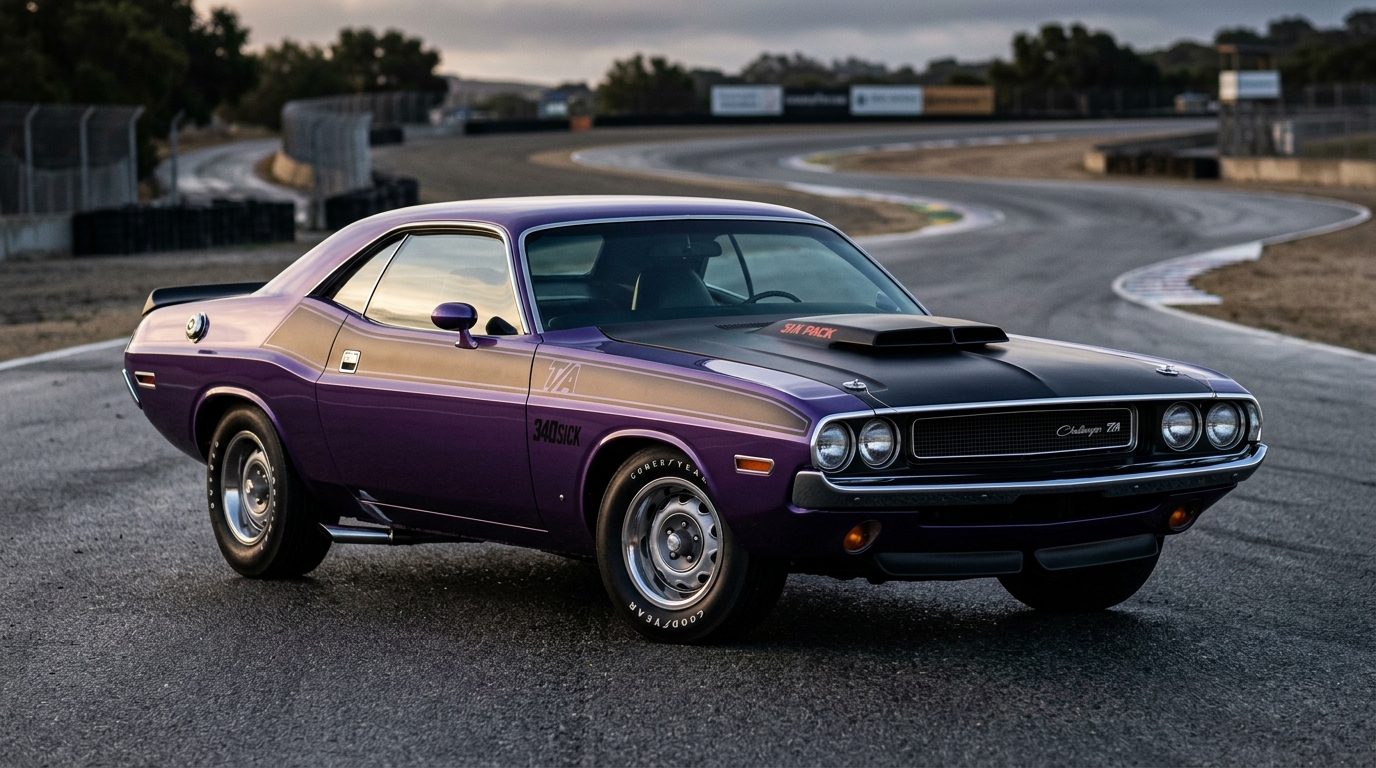
The Challenger T/A was built for SCCA Trans-Am homologation — 2,539 produced (one year only). Features: 340ci V8 with Six Pack (3x2-barrel carbs, 290hp), side-exit exhaust, front air dam, rear spoiler, special strobe stripe, and lightweight components. The T/A was Dodge's answer to the Camaro Z28, Mustang Boss 302, and AAR 'Cuda. It's a unique collector piece — not the fastest Challenger but the most historically significant.
After the R/T was dropped in 1972, the Rallye package replaced it as the performance trim: heavy-duty suspension, rallye wheels, hood scoops (non-functional), and special trim. The Rallye could be ordered with the 340ci (240–275hp) or 360ci (245hp). The Rallye is less collectible than the R/T but more than a base Challenger. The 1972 Rallye 340 is the best value post-1971 Challenger.
Market Values by Condition (2026)
| Variant | #1 Concours | #2 Excellent | #3 Good | #4 Fair | 5-Year Trend |
|---|---|---|---|---|---|
| 1970 R/T 426 Hemi Convertible | $600,000 | $400,000 | $250,000 | $110,000 | +65% |
| 1970–1971 R/T 426 Hemi Hardtop | $350,000 | $230,000 | $140,000 | $60,000 | +55% |
| 1970 Challenger T/A 340 Six Pack | $170,000 | $115,000 | $65,000 | $28,000 | +45% |
| 1970–1971 R/T 440 Six Pack | $130,000 | $90,000 | $50,000 | $22,000 | +40% |
| 1970–1971 R/T 440 Magnum | $100,000 | $70,000 | $38,000 | $16,000 | +33% |
| 1970–1971 R/T 383 | $70,000 | $48,000 | $25,000 | $11,000 | +28% |
| 1970–1971 Challenger 383 (non-R/T) | $55,000 | $38,000 | $20,000 | $8,500 | +25% |
| 1972 Rallye 340 | $55,000 | $38,000 | $20,000 | $8,500 | +22% |
| 1973–1974 Challenger 340/360 | $45,000 | $30,000 | $16,000 | $6,500 | +18% |
| 1970–1971 R/T 440 Convertible | $160,000 | $110,000 | $62,000 | $27,000 | +35% |
| 1970–1971 Challenger 318 Hardtop | $35,000 | $24,000 | $12,000 | $5,000 | +15% |
| 1974 Challenger (final year) | $40,000 | $27,000 | $14,000 | $5,500 | +18% |
Values from Mecum, Barrett-Jackson, and Bring a Trailer sold data (2024–2026). The 1970 Hemi R/T Convertible is the most valuable Challenger — only a handful built. The Hemi R/T Hardtop is the most attainable Hemi Challenger at ~$230,000 (#2). The T/A is a unique one-year-only collector piece. The R/T 440 Magnum is the best value — same R/T package, 80% of the performance, 30% of the Hemi price. The Challenger is 10–15% less than the equivalent Barracuda.
Value Trend Chart (2020–2026)
Dodge Challenger Average Values (#2 Condition)
| 2020 | 2021 | 2022 | 2023 | 2024 | 2025 | 2026 | |
|---|---|---|---|---|---|---|---|
| 1970–71 R/T Hemi (#2) | 155000 | 180000 | 200000 | 215000 | 225000 | 230000 | 230000 |
| 1970 T/A 340 Six Pack (#2) | 78000 | 92000 | 102000 | 108000 | 112000 | 115000 | 115000 |
| 1970–71 R/T 440 Magnum (#2) | 48000 | 57000 | 64000 | 67000 | 69000 | 70000 | 70000 |
Challenger vs Barracuda vs Camaro: E-Body vs F-Body
| Factor | Challenger R/T Hemi | Barracuda Hemi 'Cuda | Camaro Z28 |
|---|---|---|---|
| Platform | E-body (110" WB) | E-body (108" WB) | F-body (108" WB) |
| Top Engine | 426 Hemi (425hp) | 426 Hemi (425hp) | 302ci (290hp) |
| 0-60 mph | ~5.1 sec | ~5.0 sec | ~6.5 sec |
| Quarter Mile | 13.5 @ 105 mph | 13.4 @ 107 mph | 14.5 @ 98 mph |
| Weight | ~3,700 lbs | ~3,400 lbs | ~3,300 lbs |
| Hemi Production | ~432 (2 years) | ~786 (2 years) | N/A |
| Value (#2, top) | $230,000 | $250,000 | $58,000–$95,000 |
| Styling | More formal, longer | Sportier, shorter | Clean pony car |
The Challenger and Barracuda share the E-body but feel different — the Challenger is 2" longer in wheelbase, heavier, and more formal. The Hemi 'Cuda is rarer (786 vs 432) and worth ~10% more. The Camaro Z28 is in a different league — a Trans-Am racer with a 302ci small-block, not a big-block Hemi car. For raw power, the E-body Mopars dominate; for Trans-Am heritage, the Camaro and T/A Challenger are the ones to have.
Key Option Codes (RPO)
Dodge Challenger RPO Codes
| Code | Name / Description |
|---|---|
L2 | 426 Hemi V8 425hp; dual plugs, twin 4-barrels; ~432 in Challengers; 1970–1971 only |
L6 | 440 Six Pack V8 390hp; 3x2-barrel carbs; rare; 1970–1971; nearly as fast as Hemi |
L5 | 440 Magnum V8 375hp; 480 lb-ft; R/T upgrade engine; most common R/T big-block |
L4 | 383 Magnum V8 290–335hp; R/T base engine; most common big-block; good value |
A33 | 340 Six Pack (T/A) 290hp; 3x2-barrel; T/A Challenger only; Trans-Am homologation; 1970 |
D21 | 4-Speed Manual (A833) Close-ratio; preferred over automatic; standard on Hemi |
D32 | TorqueFlite 727 3-speed automatic; strong; common on non-Hemi cars |
Dana 60 | Dana 60 Rear Axle Standard on Hemi and Six Pack; strongest rear axle; 3.54 or 4.10 gears |
A36 | Performance Axle Package 3.54:1 or 4.10:1 gears; Sure-Grip limited-slip |
J42 | Power Disc Brakes Front disc; standard on R/T; optional on others |
N10 | Dual Exhaust Standard on R/T; adds performance and sound |
V21 | Shaker Hood Hood-mounted scoop attached to engine; shakes with torque; iconic Hemi feature |
A01 | R/T Package Road/Track: HD suspension, R/T badges, 383/440/Hemi; 1970–1971 |
A93 | T/A Package Trans-Am homologation: 340 Six Pack, side exhaust, air dam; 2,539 built; 1970 only |
Buying Guide
- Best investment: 1970–1971 R/T 426 Hemi Hardtop
- The holy grail of E-body Mopar; 425hp; ~432 built
- $230,000 (#2); appreciating 15–20% annually
- Verify Hemi-specific parts: dual plugs, twin carbs, Dana 60, shaker hood, build sheet
- Best Trans-Am: 1970 Challenger T/A 340 Six Pack
- One-year-only Trans-Am homologation; 290hp 340 Six Pack; side exhaust
- $115,000 (#2); 2,539 built; unique collector piece
- Verify T/A-specific parts: side exhaust, air dam, strobe stripe, lightweight hood
- Best value: 1970–1971 R/T 440 Magnum
- 375hp 440ci; same R/T package as Hemi; $70,000 (#2)
- 80% of the performance at 30% of the Hemi price
- Most common R/T big-block; easier to find and restore
- Best Six Pack: 1970–1971 R/T 440 Six Pack
- 390hp with 3x2-barrel carbs; nearly as fast as Hemi
- $90,000 (#2); 40% cheaper than Hemi
- Verify Six Pack-specific parts: intake manifold, carbs, air cleaner, Dana 60
- Best entry R/T: 1970–1971 R/T 383
- 290–335hp 383ci; R/T package without big-block premium; $48,000 (#2)
- Same R/T look as Hemi/Six Pack; great driver-quality car
- Can upgrade to 440 later, but numbers-matching is worth more
- Best non-R/T: 1970–1971 Challenger 383
- 290–335hp 383ci; E-body styling without R/T premium; $38,000 (#2)
- Most affordable way into an E-body Mopar
- Good for collectors who want the look without the R/T price
- Best post-1971: 1972 Rallye 340
- 240–275hp 340ci; Rallye package; $38,000 (#2)
- Last performance-oriented Challenger; affordable
- Not as collectible as R/T but better than base model
- Avoid: 1973–1974 Challenger with 225ci I6 or 318ci 2-barrel
- 145–230hp; no performance appeal; not collectible
- Only buy as a cheap project or parts car
- Better to buy a 1970 383 non-R/T than a 1973+ 318
Frequently Asked Questions
- Is the Challenger the same as the Barracuda?
- They share the Chrysler E-body platform (1970–1974), but they are different cars. The Challenger has a 2-inch longer wheelbase (110" vs 108"), different sheet metal, a more formal roofline, and different front/rear styling. The Challenger was positioned as the more luxurious E-body, while the Barracuda was sportier. Both could be ordered with the 426 Hemi. The Hemi 'Cuda is rarer (~786 vs ~432) and worth ~10% more than the Hemi Challenger.
- What is the Challenger T/A?
- The Challenger T/A (1970) was built for SCCA Trans-Am racing homologation — 2,539 produced (one year only). It featured a 340ci V8 with Six Pack (3x2-barrel carbs, 290hp), side-exit exhaust, front air dam, rear spoiler, and special strobe stripe. The T/A was Dodge's answer to the Camaro Z28, Mustang Boss 302, and Plymouth AAR 'Cuda. It's a unique one-year-only collector piece.
- Why did the Challenger only last 5 years?
- The Challenger arrived late (1970) and the muscle car era ended early (1973–1974). Insurance surcharges on high-horsepower engines killed sales after 1970. Emissions regulations detuned the engines. The 1973 oil crisis was the final blow. The Challenger was discontinued after 1974 — only ~9,900 built in the final year. The E-body platform was simply too expensive to continue without big-block power.
- How many Hemi Challengers were built?
- Approximately 432 Hemi Challengers were built across 1970–1971 (~283 in 1970, ~149 in 1971). This is rarer than the Hemi 'Cuda (~786). The Hemi Challenger R/T Convertible is the rarest — only a handful were built, making them worth $400,000–$600,000 (#2). The Hemi Challenger is the second most valuable E-body Mopar after the Hemi 'Cuda.
- Is the Challenger R/T the same as the Charger R/T?
- No. The Charger R/T was a B-body mid-size muscle car (1968–1971), while the Challenger R/T was an E-body pony car (1970–1971). They share the R/T name and some engines (440, Hemi), but they are completely different cars on different platforms. The Charger is larger, heavier, and was available as a 4-door; the Challenger is a 2-door pony car. Both are highly collectible.
Get an AI-powered valuation for your Dodge Challenger — free, instant, based on real auction data.
Value My ChallengerSources & References
- Hagerty Price Guide — Valuation Tools — Independent valuation data by condition grade #1-#4
- Bring a Trailer — Auction Results — Real-world auction sale prices for market comparison
- Related: Plymouth Barracuda Generation Hub 1964 1974 — In-depth related guide from our editorial library
- Related: Dodge Charger Generation Hub 1966 1974 — In-depth related guide from our editorial library
- Related: First Gen Camaro 1967 1969 Hub — In-depth related guide from our editorial library