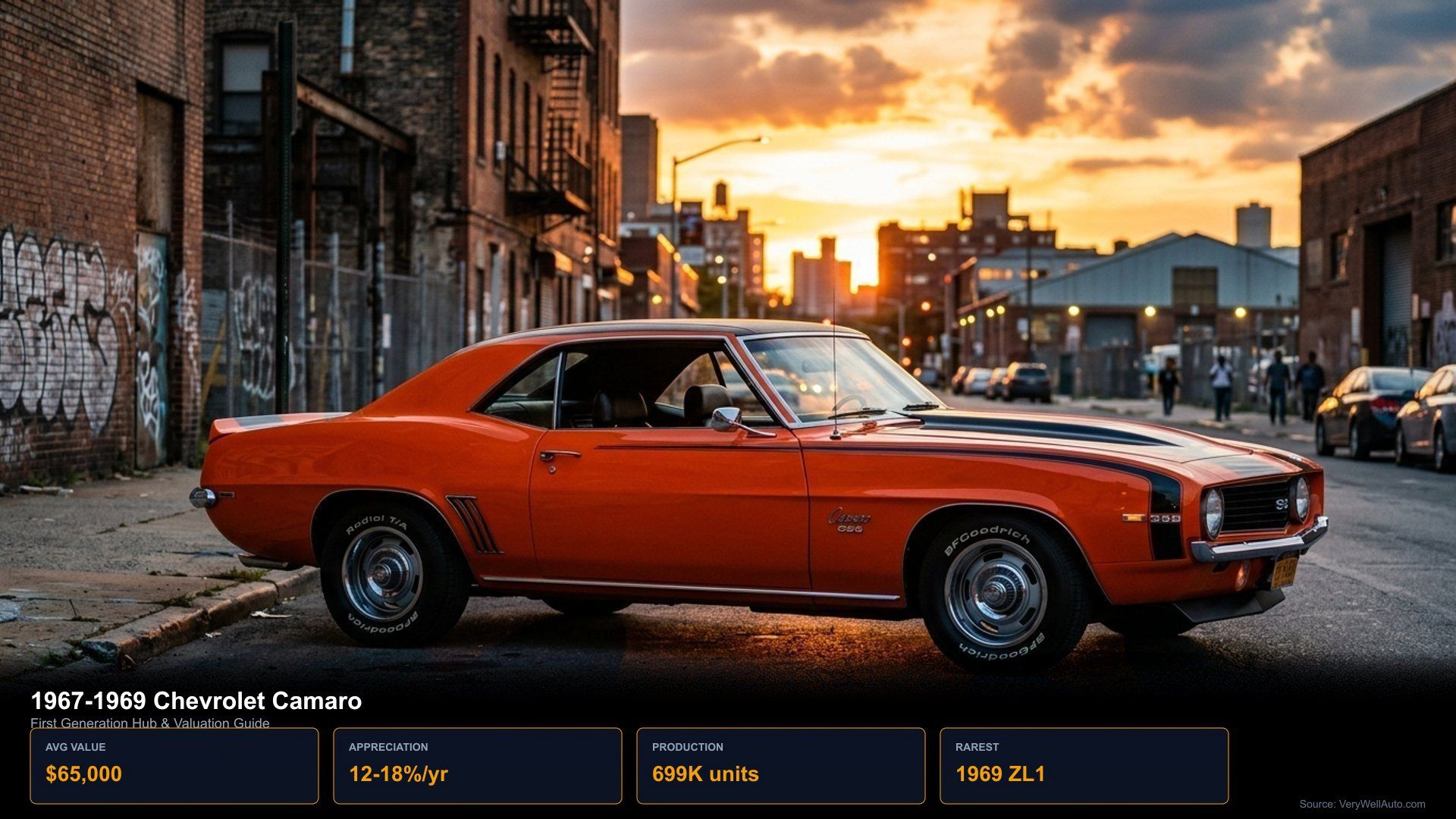
The first-generation Chevrolet Camaro (1967–1969) was GM's answer to the Mustang. The 1969 model year is the most collectible — restyled fenders, grille, and tail panel. The Z28 (302ci, 290hp) is the most desirable regular-production variant at $65,000–$120,000 (#2). The 1969 COPO 427 cars (956 built) are the holy grail at $200,000–$500,000+. The 1967–1968 SS 350 is the best value buy at $40,000–$55,000 (#2). The 1967 base 327 coupe is the entry point at $25,000–$35,000 (#2). First-gen Camaros are investment-grade assets, appreciating 10–15% annually.
Three Years, One Legend
The first-gen Camaro was rushed to market in September 1966 to compete with the Ford Mustang, which had been outselling Chevrolet for two years. The F-body platform was shared with the Pontiac Firebird. While 1967 and 1968 are visually similar, the 1969 received a significant restyle with flatter fenders, a wider grille, and squared-off tail panel — making it the most aggressive-looking and most collectible of the three years.
| Year | Total Production | Key Changes | Collectibility |
|---|---|---|---|
| 1967 | ~220,000 | First year; 230ci I6 base; 327ci V8; SS 350 introduced | Medium — first-year appeal but less aggressive styling |
| 1968 | ~235,000 | Side marker lights; Astro Ventilation; 350ci more common | Medium — similar to 1967; slightly refined |
| 1969 | ~243,000 | Major restyle: fenders, grille, tail panel; Z28 gains popularity; COPO 427 | High — the most collectible first-gen year |
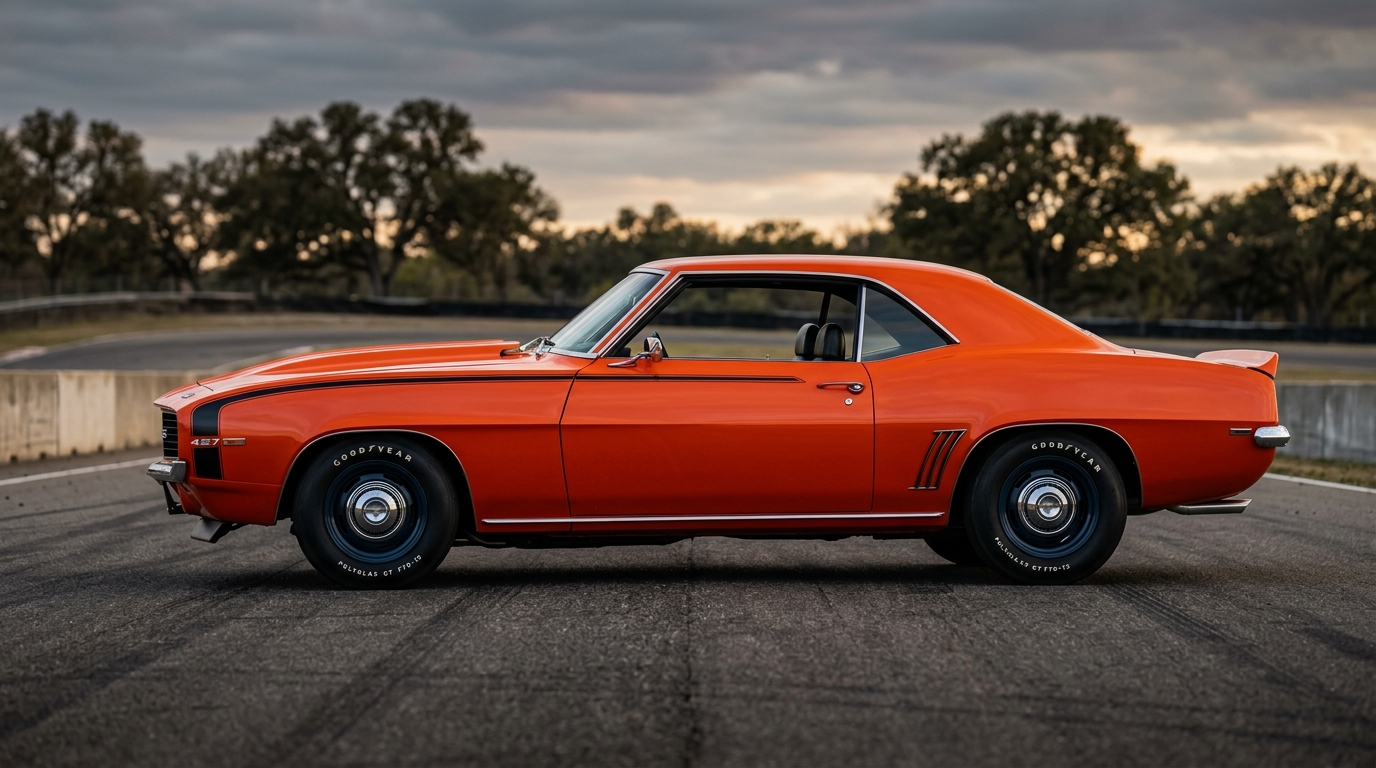
The 1969 restyle is what makes that year the most valuable. The wider, lower look with recessed grille and squared tail panel is the iconic first-gen Camaro silhouette most people picture.
Engine Specifications
| Engine | Displacement | Years | HP | Torque | Notes |
|---|---|---|---|---|---|
| 230ci I6 | 230ci | 1967–1969 | 140 | 220 | Base engine; reliable but slow; least valuable |
| 250ci I6 | 250ci | 1968–1969 | 155 | 235 | Optional I6; slightly better than 230 |
| 327ci V8 | 327ci | 1967–1969 | 210–275 | 350–355 | Most common V8; good all-around performer |
| 350ci V8 | 350ci | 1967–1969 | 295–300 | 380–410 | Introduced in SS; first year for 350 in any GM car |
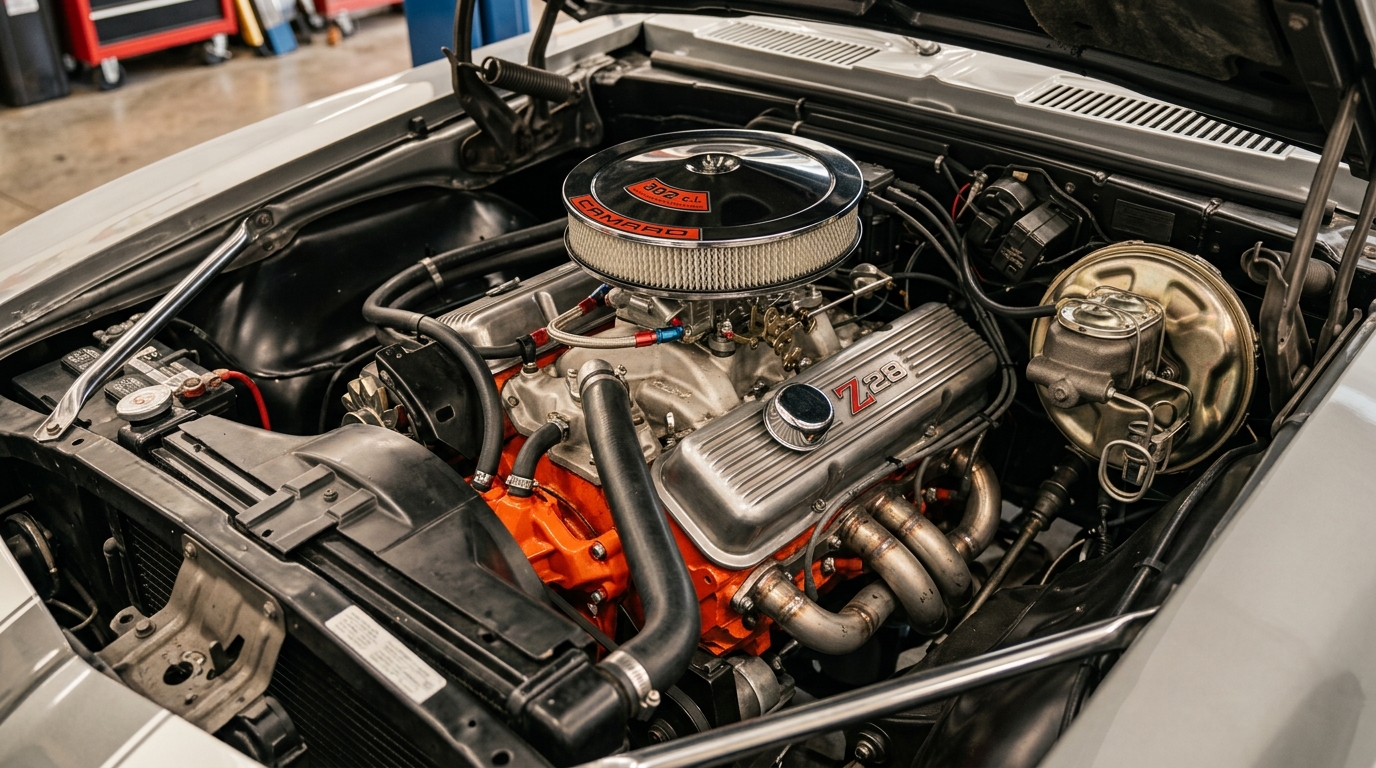
| 302ci V8 (Z28) | 302ci | 1967–1969 | 290 (actual ~400) | 290 | Trans Am racing homologation; high-revving |
| 396ci V8 (SS396) | 396ci | 1967–1969 | 325–375 | 415–415 | Big-block SS; most common big-block |
| 427ci V8 (COPO) | 427ci | 1969 | 425 | 465 | COPO 9560/9561; 956 built; ultra-rare |
The 302ci Z28 engine was underrated at 290hp — actual output was ~400hp. It was built to homologate the Camaro for SCCA Trans Am racing (5.0L displacement limit). The 350ci debuted in the 1967 Camaro SS — the first GM car to offer the 350.
Package Matrix (RS, SS, Z28, COPO)
| Package | Years | Key Features | Value Impact | Notes |
|---|---|---|---|---|
| Base | 1967–1969 | Plain trim, no badges, minimal options | Baseline | Most common; good restomod platform |
| RS (Rally Sport) | 1967–1969 | Hidden headlights, RS badges, backup lights below bumper | +10–20% | Visual package only; can be combined with SS or Z28 |
| SS (Super Sport) | 1967–1969 | 350ci or 396ci V8, SS badges, hood inserts, sport suspension | +30–50% | Performance package; most common upgraded Camaro |
| Z28 | 1967–1969 | 302ci V8, 4-speed manual, sport suspension, stripes | +60–100% | Trans Am homologation; most desirable regular-production |
| COPO 427 | 1969 | 427ci L72 or ZL1, no badges, dealer-ordered | +300–500% | 956 built; holy grail; investment-grade |
| RS/SS | 1967–1969 | RS appearance + SS performance | +40–60% | Best of both; popular combination |
| Z28/RS | 1967–1969 | Z28 performance + RS appearance | +70–110% | Rare combination; very desirable |
Packages could be combined. RS was appearance-only (hidden headlights). SS was performance (big engine). Z28 was racing (302 + 4-speed). COPO was a back-door ordering system that bypassed GM's 400ci engine limit for the Camaro.
Market Values by Condition (2026)
| Variant | #1 Concours | #2 Excellent | #3 Good | #4 Fair | 5-Year Trend |
|---|---|---|---|---|---|
| 1969 COPO 427 L72 | $500,000 | $300,000 | $180,000 | $80,000 | +55% |
| 1969 COPO ZL1 (aluminum 427) | $1,200,000 | $800,000 | $500,000 | $250,000 | +70% |
| 1969 Z28 (matching numbers) | $140,000 | $95,000 | $55,000 | $25,000 | +45% |
| 1967–1968 Z28 | $110,000 | $75,000 | $42,000 | $18,000 | +40% |
| 1969 SS 396 (375hp) | $100,000 | $70,000 | $40,000 | $17,000 | +38% |
| 1967–1968 SS 396 (375hp) | $85,000 | $58,000 | $32,000 | $14,000 | +35% |
| 1969 SS 350 | $75,000 | $50,000 | $28,000 | $12,000 | +32% |
| 1967–1968 SS 350 | $65,000 | $45,000 | $24,000 | $10,000 | +30% |
| 1969 RS/SS 350 | $80,000 | $55,000 | $30,000 | $13,000 | +33% |
| 1967–1969 327 Coupe | $50,000 | $32,000 | $17,000 | $7,000 | +28% |
| 1967–1969 230/250 I6 Coupe | $35,000 | $22,000 | $11,000 | $4,500 | +22% |
| 1967–1969 SS Convertible (350) | $85,000 | $58,000 | $32,000 | $14,000 | +35% |
| 1969 Z28 Convertible | $180,000 | $125,000 | $75,000 | $35,000 | +50% |
Values from Mecum, Barrett-Jackson, and Bring a Trailer sold data (2024–2026). Matching numbers (original engine) adds 30–50% to value. COPO ZL1 values are based on very limited transactions (69 built).
Value Trend Chart (2020–2026)
First-Gen Camaro Average Values (#2 Condition)
| 2020 | 2021 | 2022 | 2023 | 2024 | 2025 | 2026 | |
|---|---|---|---|---|---|---|---|
| 1969 Z28 (#2) | 70000 | 78000 | 85000 | 90000 | 93000 | 95000 | 95000 |
| 1969 SS 396 (#2) | 50000 | 56000 | 62000 | 66000 | 68000 | 70000 | 70000 |
| 1967–68 SS 350 (#2) | 32000 | 37000 | 41000 | 43000 | 44000 | 45000 | 45000 |
The COPO 427: Camaro's Holy Grail
GM corporate policy prohibited engines larger than 400ci in the Camaro (to protect Corvette sales). Chevrolet dealer Don Yenko and others used the COPO (Central Office Production Order) system — normally for fleet orders — to request 427ci L72 engines in Camaros. GM fulfilled the orders. Two COPO 427 variants exist: COPO 9561 (iron-block L72, ~1,015 built) and COPO 9560 (aluminum-block ZL1, 69 built). The ZL1 is the most valuable Camaro ever produced.
Key Option Codes (RPO)
First-Gen Camaro RPO Codes
| Code | Name / Description |
|---|---|
Z28 | Z28 Performance Package 302ci V8, 4-speed, sport suspension, racing stripes; Trans Am homologation |
Z22 | Rally Sport (RS) Package Hidden headlights, RS badges, rear backup lights below bumper |
Z27 | Super Sport (SS) Package 350ci or 396ci V8, SS badges, hood inserts, sport suspension |
L48 | 350ci V8 (295hp) First-year 350; standard in SS 350; 295–300hp |
L35 | 396ci V8 (325hp) Base big-block SS 396; most common 396 |
L78 | 396ci V8 (375hp) High-output 396; solid lifters; rare and desirable |
L72 | 427ci V8 (425hp) COPO 9561; iron block; ~1,015 built in 1969 |
ZL1 | 427ci Aluminum V8 (425hp) COPO 9560; all-aluminum block; 69 built; $800K+ cars |
DZ | 302ci V8 (290hp) Z28 engine; actual output ~400hp; high-revving |
M21 | 4-Speed Manual (Muncie) Close-ratio; standard on Z28; preferred over M20 |
M40 | Turbo Hydra-Matic 350 3-speed automatic; available on non-Z28 models |
G80 | Positraction Rear Axle Limited-slip; essential for performance; verify ratio |
J52 | Power Disc Brakes Front disc brakes; standard on SS; optional on others |
N10 | Dual Exhaust Standard on SS and Z28; adds performance and sound |
How to Verify an Original First-Gen Camaro
- Check the VIN and trim tag
- VIN: 1st digit = 1 (Chevrolet), 2nd-3rd = year (67/68/69), 4th-5th = 37 (coupe) or 67 (convertible)
- Trim tag (Norwood or LA plant): contains body style, trim, paint, and build date
- Verify trim tag codes match the car's current configuration
- Verify engine numbers (matching numbers)
- Engine block stamping pad: should have VIN suffix and engine suffix code (e.g., DZ = 302 Z28, MO = 350 SS)
- Block casting number: verify it matches year and engine option
- Heads: check casting numbers on cylinder heads
- Matching numbers adds 30–50% to value
- Authenticate Z28 and COPO
- Z28: verify 302ci engine (DZ suffix), 4-speed manual, and X33 or X77 trim tag code (1969)
- COPO: verify 427ci engine, specific trim tag codes (X66 for L72), and documentation
- Both: require expert authentication; many fakes and tributes exist
- Inspect for common issues
- Floor pan rust (especially under driver seat)
- Trunk floor rust (check spare tire well)
- Lower quarter panel rust behind wheels
- Subframe rust (F-body has a bolt-on front subframe — check mounting points)
- Cowl area rust (where firewall meets hood — water intrusion point)
The first-gen Camaro market is plagued by clone/tribute cars — base models with SS or Z28 badges and parts. A 6-cylinder car with a 350 swap and Z28 stripes is NOT a Z28. Verify the trim tag codes, engine stamping, and documentation. A genuine Z28 has a DZ-stamped 302ci engine. A genuine SS has the correct trim tag code (X11, X22, X55, X66, X77 depending on year/engine). Clone cars are worth 30–50% of genuine cars.
Buying Guide
- Best investment: 1969 Z28 (matching numbers)
- 302ci, 4-speed, racing heritage; $95,000 (#2)
- Appreciating 10–15% annually; investment-grade
- Verify DZ engine stamp and X77/X33 trim tag
- Best big-block: 1969 SS 396 L78 (375hp)
- 375hp solid-lifter 396; rarer than 325hp version
- $70,000 (#2); strong appreciation
- L78 code on trim tag; verify engine suffix code
- Best value: 1967–1968 SS 350 Coupe
- 295hp 350ci; first-year 350 engine; good performance
- $45,000 (#2) — entry to SS ownership
- More available than 1969; same basic styling
- Best entry point: 1967 327 Coupe
- 210hp 327ci V8; adequate performance; classic looks
- $32,000 (#2) — cheapest V8 Camaro
- Good restomod platform; can upgrade to 350 later
- Best convertible: 1969 SS 350 Convertible
- Open-top cruising with SS performance
- $58,000 (#2) — 20% premium over coupe
- Rarer than coupe; more desirable for shows
- Avoid: 6-cylinder automatic coupes
- 140hp is slow; no collector appeal
- Only valuable as a restomod donor or clone base
- If you buy one, plan an engine swap
- Avoid: Any Camaro without documentation claiming to be Z28/COPO
- Clones and tributes are common; verify everything
- A fake Z28 is worth $30,000, not $95,000
- Require trim tag, engine stamping, and ideally build sheet
Frequently Asked Questions
- What is the difference between RS and SS?
- RS (Rally Sport) is an appearance package: hidden headlights, RS badges, different taillights. SS (Super Sport) is a performance package: bigger engine, sport suspension, SS badges. They could be combined (RS/SS). A Z28 could also have RS (Z28/RS).
- How can I tell if a Z28 is real?
- Check the trim tag for Z28-specific codes (X33 or X77 on 1969). Verify the engine stamping pad has "DZ" suffix (302ci). The transmission should be a Muncie 4-speed. Z28s did not have an automatic option. Require documentation for top-value cars.
- What is a COPO Camaro?
- COPO (Central Office Production Order) was used to bypass GM's 400ci engine limit. Dealers like Don Yenko ordered Camaros with 427ci engines through COPO. Two variants: L72 (iron block, ~1,015 built) and ZL1 (aluminum block, 69 built). COPOs have no special badges — they look like base Camaros with big engines.
- Are first-gen Camaros good investments?
- Yes — they're among the most appreciating American collector cars. Z28s and big-block SS cars are up 35–45% in 5 years. COPO 427s are up 55–70%. Even base 327 coupes are up 28%. The key is originality and documentation — matching-numbers cars appreciate fastest.
- Should I restore or restomod my Camaro?
- For Z28, SS 396, and COPO: restore to original — these are investment-grade and modifications destroy value. For base 327/6-cylinder cars: restomod is acceptable and can increase value. A pro-touring build (LS engine, modern suspension, big brakes) on a base coupe can be worth $40,000–$70,000.
Get an AI-powered valuation for your first-gen Camaro — free, instant, based on real auction data.
Value My CamaroSources & References
- Hagerty Price Guide — Valuation Tools — Independent valuation data by condition grade #1-#4
- Bring a Trailer — Auction Results — Real-world auction sale prices for market comparison
- Related: C3 Corvette Generation Hub — In-depth related guide from our editorial library
- Related: Fox Body Mustang Generation Hub — In-depth related guide from our editorial library
- Related: Restoration Cost Calculator — In-depth related guide from our editorial library