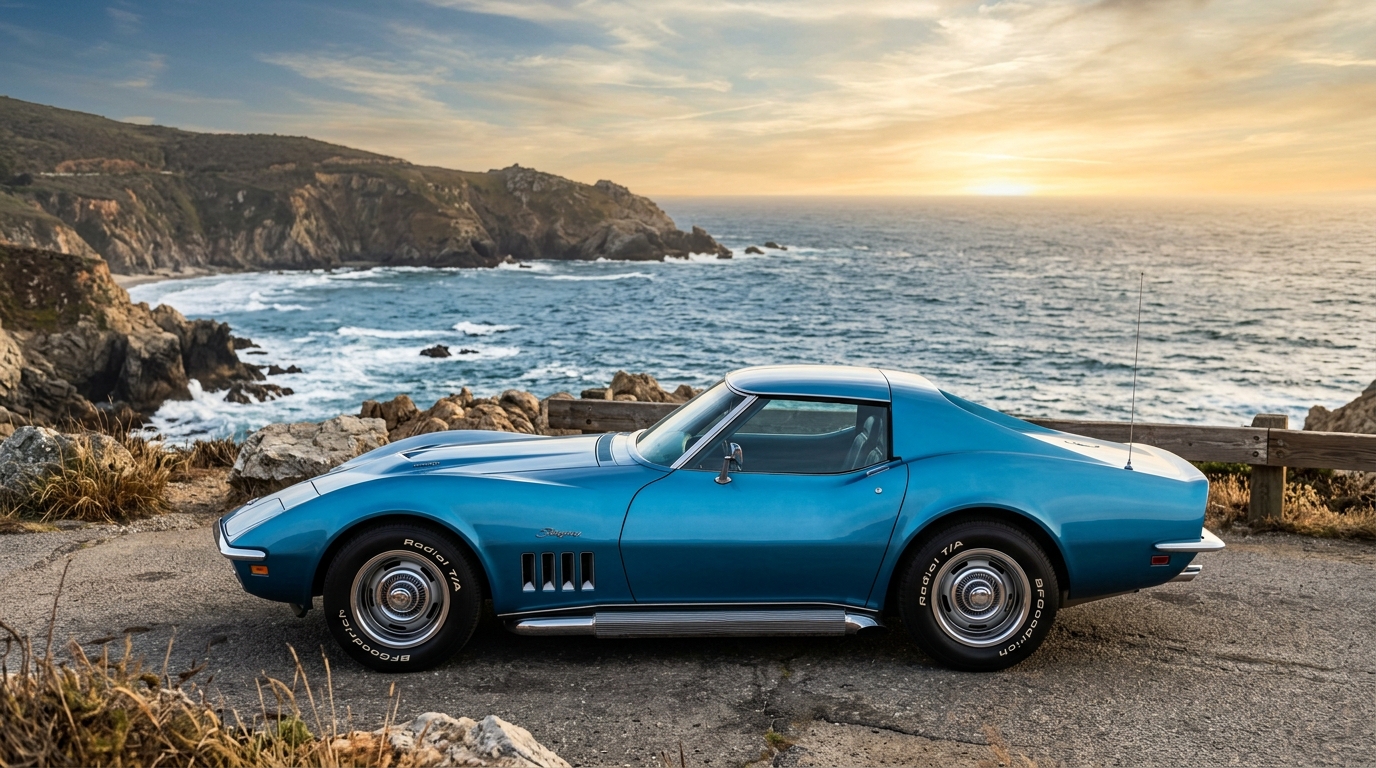
The Chevrolet C3 Corvette was produced from 1968 to 1982 on the Mako Shark II-inspired platform. The generation divides into two eras: Chrome Bumper (1968–1972, high horsepower, collectible) and Rubber Bumper (1973–1982, emissions-choked, less valuable). The 1968–1970 big-block cars (L88, ZL1) are the most valuable American cars ever sold, with #1 examples exceeding $1,000,000. The 1970 LT-1 small-block is the best value buy — 370hp, reliable, and $45,000–$70,000 in #2 condition. The 1978–1982 cars are the entry point, with #3 examples at $15,000–$25,000.
Chrome Bumper vs Rubber Bumper Eras
The C3 Corvette's 15-year run is defined by a single styling change in 1973 that also marked a dramatic shift in performance and collectibility:
| Feature | Chrome Bumper (1968–1972) | Rubber Bumper (1973–1982) |
|---|---|---|
| Front Bumper | Chrome, exposed | Body-colored urethane (5 mph impact standard) |
| Rear Bumper | Chrome (1968–1974) | Body-colored urethane (1974–1982) |
| Horsepower Range | 300–560hp (gross rating) | 165–230hp (net rating, emissions-choked) |
| Collector Appeal | Very High — investment grade | Moderate — driver quality |
| Value Range (#2) | $45,000–$2,500,000 | $18,000–$55,000 |
| Key Engines | 427ci L88, 454ci LS7, 350ci LT-1 | 350ci L82, 350ci base, 305ci LG4 (CA) |
| Defining Moment | 1971 compression drop (8.5:1) | 1975 catalytic converter; 1980 305ci in California |
The 1973 model year is the dividing line. Chrome front bumper + rubber rear bumper = 1973 only (transition year). Both chrome = 1968–1972. Both rubber = 1974–1982.
Production Numbers by Year
| Year | Total Production | Convertibles | Notes |
|---|---|---|---|
| 1968 | 28,566 | 18,630 | First C3 year; quality issues; 427ci L88 introduced |
| 1969 | 38,762 | 16,332 | Stingray badge added; ZL1 aluminum 427 (2 built) |
| 1970 | 17,316 | 6,648 | Lowest production year; LT-1 350ci introduced; 454ci replaces 427ci |
| 1971 | 21,801 | 7,121 | Compression dropped to 8.5:1; LS6 454 (188 built) |
| 1972 | 27,004 | 6,121 | Last chrome bumper year; LT-1 detuned to 255hp (net) |
| 1973 | 30,464 | 4,943 | Rubber front bumper; last year for removable rear window |
| 1974 | 37,504 | 5,294 | Both bumpers rubber; 454ci discontinued after 1974 |
| 1975 | 38,465 | 6,488 | Last convertible until 1986; base 350 drops to 165hp |
| 1976 | 46,558 | N/A | Stingray badge removed; highest production to date |
| 1977 | 49,213 | N/A | Leather seats optional; console redesigned |
| 1978 | 46,776 | N/A | 25th Anniversary; Indy Pace Car; fastback rear window |
| 1979 | 53,807 | N/A | Highest production year ever; Pace Car styling available |
| 1980 | 40,614 | N/A | Front spoiler standard; 305ci in California; 190hp L82 |
| 1981 | 40,606 | N/A | St. Louis assembly ends; Bowling Green begins |
| 1982 | 25,407 | N/A | Final C3 year; Collector Edition; 200hp Cross-Fire Injection |
Production data from GM and NCRS (National Corvette Restorers Society). The 1970 low production was due to a UAW strike, not low demand — 1970s are among the most desirable C3s.
Engine Specifications
The C3 Corvette was offered with more engine variants than any other Corvette generation. The big-block 427/454 cars are the most valuable; the LT-1 small-block is the best balance of performance and value.
| Engine | Displacement | Years | HP (Gross/Net) | Notes |
|---|---|---|---|---|
| 327ci L79 | 327ci | 1968–1969 | 300 / ~250 | Base small-block; reliable |
| 350ci L46 | 350ci | 1969 | 350 / ~290 | First 350 in Corvette |
| 350ci LT-1 | 350ci | 1970–1972 | 370 / 255 net | Best small-block; solid lifter, high revving |
| 350ci L82 | 350ci | 1973–1976, 1978–1980 | 205–230 net | Performance option; emissions-choked |
| 350ci L48 | 350ci | 1969–1980 | 195–300 | Base engine; most common |
| 350ci L81 | 350ci | 1981 | 190 net | Only engine available in 1981 |
| 350ci CE | 350ci | 1982 | 200 net | Cross-Fire Injection; last C3 engine |
| 427ci L36 | 427ci | 1968–1969 | 390 / ~320 | Base big-block; underrated |
| 427ci L68 | 427ci | 1968–1969 | 400 / ~340 | Tri-power; 3x2-barrel carbs |
| 427ci L71 | 427ci | 1968–1969 | 435 / ~375 | Tri-power; most common 427 |
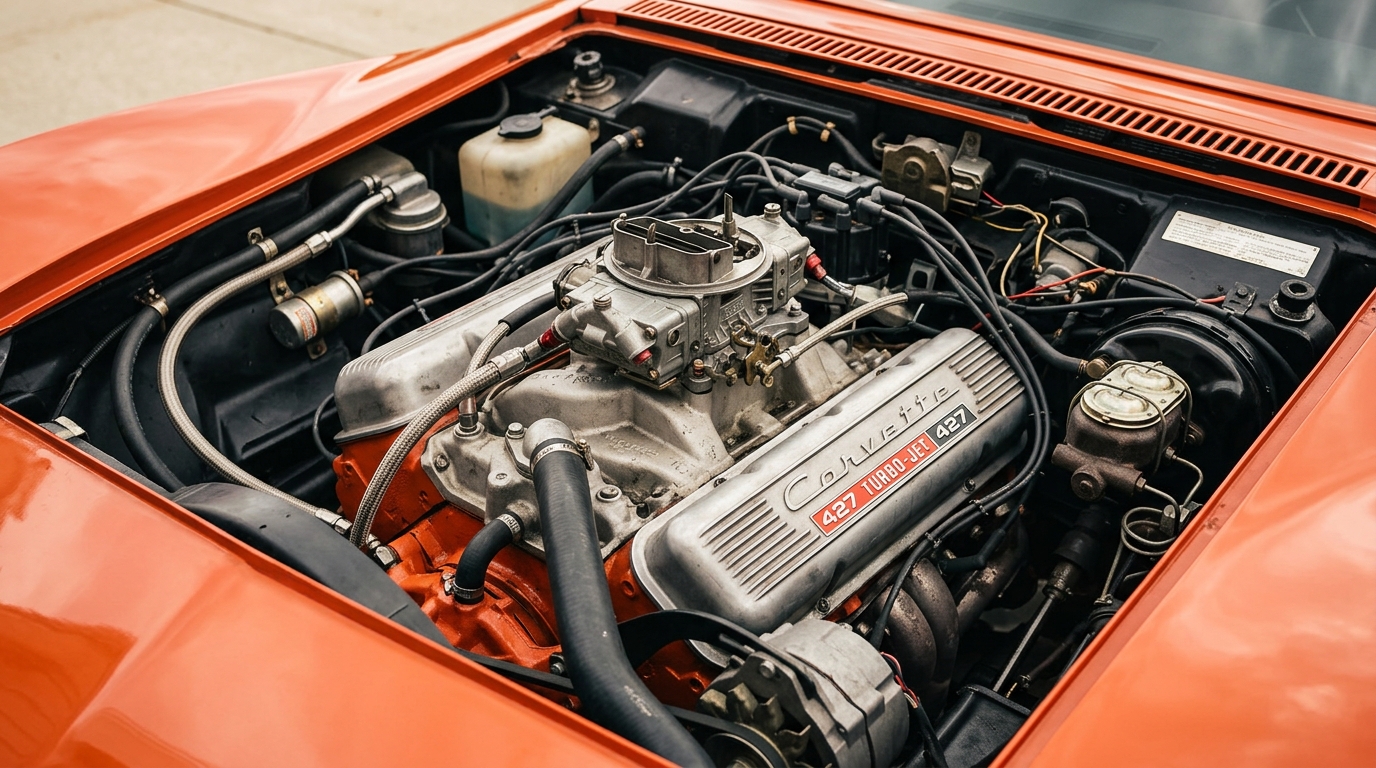
| 427ci L88 | 427ci | 1968–1969 | 430 / ~560 | Race engine; ~80 built; $1M+ cars |
| 427ci ZL1 | 427ci | 1969 | 430 / ~560 | All-aluminum block; 2 built; $3M+ |
| 454ci LS5 | 454ci | 1970–1971 | 390 / 270 net | Base big-block replacement |
| 454ci LS7 | 454ci | 1971 | 465 / ~325 | Never officially offered; some installed |
| 454ci LS6 | 454ci | 1971 | 425 / 270 net | 188 built; last high-po big-block |
| 454ci LS4 | 454ci | 1973–1974 | 275 / 215 net | Last big-block; emissions-choked |
| 305ci LG4 | 305ci | 1980 (CA only) | 180 net | Smog-era; only California; least powerful V8 |
Horsepower ratings changed from gross (engine only) to net (with accessories) in 1972. A 1971 LT-1 rated at 270hp (net) is the same engine as the 1970 LT-1 rated at 370hp (gross). The L88 was underrated at 430hp — actual output was ~560hp.
Market Values by Condition (2026)
| Variant | #1 Concours | #2 Excellent | #3 Good | #4 Fair | 5-Year Trend |
|---|---|---|---|---|---|
| 1968–1969 L88 | $2,500,000 | $1,800,000 | $1,200,000 | $600,000 | +60% |
| 1969 ZL1 (aluminum 427) | $3,500,000 | $2,500,000 | $1,800,000 | $900,000 | +80% |
| 1968–1969 L71 (435hp 427) | $180,000 | $120,000 | $75,000 | $35,000 | +45% |
| 1970 LT-1 (370hp 350) | $85,000 | $60,000 | $35,000 | $15,000 | +40% |
| 1970–1971 LS5 (390hp 454) | $95,000 | $65,000 | $40,000 | $18,000 | +42% |
| 1971 LS6 (425hp 454) | $250,000 | $175,000 | $110,000 | $55,000 | +55% |
| 1968–1972 Base 350 (L46/L48) | $55,000 | $38,000 | $22,000 | $9,000 | +35% |
| 1973–1974 LS4 (454) | $70,000 | $48,000 | $28,000 | $12,000 | +38% |
| 1973–1977 L82 (350) | $50,000 | $35,000 | $20,000 | $8,000 | +30% |
| 1973–1977 Base 350 | $40,000 | $28,000 | $16,000 | $6,500 | +28% |
| 1978 Pace Car (L82) | $55,000 | $38,000 | $22,000 | $9,000 | +32% |
| 1978–1979 Base 350 | $35,000 | $24,000 | $14,000 | $5,500 | +25% |
| 1980–1982 (all) | $30,000 | $20,000 | $12,000 | $4,500 | +22% |
| 1982 Collector Edition | $45,000 | $32,000 | $18,000 | $7,500 | +30% |
Values from Mecum, Barrett-Jackson, and Bring a Trailer sold data (2024–2026). L88 and ZL1 values are based on very limited transactions. Big-block chrome bumper cars (1968–1971) are investment-grade assets.
Value Trend Chart (2020–2026)
C3 Corvette Average Values (#2 Condition)
| 2020 | 2021 | 2022 | 2023 | 2024 | 2025 | 2026 | |
|---|---|---|---|---|---|---|---|
| 1970 LT-1 (#2) | 42000 | 48000 | 53000 | 56000 | 58000 | 60000 | 60000 |
| 1969 L71 427 (#2) | 85000 | 95000 | 105000 | 110000 | 115000 | 120000 | 120000 |
| 1975–1977 Base 350 (#2) | 20000 | 23000 | 25000 | 26000 | 27000 | 28000 | 28000 |
Special Editions and Packages
| Edition | Year | Production | Key Features | Value Premium |
|---|---|---|---|---|
| L88 | 1968–1969 | ~80 | Race engine, aluminum heads, no heater, no radio | +1000% over base |
| ZL1 | 1969 | 2 | All-aluminum 427 block; lightest big-block ever | +2000% over base |
| LT-1 | 1970–1972 | ~5,000 | Solid-lifter 350, 370hp, F41 suspension, no A/C | +60% over base 350 |
| ZR-1 | 1970–1972 | 25 | LT-1 + ZR-1 race package (no A/C, no radio, F41, J56 brakes) | +150% over LT-1 |
| Pace Car | 1978 | 6,502 | Black/silver two-tone, L82, 4-speed, special interior | +50% over base 1978 |
| Collector Edition | 1982 | 6,000 | Silver/blue, lift-up rear hatch, 0-60 badge, special wheels | +60% over base 1982 |
| Indy 500 Pace Car | 1978 | 1 (pace) + 6,501 replicas | Only Corvette to pace Indy 500 in C3 era | See Pace Car row |
The L88 and ZL1 are among the rarest and most valuable American cars ever built. The LT-1 is the most accessible special edition. The 1978 Pace Car was overproduced (6,502 units) but still commands a premium over base 1978s.
Key Option Codes (RPO)
C3 Corvette RPO Codes
| Code | Name / Description |
|---|---|
LT1 | 350ci Solid-Lifter V8 370hp (gross); only high-rev small-block in C3; 1970–1972 |
L88 | 427ci Race Engine ~560hp actual; aluminum heads, no heater/radio; ~80 built |
ZL1 | 427ci Aluminum Block All-aluminum 427; 2 built; $3M+ cars |
L82 | 350ci Performance V8 205–230hp (net); performance option 1973–1980 |
LS5 | 454ci V8 390hp (gross); base big-block 1970–1971 |
LS6 | 454ci High-Output V8 425hp (gross); 188 built in 1971; very rare |
LS4 | 454ci V8 (Late) 275hp (gross); last big-block 1973–1974 |
M21 | 4-Speed Manual (Muncie) Close-ratio; preferred over M20 wide-ratio |
M40 | Turbo Hydra-Matic 400 3-speed automatic; less desirable than 4-speed |
G81 | Positraction Rear Axle Limited-slip; essential for performance; verify ratio |
F41 | Special Suspension Stiffer springs, larger sway bars; standard on LT-1 |
J56 | Heavy-Duty Brakes Dual-piston front calipers, sintered metallic pads; ZR-1 only |
C60 | Air Conditioning Not available with LT-1 (1970–1971); available 1972+; adds $2,000–$4,000 |
A82 | Auxiliary Hardtop Removable hardtop for convertibles; rare and valuable |
How to Verify an Original C3
- Check the VIN and trim tag
- VIN: 1st 2 digits = year (68–82), 3rd-4th = 37 (coupe) or 67 (convertible)
- Trim tag on driver-side door jamb: contains body style, trim, paint, and build date
- Verify trim tag paint code matches current exterior color
- Verify engine numbers
- Engine block stamping pad: should have engine suffix code matching RPO (e.g., LT-1 = "CT" code)
- Block casting number on rear of block: verify it matches the year and engine option
- Heads: check casting numbers on cylinder heads
- Original engine (matching numbers) adds 30–50% to value
- Authenticate L88 and ZL1
- L88: verify aluminum heads (casting #3919842), no heater box, no radio hole, specific carb
- ZL1: verify aluminum block (casting #3946052) — extremely rare; require documentation
- Both: require NCRS or Bloomington Gold validation for top values
- Inspect for common C3 issues
- Birdcage rust (windshield frame structure) — critical; check A-pillars and windshield frame
- Frame rust behind rear wheels where frame kicks up
- Floor pan rust (fiberglass can hide steel floor rot)
- Headlight vacuum system (worn seals cause slow/failed pop-up)
The C3 Corvette has a steel structural frame (the "birdcage") hidden under the fiberglass body. The windshield pillar area is particularly vulnerable — water enters through windshield leaks and rots the steel from the inside. A rusted birdcage can cost $15,000–$30,000 to repair and may make the car unsafe. Always inspect the A-pillars and lower windshield frame for rust bubbles or soft spots. A magnet can detect hidden steel rust under fiberglass.
Buying Guide: Best Years and Variants
- Best investment: 1968–1969 L88 or ZL1
- Already at $1.8M–$3.5M (#2); appreciating 15–20% annually
- Require expert authentication; many fakes exist
- Only for serious collectors with deep pockets
- Best value: 1970 LT-1 Coupe
- 370hp solid-lifter 350, 4-speed, F41 suspension
- $60,000 (#2) — big-block performance at small-block price
- 1970 is the lowest production year (17,316) — rarity premium
- Best big-block: 1969 L71 (435hp 427)
- Most common 427; ~8,500 built; tri-power 3x2-barrel carbs
- $120,000 (#2) — entry to big-block ownership
- Iconic 427 side badge; investment-grade
- Best driver: 1975–1977 L82 4-speed
- 205hp is enough for cruising; parts are affordable
- $35,000 (#2) — rubber bumper era but still a Corvette
- T-top coupe is the most practical C3 configuration
- Best entry point: 1979 L48 4-speed
- Highest production year = most available = lowest prices
- $14,000 (#3) — cheapest way into C3 ownership
- Upgrade to L82 cam/intake for 250hp on a budget
- Avoid: 1980 California 305ci
- 180hp — slowest Corvette ever built
- Only sold in California; limited market
- Values flat; minimal appreciation potential
Frequently Asked Questions
- What is a "matching numbers" Corvette?
- A Corvette where the engine block stamping pad has the correct VIN suffix and engine code, confirming it's the original engine. Matching numbers adds 30–50% to value. Non-matching (replacement engine) cars are worth significantly less but still enjoyable as drivers.
- Are rubber bumper C3s worth buying?
- Yes, especially 1973–1975 with the L82 or LS4. They're 50–70% cheaper than chrome bumper cars and provide the same C3 driving experience. The 1973 transition year (chrome rear, rubber front) is particularly desirable as a "best of both worlds" car.
- What is NCRS and why does it matter?
- NCRS (National Corvette Restorers Society) provides judging and validation for Corvette authenticity. An NCRS Top Flight award confirms the car meets factory-original standards. This certification can add $10,000–$50,000 to value for chrome bumper cars.
- Can I daily drive a C3 Corvette?
- A 1975–1982 C3 in good mechanical condition can be a weekend driver. The 1968–1972 cars are too valuable and too maintenance-intensive for regular use. Common daily-driver issues: overheating in traffic, poor braking (drum brakes on 1968–1974 base cars), and fiberglass cracking from road debris.
- Should I buy a C3 or C4 Corvette?
- C3 (1968–1982) for classic styling and investment potential. C4 (1984–1996) for modern performance and daily drivability at lower cost ($8,000–$25,000). The C3 is appreciating; the C4 is still flat. If budget allows, the C3 is the better long-term play.
Get an AI-powered valuation for your C3 Corvette — free, instant, based on real auction data.
Value My CorvetteSources & References
- Hagerty Price Guide — Valuation Tools — Independent valuation data by condition grade #1-#4
- Bring a Trailer — Auction Results — Real-world auction sale prices for market comparison
- Related: Fox Body Mustang Generation Hub — In-depth related guide from our editorial library
- Related: Restoration Cost Calculator — In-depth related guide from our editorial library
- Related: Nada Classic Values Cross Reference — In-depth related guide from our editorial library