The Most Famous Cheating Story in NASCAR History
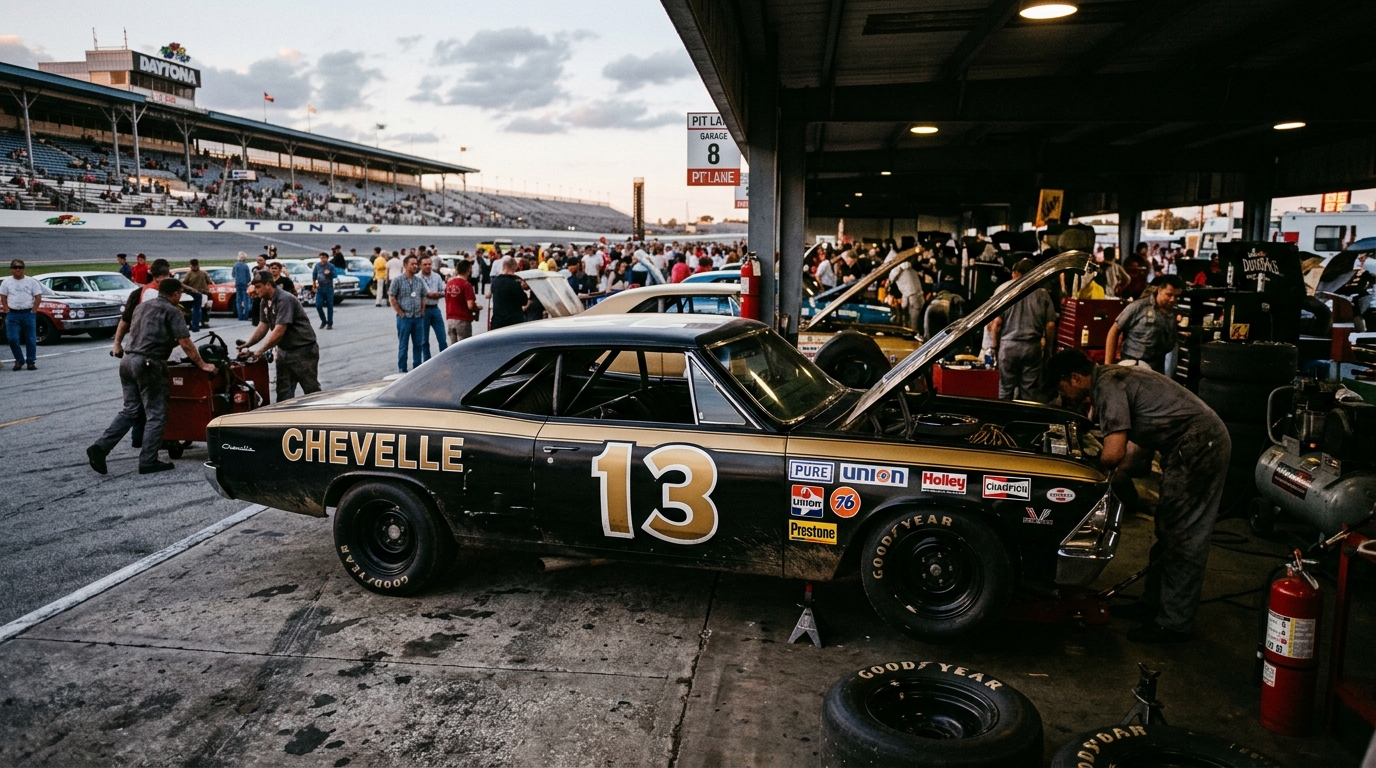
Here is the story you have heard: Legendary NASCAR mechanic Henry "Smokey" Yunick built a 1966 Chevrolet Chevelle at 7/8ths scale — a miniature replica of the production car — to cheat the wind and the rulebook at the 1968 Daytona 500. NASCAR officials knew something was wrong but could not figure out what. They eventually banned the car, and Smokey drove off in a huff, leaving his fuel tank sitting on the asphalt. The car never raced. It became the most famous stock car that never turned a lap.
It is a great story. It has been repeated in magazines, documentaries, podcasts, and bar conversations for nearly 60 years. There is only one problem: the 7/8ths scale part is completely false. The car still exists. People have put tape measures to it. It is not a scale model. It is a full-size 1966 Chevelle — and the truth about what Smokey actually did is far more interesting than the myth.
Why a 7/8ths Scale Car Would Be Impossible to Hide
Let us do the math. A 1966 Chevrolet Chevelle two-door post coupe has a wheelbase of 115 inches, an overall length of approximately 197 inches, a width of approximately 75 inches, and a track width of approximately 60 inches. If you built that car at 7/8ths scale (87.5%), here is what you would get:
| Dimension | Stock 1966 Chevelle | 7/8ths Scale (87.5%) | Difference |
|---|---|---|---|
| Wheelbase | 115 inches | 100.6 inches | -14.4 inches |
| Overall Length | ~197 inches | ~172.4 inches | -24.6 inches |
| Overall Width | ~75 inches | ~65.6 inches | -9.4 inches |
| Track Width | ~60 inches | ~52.5 inches | -7.5 inches |
| Roof Height | ~54 inches | ~47.3 inches | -6.7 inches |
Dimensional comparison of a stock 1966 Chevelle vs. a hypothetical 7/8ths scale version. A 7/8ths car would be nearly 2 feet shorter and almost 10 inches narrower — roughly the size of a Chevy Vega. No one would need a template to notice that.
A 7/8ths scale Chevelle would be roughly the size of a Chevrolet Vega. It would sit next to the other race cars in the Daytona garage looking like a child's toy. The wheels, headlights, taillights, bumpers, and glass — all of which would have to be stock production parts per the rulebook — would stick out on the shrunken body "like swollen thumbs," as Mac's Motor City Garage put it. You would not need templates or calipers to catch it. You would need only your eyes.
The 15/16ths version of the myth is slightly less absurd but still impossible. A 15/16ths scale Chevelle would still be 6 inches narrower and over 12 inches shorter than stock. That is not a subtle difference. It would be obvious in a rainstorm at midnight.
Where the Myth Came From
If the car is not 7/8ths scale, why does everyone say it is? The answer comes from Smokey Yunick himself, writing in his October 1987 column for Circle Track magazine. According to Yunick, the scale-model rumor started when NASCAR officials decided to create a body template to check his Chevelle against a production car. The problem: they built the template from the wrong car.
NASCAR used the wrecked race car of driver Bobby Johns as the pattern for their template. Johns' car had been crashed and rebuilt with significant amounts of Bondo body filler to repair the damage. The template they created from this wrecked, Bondo-covered car did not fit Yunick's Chevelle. It did not fit any Chevelle they tried it on. The template was wrong, but the officials assumed Yunick's car was the problem, not their template. The rumor mill did the rest.
Smokey himself never corrected the myth. In fact, he actively encouraged it. He loved that his Chevelle had become "the half-whispered stuff of legend" — his masterpiece, the Mona Lisa of illegal race cars. The 7/8ths story made the car far more famous than it would have been for simply having a custom frame. As Motor Trend noted, "the Chevelle became a thousand times more famous for being banned than it ever would have been for racing."
What Smokey Actually Did to the Car
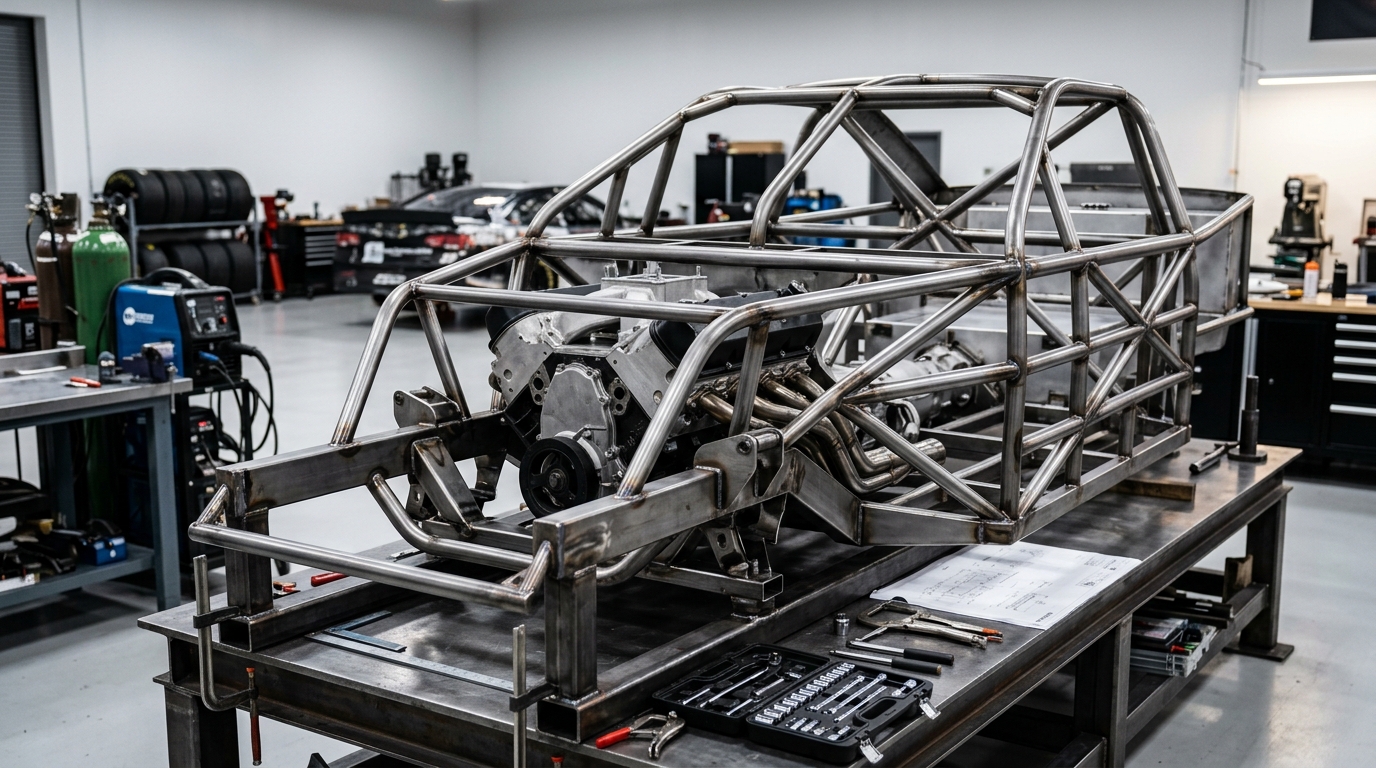
The real modifications on Yunick's Chevelle were not about shrinking the body. They were about aerodynamics, weight distribution, and engineering innovation — things that were legal in the gray area of NASCAR's 1960s rulebook but that officials had never seen before. Here is what was actually on the car:
| Modification | Purpose | Stock? |
|---|---|---|
| Custom scratch-built frame | Used engine as stressed member (F1 innovation), reduced weight | No — primary violation |
| Body shifted 2" rearward on chassis | Improved weight distribution, moved aero center of pressure rearward | No — listed violation |
| Destroked 416ci V8 (not 427) | Higher revving engine for better power band | Legal displacement, non-stock internals |
| Flush-fitted plastic windows | Reduced aerodynamic drag vs raised glass windows | No — listed violation |
| Smoothed underbelly | Reduced under-car turbulence and drag | No — listed violation |
| Front bumper extended downward as air dam | Reduced front-end lift and drag | No — listed violation |
| Rear roof/trunk lip (spoiler) | Generated downforce — officials refused to believe it was stock | No — listed violation |
| Side glass moved flush with body | Improved airflow along the body sides | No — listed violation |
| Driver's seat offset to the left | Improved left-side weight distribution on oval | No — listed violation |
| Exhaust tucked under floor pan | Reduced drag and improved ground clearance | No — listed violation |
| Inner fenders with large holes | Treated tires as air pumps — reduced fender well pressure | No — listed violation |
The actual modifications on Yunick's Chevelle, based on NASCAR inspection reports and Smokey's own accounts. Note: none of these involve scaling the body to 7/8ths size. The car was full-size — it was just engineered to within an inch of its life in every area the rulebook did not explicitly forbid.
The Fuel Tank Story: Also Mostly Myth
The other famous part of the legend is the fuel tank. The story goes: NASCAR told Smokey to remove his fuel tank for inspection. Smokey said "make it twelve" (or eleven, or thirteen — the number changes every telling), got in the car, and drove all the way home to his shop in Daytona Beach with the fuel tank sitting on the ground behind him. The implication is that Yunick had oversized fuel lines that held enough gasoline to drive the car without a tank.
The reality, as with most Smokey stories, is murkier. Accounts vary on whether he actually drove the car off the track or loaded it on a trailer. The number of violations changes with every telling — 10, 11, 13, or 16 depending on the source. Some versions say it was a Pontiac, not a Chevelle. Hagerty's centennial profile of Yunick notes that "in one telling it's a Pontiac, in another, a Chevelle. One twist says the scrutineers had chalked up 16 infractions, another has them unable to find anything even after pulling the car apart."
What is documented is that Yunick did use oversized fuel lines on some of his cars — a 10-foot-long, 2-inch-diameter line that held an extra 2 gallons of fuel. And he did use the basketball-in-the-fuel-tank trick on at least one occasion (inflate a basketball inside the tank during inspection to reduce measured capacity, then deflate it for the race to add fuel). But the dramatic "drove home without a tank" moment has grown in the telling, as all Smokey stories do.
The Car Still Exists — and People Have Measured It
The most definitive proof that the 7/8ths story is false is that the car still exists. It is owned by the Collier Collection at the Revs Institute in Naples, Florida. And people have put tape measures to it.
In 2019, the podcast Dinner With Racers filmed an episode at the Revs Institute where they took a tape measure to the Yunick Chevelle and compared it to a production 1966 Chevelle. The dimensions matched. The car is full-size. There is no 7/8ths scale. There never was.
Mac's Motor City Garage performed a similar photographic comparison, overlaying the Yunick car with a stock Chevelle using a calibrated grid. Their conclusion: "Disappointingly stock, isn't it? It's clearly not a scale model in any sense, and compared to the NASCAR stockers of later years, the car is remarkably unmodified." The only visible body modification was that the body had been moved approximately 2 inches rearward on the chassis — an improvement to weight distribution, not a scaling trick.
Why the Myth Persists
The 7/8ths scale myth survives because it is a better story than the truth. "Smokey built a miniature race car and snuck it past NASCAR" is a tale of brazen genius. "Smokey built a custom frame and flushed the windows" is a tale of engineering competence. The myth has the better narrative arc: the underdog mechanic outsmarting the establishment with an audacious scheme, getting caught, and driving off in defiance.
Smokey himself fed the myth because it served him. The 7/8ths story made his car more famous than any car that actually won at Daytona. As he told it, Bill France banned the car because Ford and Chrysler threatened to pull out of the sport if the little Chevy was allowed to embarrass them on Sunday. In Smokey's version, he was not cheating — he was just smarter than everyone else, and the establishment punished him for it. That is a much more compelling story than "his frame was not stock."
The myth also survives because most people who repeat it have never seen the car in person. If you stand next to the Yunick Chevelle at the Revs Institute, the 7/8ths story collapses instantly. It is a full-size Chevelle. It looks like a Chevelle. It is parked next to other full-size cars and it is the same size as all of them. The myth requires distance — it thrives in the space between the telling and the seeing.
What Yunick's Chevelle Actually Changed in NASCAR
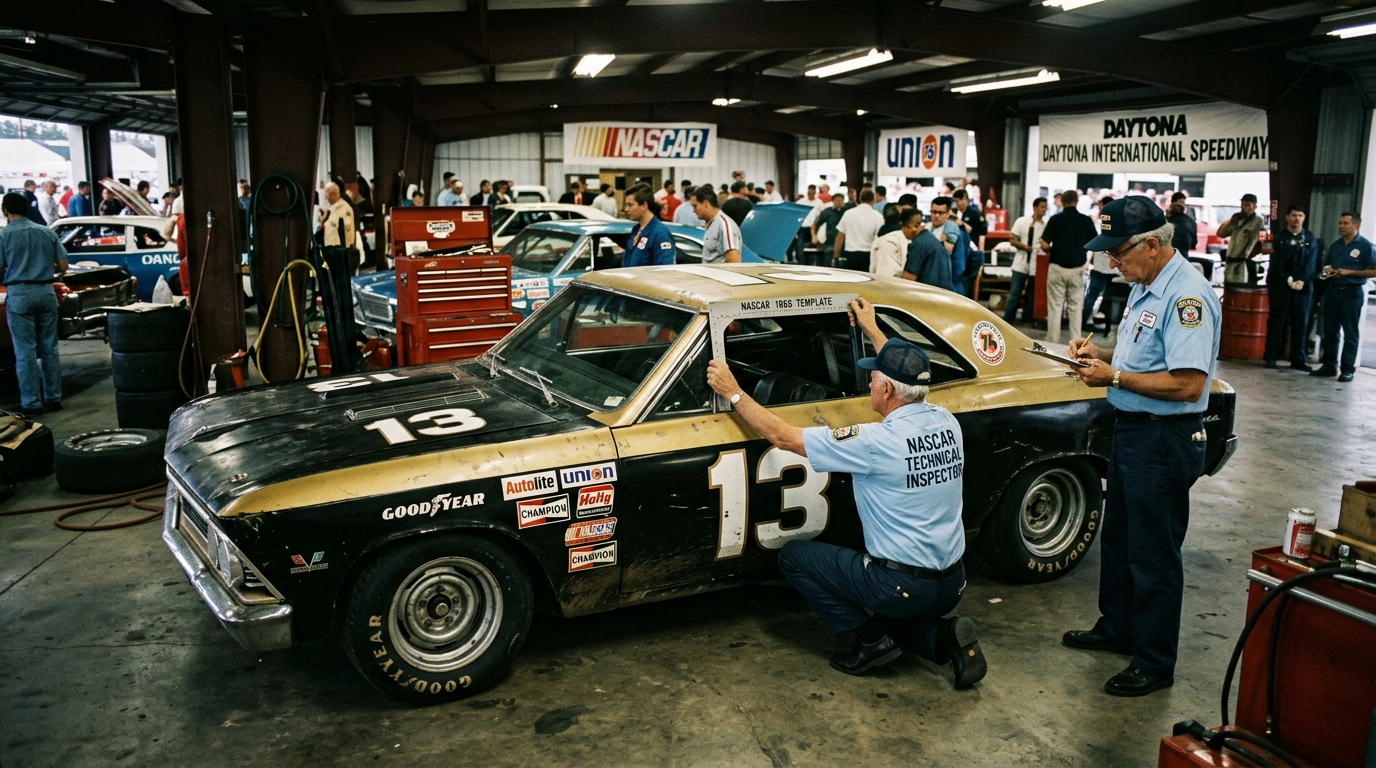
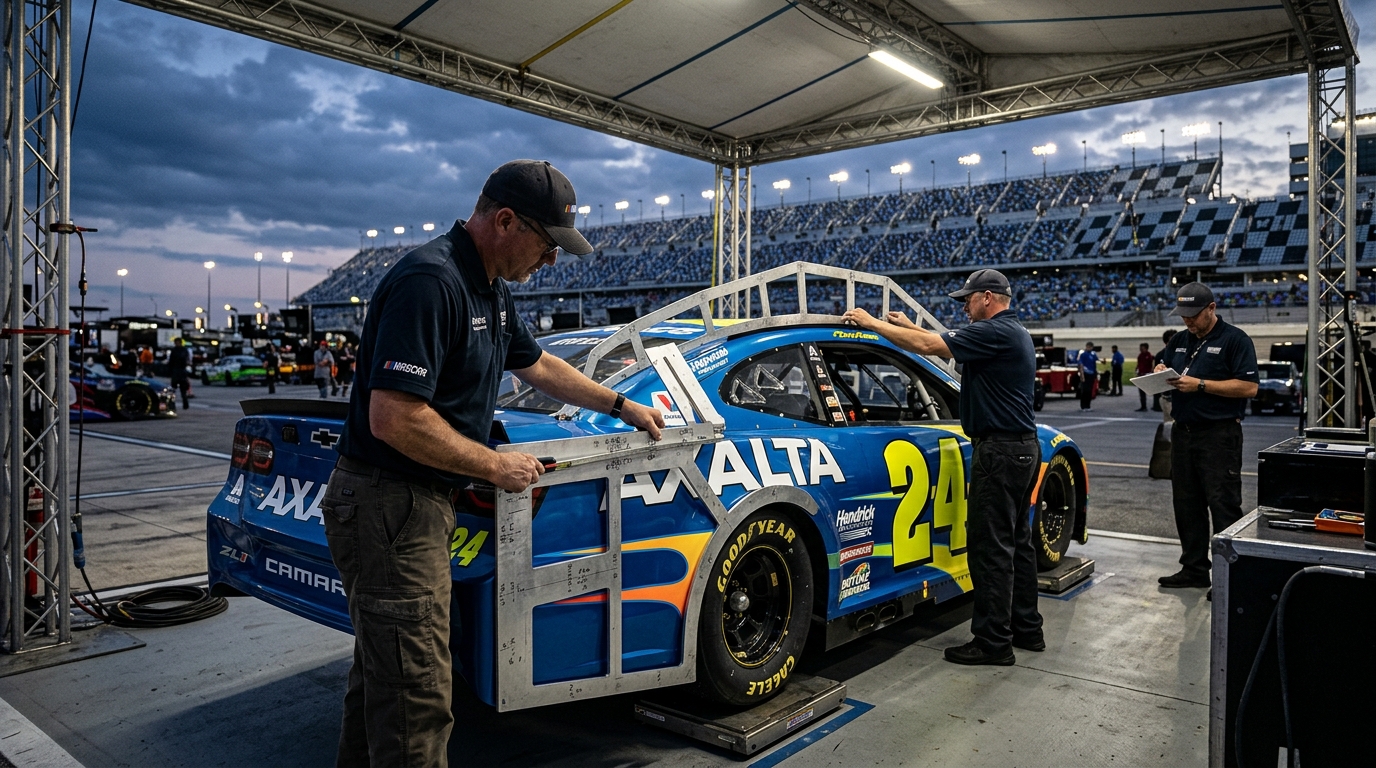
The real legacy of the Yunick Chevelle is not the 7/8ths myth. It is the fact that this car forced NASCAR to adopt the standardized body template system. Before Yunick's Chevelle, NASCAR tech inspection was largely visual — officials looked at the car and decided if it "looked right." After Yunick, NASCAR created aluminum templates cut from production car bodies and placed them against race cars to verify dimensional conformity. This template system remained in use for 50 years, until 2018, when NASCAR replaced physical templates with an optical scanning station that uses lasers to create a 3D point cloud of the car body.
In an ironic twist noted by Motor Trend, many of the innovations that got Yunick's Chevelle banned in 1968 became standard equipment on NASCAR's Car of Tomorrow decades later: smoothed underbellies, flush windows, air dams, and rear spoilers. As Motor Trend wrote, "Yunick's greatest sin was being too far ahead of his time."
The Bottom Line
Smokey Yunick was a genius. He was also a notorious rule-bender who pushed every gray area in the NASCAR rulebook to its limit. His Chevelle was the most creatively engineered stock car of its era. But it was not 7/8ths scale. It was not 15/16ths scale. It was a full-size 1966 Chevelle with a custom frame, a destroked engine, flush windows, a smoothed belly, and a body shifted 2 inches to the rear. Those modifications were enough to get the car banned — and they were enough to make NASCAR fundamentally change how it inspected race cars.
The 7/8ths scale story is a myth. It has been debunked by tape measures, by photographic overlays, and by Smokey Yunick's own writings. But like all good myths, it refuses to die — because the truth, while more interesting to engineers, is less interesting to storytellers. The next time someone tells you about the 7/8ths scale Chevelle, tell them the real story. It is better.
Sources & References
- Revs Institute — Collier Collection (where the Yunick Chevelle is displayed) — The Yunick Chevelle is part of the Collier Collection at the Revs Institute in Naples, Florida — visitors can see the car in person and verify it is full-size
- Mac's Motor City Garage — The Truth About Smokey Yunick's 7/8-Scale Chevelle — Detailed photographic comparison of the Yunick Chevelle with a stock Chevelle using calibrated grid overlays
- Pit Box Press — The Tall Tale of Smokey Yunick's 7/8ths-Scale Chevelle — Comprehensive analysis of the Yunick Chevelle myth, including the Dinner With Racers tape-measure inspection
- Motor Trend Classic — 1966 Chevrolet Chevelle Grand National Race Car — Motor Trend's in-depth feature on the Yunick Chevelle with technical analysis of the actual modifications
- Hagerty Media — On His 100th Birthday, the Legend of NASCAR's Greatest Cheater — Hagerty's centennial profile of Smokey Yunick, documenting how the myth evolved and grew over decades
- Related: Chevelle Generation Hub (1964–1972) — Complete guide to the Chevrolet Chevelle including the 1966 model that Yunick modified
- Related: Matching Numbers Explained — Classic Car Value — How originality and matching numbers affect classic car value — relevant to surviving NASCAR stock cars
- Related: Classic Car Engine Rebuild Cost Guide (2026) — Engine rebuild costs and procedures — Yunick's destroked 416ci V8 was a custom build