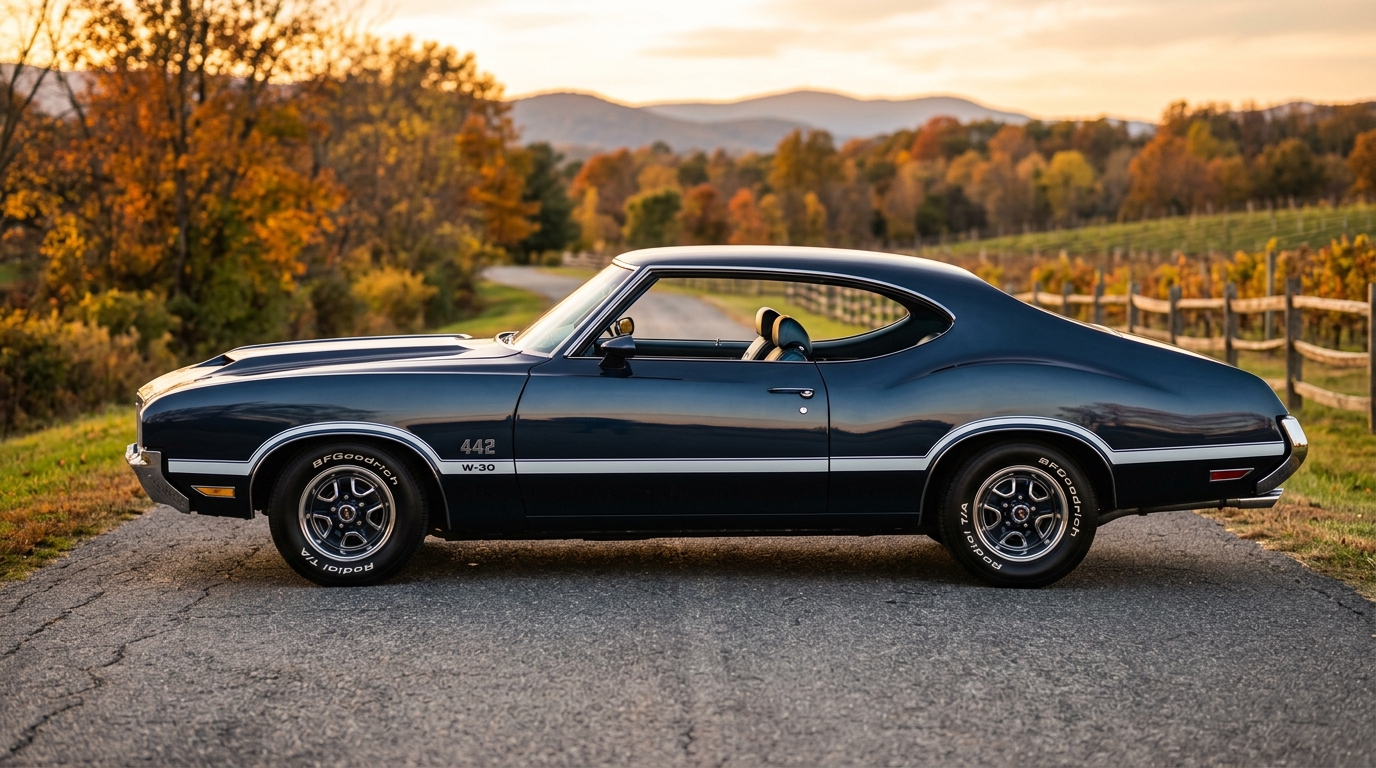
The Oldsmobile 442 (1964–1972) was Oldsmobile's entry in the muscle car wars — a refined A-body with more sophisticated engineering than its Chevrolet Chevelle sibling. The 1968–1971 W-30 with the 455ci V8 (370hp) is the most collectible, at $60,000–$100,000 (#2). The 1968–1969 Hurst/Olds editions (455ci, 390hp) are the rarest and most valuable at $80,000–$140,000 (#2). The 1966–1967 442 with the 400ci V8 is the best value buy at $35,000–$50,000 (#2). The 1964–1965 330ci is the entry point at $25,000–$35,000 (#2). The 442 was always more expensive and more refined than the Chevelle SS — today it's 10–20% cheaper, making it the smart A-body buy.
The Refined Muscle Car
The Oldsmobile 442 began in 1964 as an option package (B09 Police Apprehender Pursuit) on the F-85/Cutlass. The name "4-4-2" originally stood for: 4-barrel carburetor, 4-speed manual transmission, dual exhaust. By 1968, the 442 became its own model and Oldsmobile positioned it as the "gentleman's muscle car" — more refined, better appointed, and more technically sophisticated than the Chevelle SS or Pontiac GTO. The W-30 and W-31 performance packages and the Hurst/Olds collaborations made the 442 a serious performer that could beat a GTO on the strip.
| Generation | Years | Styling | Key Engines | Collectibility |
|---|---|---|---|---|
| 1st Gen | 1964–1967 | Clean, formal; Olds split grille; 330ci then 400ci | 330ci (290/310hp), 400ci (345/350/360hp) | Medium — 1966–1967 400 is the sweet spot |
| 2nd Gen | 1968–1972 | Coke-bottle curves; graceful styling; W-30 package | 400ci (290–360hp), 455ci (365–400hp), W-30/W-31 | Very High — 1968–1970 W-30 and Hurst/Olds |
| 3rd Gen (Colonnade) | 1973–1974 | Larger, safety bumpers; not covered in this guide | 455ci (detuned) | Low — not in this guide |
The 2nd gen (1968–1972) is the peak 442 — the W-30 with 455ci and the Hurst/Olds editions are the most collectible. The 1st gen (1964–1967) is more affordable but still desirable. The 442 was always the most refined A-body — better interior materials, smoother ride, and more sophisticated engineering than the Chevelle.
Production Numbers
| Year | 442 Production | W-30 Production | Hurst/Olds | Notes |
|---|---|---|---|---|
| 1964 | ~3,000 | N/A | N/A | Option package on F-85/Cutlass; 330ci only; rare |
| 1965 | ~25,000 | N/A | N/A | 442 becomes more popular; 400ci not yet available |
| 1966 | ~21,000 | N/A | N/A | 400ci introduced (345/350hp); 442 as standalone option |
| 1967 | ~17,000 | ~500 (W-30) | N/A | W-30 package introduced; 400ci (360hp) Tri-Power |
| 1968 | ~33,000 | ~1,200 | 515 | All-new 2nd gen; 455ci introduced; first Hurst/Olds |
| 1969 | ~29,000 | ~1,500 | 906 | W-30 refined; Hurst/Olds continues; 455ci standard |
| 1970 | ~22,000 | ~2,100 | N/A (Hurst paused) | Peak W-30 year; 455ci (370hp); no Hurst/Olds this year |
| 1971 | ~16,000 | ~1,000 | N/A | Compression drop; 455 detuned; W-30 continues |
| 1972 | ~7,000 | ~600 | N/A | Final classic 442 year; very low production; 455 still available |
Production data from Oldsmobile Division. The 1964 442 is the rarest (~3,000 built). The 1968–1969 Hurst/Olds (~1,421 combined) are the most valuable limited editions. The 1972 442 is very rare (~7,000) — the muscle car era was ending. W-30 production was always low — these are the most desirable 442s.
Engine Specifications
| Engine | Displacement | Years | HP | Torque | Notes |
|---|---|---|---|---|---|
| 330ci V8 | 330ci | 1964–1965 | 290–310 | 355–390 | First 442 engine; reliable; entry-level collectibility |
| 400ci V8 | 400ci | 1966–1967 | 345–360 | 440 | Replaced 330; Tri-Power (360hp) is most desirable 1st gen |
| 400ci V8 | 400ci | 1968–1972 | 290–360 | 395–440 | Base 2nd gen engine; detuned after 1970 |
| 455ci V8 | 455ci | 1968–1972 | 365–400 | 470–510 | Big-block; standard in 442 from 1968; torque monster |
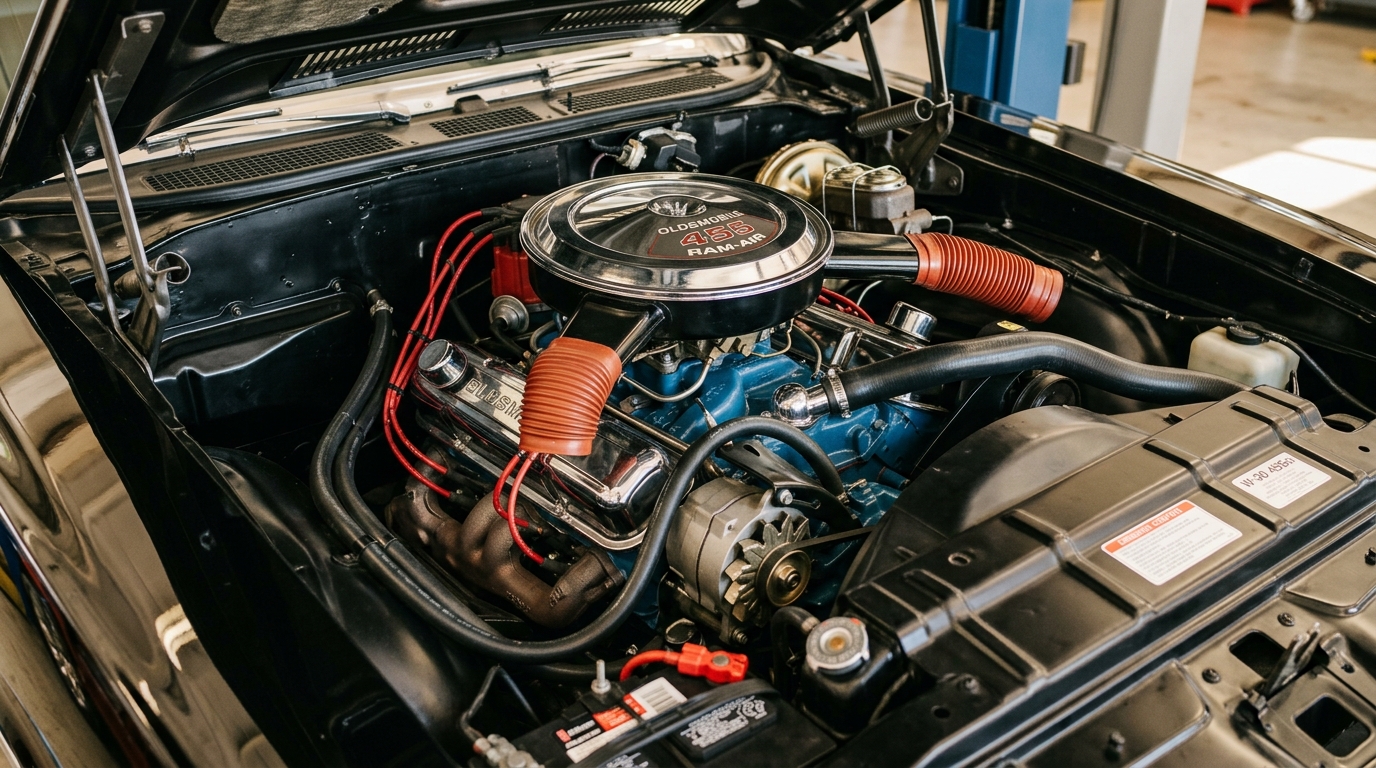
| 455ci W-30 | 455ci | 1968–1971 | 370–400 | 480–510 | Hot cam, aluminum intake, red fender wells; most desirable |
| 455ci W-31 | 455ci | 1969–1970 | 340–360 | 440 | Small-cam 455; less common than W-30; good value |
| 455ci Hurst/Olds | 455ci | 1968–1969 | 390 | 480 | Hurst-modified 455; special cam and tuning; rare |
The W-30 455 is the king of 442 engines — 370–400hp, 510 lb-ft torque, aluminum intake, red inner fender wells, and Force-Air induction (twin scoops on the hood). The Hurst/Olds 455 (390hp) is the rarest. The 330ci is the least desirable — only suitable for 1964–1965 entry-level collectors.
W-30 and Hurst/Olds: The Performance Packages
The W-30 was Oldsmobile's top performance package: 455ci V8 with hot cam, aluminum intake manifold, special distributor, Force-Air hood scoops (twin scoops feeding directly into the air cleaner), red inner fender wells, and 3.91:1 or 4.33:1 rear gears. The W-30 was one of the fastest muscle cars of the era — a 1970 W-30 ran 0-60 in 5.4 seconds and the quarter mile in 13.9 seconds at 102 mph. Only ~6,400 W-30s were built across all years.
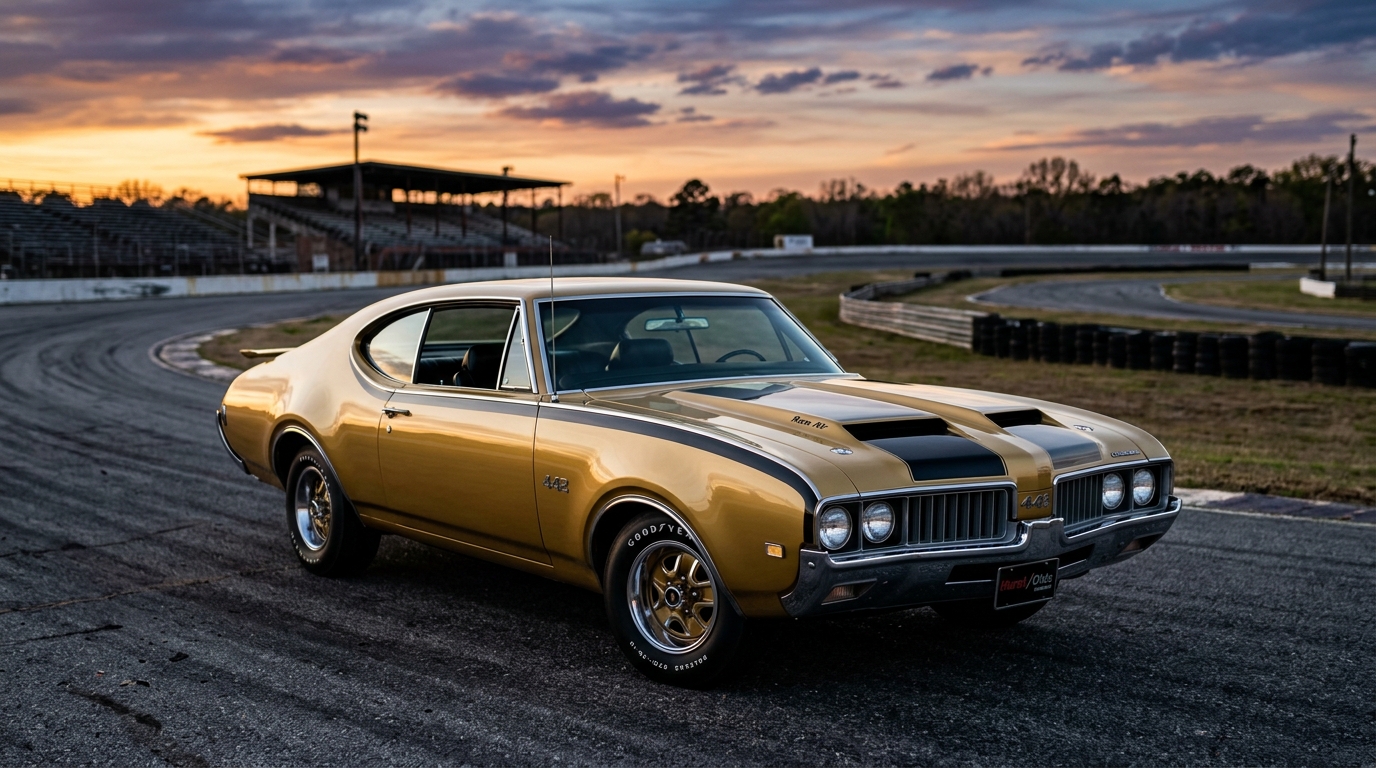
The Hurst/Olds was a collaboration between Oldsmobile and Hurst Performance. The 1968 edition featured a 455ci V8 (390hp) with Hurst Dual-Gate shifter, special Peruvian Silver/Black paint scheme, and H/O badges. Only 515 built in 1968 and 906 in 1969. The 1968 Hurst/Olds is the most valuable 442 variant — it was the first factory collaboration between an OEM and an aftermarket company, setting the template for future special editions.
Market Values by Condition (2026)
| Variant | #1 Concours | #2 Excellent | #3 Good | #4 Fair | 5-Year Trend |
|---|---|---|---|---|---|
| 1968 Hurst/Olds 455 Convertible | $200,000 | $140,000 | $80,000 | $35,000 | +50% |
| 1968 Hurst/Olds 455 Hardtop | $160,000 | $110,000 | $62,000 | $27,000 | +48% |
| 1969 Hurst/Olds 455 Hardtop | $130,000 | $90,000 | $50,000 | $22,000 | +42% |
| 1970 W-30 455 Hardtop | $120,000 | $85,000 | $48,000 | $21,000 | +45% |
| 1968–1969 W-30 455 Hardtop | $100,000 | $70,000 | $40,000 | $17,000 | +38% |
| 1971 W-30 455 Hardtop | $90,000 | $62,000 | $35,000 | $15,000 | +35% |
| 1966–1967 442 400 Tri-Power Hardtop | $80,000 | $55,000 | $30,000 | $13,000 | +32% |
| 1968–1970 442 455 4-barrel Hardtop | $75,000 | $52,000 | $28,000 | $12,000 | +30% |
| 1966–1967 442 400 4-barrel Hardtop | $65,000 | $45,000 | $24,000 | $10,000 | +28% |
| 1971–1972 442 455 Base Hardtop | $55,000 | $38,000 | $20,000 | $8,500 | +25% |
| 1964–1965 442 330ci Hardtop | $45,000 | $30,000 | $16,000 | $6,500 | +22% |
| 1966–1967 442 400 Convertible | $85,000 | $58,000 | $32,000 | $14,000 | +33% |
| 1968–1970 W-30 455 Convertible | $140,000 | $95,000 | $55,000 | $25,000 | +42% |
Values from Mecum, Barrett-Jackson, and Bring a Trailer sold data (2024–2026). The 1968 Hurst/Olds Convertible is the rarest and most valuable 442 — fewer than 50 built. The W-30 is the performance collector's choice. The 442 is 10–20% cheaper than equivalent GTOs and Chevelle SS models, making it the best value A-body muscle car.
Value Trend Chart (2020–2026)
Oldsmobile 442 Average Values (#2 Condition)
| 2020 | 2021 | 2022 | 2023 | 2024 | 2025 | 2026 | |
|---|---|---|---|---|---|---|---|
| 1968 Hurst/Olds (#2) | 75000 | 88000 | 98000 | 105000 | 108000 | 110000 | 110000 |
| 1970 W-30 455 (#2) | 55000 | 65000 | 74000 | 80000 | 83000 | 85000 | 85000 |
| 1966–67 400 4-barrel (#2) | 32000 | 38000 | 42000 | 44000 | 45000 | 45000 | 45000 |
442 vs GTO vs Chevelle SS: A-Body Comparison
| Factor | Olds 442 W-30 | Pontiac GTO Judge | Chevelle SS 454 |
|---|---|---|---|
| Platform | GM A-body | GM A-body | GM A-body |
| Top Engine | 455ci (370–400hp) | 400ci Ram Air IV (370hp) | 454ci LS6 (450hp) |
| Torque | 510 lb-ft | 445 lb-ft | 500 lb-ft |
| 0-60 mph | ~5.4 sec | ~5.5 sec | ~5.3 sec |
| Quarter Mile | 13.9 @ 102 mph | 14.0 @ 100 mph | 13.7 @ 104 mph |
| Weight | ~3,600 lbs | ~3,600 lbs | ~3,800 lbs |
| Rarity (W-30/Judge/LS6) | ~6,400 total | ~11,100 total | ~4,475 (1 year) |
| Value (#2, top variant) | $85,000 | $75,000–$100,000 | $150,000–$200,000 |
| Refinement | Highest — luxury interior | Medium — sporty | Medium — basic |
The 442 W-30 has the most torque (510 lb-ft) and is nearly as fast as the LS6 Chevelle, but costs 40–50% less. The 442 is the smart A-body buy — same performance, more refinement, lower price. The Chevelle LS6 commands its premium because of the 450hp number and one-year-only rarity.
Key Option Codes (RPO)
Oldsmobile 442 RPO Codes
| Code | Name / Description |
|---|---|
W-30 | Performance Package 455ci with hot cam, aluminum intake, Force-Air scoops, red fender wells; 1966–1971 |
W-31 | Performance Package (Mild) 455ci with mild cam; less aggressive than W-30; 1969–1970; good value |
W-32 | Force-Air Induction Hood scoops feeding air cleaner; part of W-30; also available standalone |
L69 | 455ci V8 (370hp) W-30 engine; 510 lb-ft torque; aluminum intake; 1968–1971 |
L75 | 455ci V8 (365hp) Base 455; 470 lb-ft torque; standard in 442 from 1968 |
L74 | 400ci V8 (345–360hp) 1st gen top engine; Tri-Power (360hp) is most desirable; 1966–1967 |
M21 | 4-Speed Manual (Muncie) Close-ratio; standard on W-30; preferred over automatic |
M40 | Turbo Hydra-Matic 400 3-speed automatic; strong; common on non-W-30 cars |
G80 | Anti-Spin Rear Axle Olds limited-slip; essential for performance |
N10 | Dual Exhaust Standard on 442; adds performance and sound |
J56 | Power Disc Brakes Front disc; optional; standard on W-30 |
C60 | Air Conditioning Factory A/C; rare on W-30; adds comfort and value on non-W-30 |
V26 | Vinyl Top Common on 442; check for rust along rear window |
FE7 | Heavy-Duty Suspension Stiffer springs, larger sway bars; standard on W-30 |
Buying Guide
- Best investment: 1968 Hurst/Olds 455 Hardtop
- First factory OEM + aftermarket collaboration; 390hp 455
- $110,000 (#2); appreciating 12–15% annually
- Only 515 built — verify H/O-specific parts and paint scheme
- Best performance: 1970 W-30 455 Hardtop
- 370hp, 510 lb-ft torque; Force-Air scoops; red fender wells
- $85,000 (#2); one of the fastest A-bodies
- Verify W-30-specific parts: aluminum intake, cam, distributor
- Best value: 1966–1967 442 400 4-barrel Hardtop
- 345hp 400ci; clean 1st gen styling; $45,000 (#2)
- 10–20% cheaper than equivalent GTO or Chevelle SS
- Most common 1st gen; easier to find and restore
- Best late 442: 1968–1970 442 455 4-barrel Hardtop
- 365hp 455ci; 470 lb-ft torque; 2nd gen styling; $52,000 (#2)
- Same engine family as W-30 without the premium
- Good driver-quality car; parts readily available
- Best convertible: 1966–1967 442 400 Convertible
- Open-top muscle; $58,000 (#2); rarer than hardtop
- 40–50% premium over hardtop
- Verify top mechanism and floor pan condition
- Best entry point: 1964–1965 442 330ci Hardtop
- 290hp 330ci; the original 4-4-2; $30,000 (#2)
- Very rare (~3,000 built in 1964); historical significance
- Good for collectors who want the first-year 442
- Avoid: 1972 442 with 350ci 2-barrel
- Lowest output 442; 175hp; no performance appeal
- Only buy if numbers-matching and very cheap
- Better to buy a Cutlass S with a 350 than a 442 with a 350
Frequently Asked Questions
- What does "442" stand for?
- Originally (1964): 4-barrel carburetor, 4-speed manual transmission, dual exhaust. By 1965, the 442 became a model name rather than an acronym, and the meaning was retroactively changed to "400 cubic inches, 4-barrel carb, 2 exhausts." In 1968, with the 455ci engine, the name was purely a model designation with no acronym meaning.
- Is the 442 the same as a Chevelle SS?
- No. Both are GM A-bodies, so they share the chassis, suspension design, and some drivetrain components. But the engines are different — Olds 330/400/455 vs Chevy 350/396/454. The bodies are different — Olds had its own grille, taillights, and interior. The 442 was positioned as more refined and more expensive than the Chevelle SS when new.
- What is the W-30 package?
- The W-30 was Olds' top performance package (1966–1971): 455ci V8 with hot cam, aluminum intake, Force-Air hood scoops, red inner fender wells, and 3.91:1 or 4.33:1 rear gears. Only ~6,400 W-30s were built across all years. The 1970 W-30 is the peak — 370hp, 510 lb-ft, 0-60 in 5.4 seconds.
- What is a Hurst/Olds?
- The Hurst/Olds (1968–1969, revived 1972–1973) was a collaboration between Oldsmobile and Hurst Performance. It featured a specially tuned 455ci V8 (390hp), Hurst Dual-Gate shifter, unique silver/black paint, and H/O badges. The 1968 edition (515 built) was the first factory OEM + aftermarket collaboration — setting the template for future special editions.
- Why is the 442 cheaper than the GTO and Chevelle SS?
- Supply and demand — fewer people know about the 442, so demand is lower. The GTO has the "first muscle car" historical significance, and the Chevelle SS has the LS6 450hp legend. The 442 is actually faster than the GTO Judge and nearly as fast as the LS6 Chevelle, but lacks the name recognition. This makes it the smart A-body buy for knowledgeable collectors.
Get an AI-powered valuation for your Oldsmobile 442 — free, instant, based on real auction data.
Value My 442Sources & References
- Hagerty Price Guide — Valuation Tools — Independent valuation data by condition grade #1-#4
- Bring a Trailer — Auction Results — Real-world auction sale prices for market comparison
- Related: Pontiac Gto Generation Hub 1964 1972 — In-depth related guide from our editorial library
- Related: Chevelle Generation Hub 1964 1972 — In-depth related guide from our editorial library
- Related: Restoration Cost Calculator — In-depth related guide from our editorial library