
How Online Car Appraisal Tools Actually Work
Every online car appraisal tool follows the same basic process: you enter the vehicle information (VIN, make/model/year, mileage, condition, options), the tool queries a database of historical transactions and current listings, and it returns an estimated value range. The difference between tools is in the data sources and the algorithm. Kelley Blue Book aggregates dealer transactions and listing data. Edmunds uses a True Market Value algorithm based on what consumers actually paid. Hagerty combines auction results, insurance valuations, and dealer data for collector cars. Bring a Trailer shows you raw auction results with no algorithm — you see exactly what cars sold for. AI-powered tools like VeryWellAuto decode the VIN, pull comparables from multiple sources, and use machine learning to adjust for condition factors from uploaded photos. No online tool is 100% accurate because none can physically inspect the vehicle — the condition assessment is always the weakest link.

The 12 Best Online Car Appraisal Tools Compared
| Tool | Best For | Cost | Classic Cars? | Accuracy | Key Feature |
|---|---|---|---|---|---|
| Hagerty Valuation Tool | Classic & collector cars | 3 free, then membership | Yes (40,000+) | ±10-15% | 15+ years pricing data, #1-#4 condition values |
| Kelley Blue Book (KBB) | Modern used cars (1980+) | Free | No (1980+ only) | ±10-15% | Dealer + private party + trade-in values |
| Edmunds TMV | New & near-new cars | Free | No (1990+ only) | ±10% | Shows what others actually paid |
| Bring a Trailer | Real classic car market data | Free | Yes | N/A (raw data) | Actual sold prices with photos and comments |
| VeryWellAuto AI | Quick classic car estimates | Free | Yes (all years) | ±15-20% | AI + VIN decode + photo condition assessment |
| NADA Guides (J.D. Power) | Used car trade-in values | Free | Limited | ±15% | Legacy NADA condition tiers |
| Hemmings Valuation | High-value classics | $99.95/report | Yes | ±5-10% | Human expert analysis with photos |
| ClassicDecoder | Pre-1981 VIN identification | Free decode, $29.99 report | Yes (specialist) | N/A (ID only) | Best pre-1981 VIN decoder |
| Manheim Market Report | Dealer wholesale values | Dealer only | No | ±5% | Wholesale auction data (dealer access) |
| Black Book | Dealer trade-in values | Dealer only | No | ±10% | Weekly updated dealer data |
| AutoTrader Valuation | Consumer used car values | Free | No (1990+) | ±15% | Listing-based estimates |
| CarGurus Deal Rating | Used car listing analysis | Free | No (1990+) | ±15% | Rates individual listings as great/good/fair/overpriced |
How Accurate Are Online Car Value Calculators?
Online car value calculators are accurate within 10-15% for modern vehicles (1990-present) when the user correctly inputs mileage, condition, and options. For classic cars (pre-1990), accuracy drops to 15-25% because condition is harder to assess remotely and the market is less liquid. The biggest source of error is condition misclassification — users consistently overestimate their car's condition. A car the owner rates as "excellent" is often "good" by industry standards, and that one-grade difference can mean a 30-50% price gap. The second biggest error source is modifications — most online tools assume stock condition, but a classic car with a non-original engine, aftermarket wheels, or a color change may be worth significantly more or less than the stock estimate. The third source is regional variation — a convertible is worth more in Southern California than in North Dakota, but most tools do not adjust for geography.
Studies show that 70% of car owners rate their vehicle as "excellent" or "very good" when professional appraisers would rate it "good" or "fair." This condition bias means online appraisal tools that rely on user-reported condition are systematically overestimating values by 20-30%. The fix: be brutally honest about condition, or use a tool that assesses condition from photos (VeryWellAuto AI) rather than self-reporting.
Classic Car Value Calculator: What Makes It Different
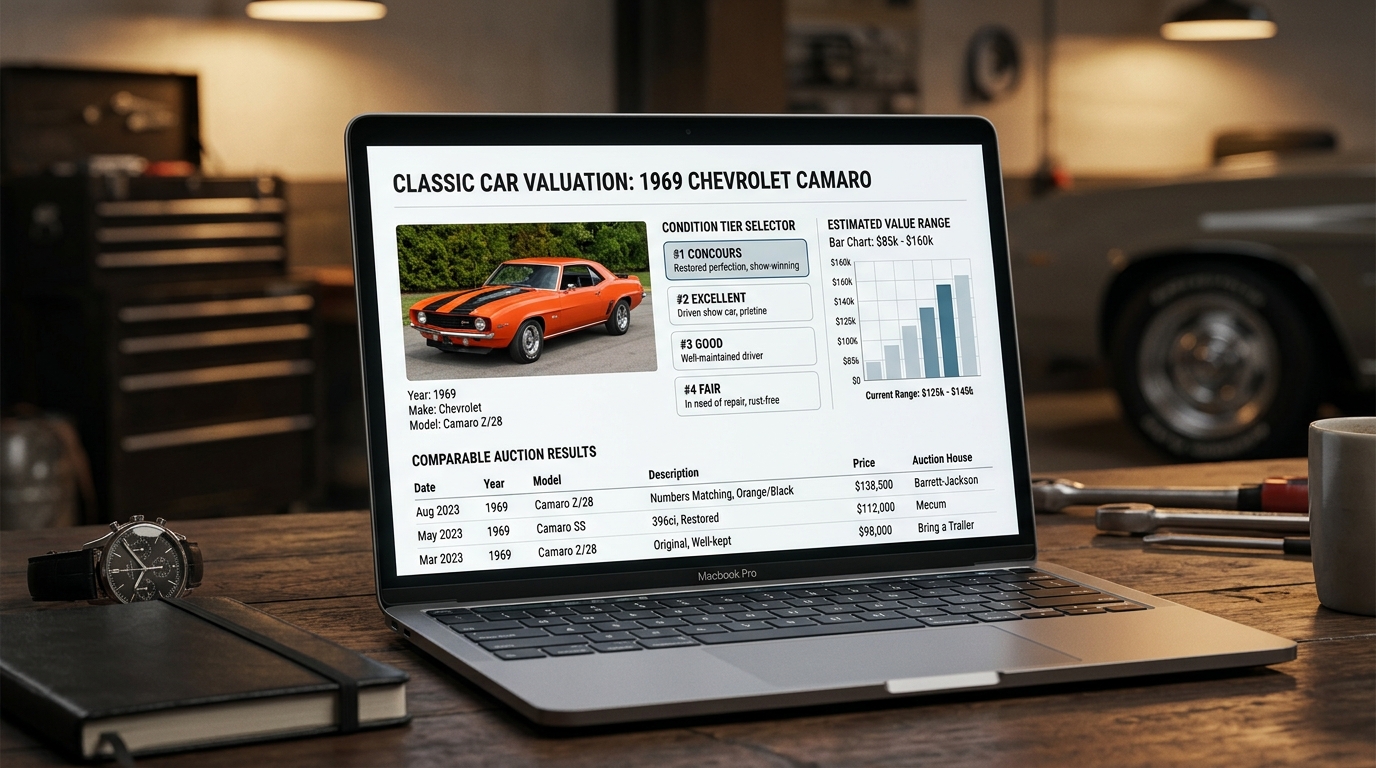
A classic car value calculator differs from a standard car value calculator in three key ways. First, it must handle pre-1981 VINs — KBB and Edmunds cannot, because their databases start at 1980 or 1990. Second, it must account for matching numbers, originality, and provenance — factors that are irrelevant for modern used cars but account for 30-50% of a classic's value. Third, it must use collector car comparables (auction results, Bring a Trailer sales, Hagerty data) rather than dealer transaction data, because classics do not trade through the same channels as modern used cars. The Hagerty Valuation Tool is the gold standard because it was built specifically for classics — it covers 40,000+ vehicles with 15+ years of auction and insurance data, and it provides values across four condition tiers (#1-#4) rather than a single number.
When Online Appraisal Is Not Enough: The $25,000 Threshold
Online car appraisal tools are excellent for initial research, ballpark estimates, and deciding whether to pursue a purchase. But they have a hard ceiling on reliability. For any transaction over $25,000, you need more than an online estimate. Here is when to upgrade from an online tool to a professional appraisal: (1) Vehicle value over $25,000 — the financial risk of a 15% error is $3,750+, which exceeds the cost of a professional appraisal. (2) Insurance agreed-value coverage — most insurers require a certified appraisal for vehicles valued over $50,000. (3) Estate or tax purposes — the IRS requires a qualified appraisal for vehicles over $50,000 in an estate. (4) Divorce or litigation — courts do not accept online valuations as evidence. (5) Matching-numbers verification — no online tool can verify engine block stampings; this requires physical inspection. (6) Pre-purchase inspection — for any classic car purchase, a $200-$400 PPI is worth 10-100x its cost in avoided mistakes.
How to Get the Most Accurate Online Valuation
- Use at least three tools — Cross-reference Hagerty, Bring a Trailer, and VeryWellAuto AI for classics. Use KBB, Edmunds, and AutoTrader for modern cars. Never rely on a single source.
- Be honest about condition — If you are not sure whether your car is #2 or #3, assume #3. Overestimating condition is the #1 source of valuation error.
- Input the correct engine and transmission — A 350/300hp is not a 350/350hp. Verify the engine code before entering it. The difference can be $15,000+.
- Check recent sold prices, not asking prices — Bring a Trailer sold listings show what cars actually sold for. Asking prices on eBay and Autotrader are wishes, not market data.
- Adjust for your region — Convertibles sell for more in warm climates. 4x4 trucks sell for more in mountain states. Rust-free cars from dry climates command 10-20% premiums.
- Factor in documentation — If you have the original window sticker, build sheet, and service records, add 10-25% to the online estimate. Most tools do not account for documentation.
- Get a physical inspection for high-value cars — No online tool can detect hidden rust, verify matching numbers, or assess mechanical condition. For cars over $25,000, a $300 PPI is insurance against a $5,000+ mistake.
Sources & References
- Hagerty Valuation Tool — Industry-standard classic car valuation tool. 40,000+ vehicles, 15+ years of data, 3 free lookups.
- Kelley Blue Book Car Values — Free car value calculator for modern used cars (1980-present). Dealer, private party, and trade-in values.
- Edmunds True Market Value — Free car appraisal tool showing what other consumers actually paid for the same vehicle.
- Bring a Trailer Sold Listings — Free database of classic car auction results with photos, descriptions, and community discussion.
- Classic Car Valuation Guide 2026 — Our comprehensive valuation guide — classification, condition grading, comparables, and 12 value factors.
- Car Appraisal by VIN Guide — How to value any vehicle by its VIN number, including pre-1981 classic car serial numbers.
- Vintage Car Appraisal Guide 2026 — Professional appraisal process, costs, and when you need one.