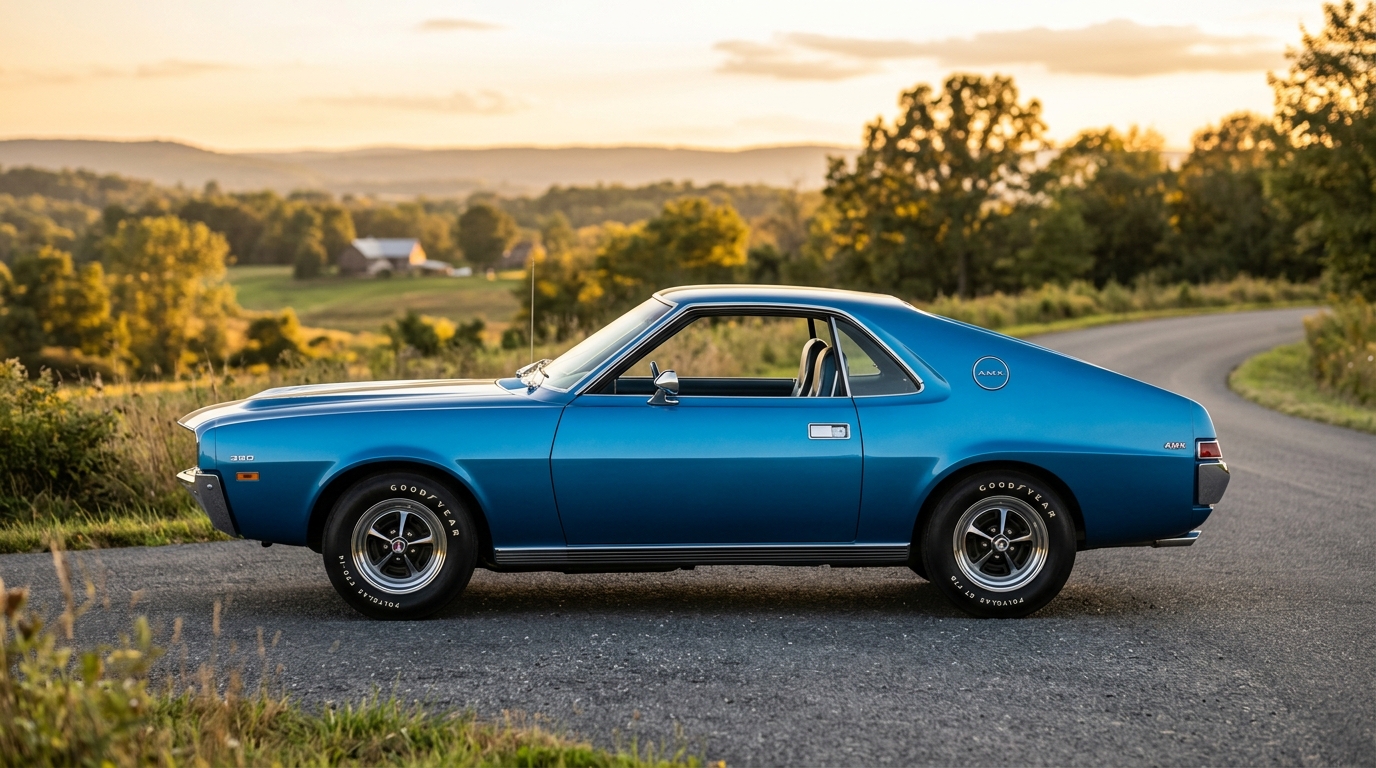
The AMC AMX (1968–1974) was American Motors Corporation's muscle car — a shortened 2-seat sports car (1968–1970) based on the Javelin, then a performance package on the Javelin (1971–1974). The 1969–1970 AMX with the 390ci V8 (315–340hp) is the most collectible, at $40,000–$65,000 (#2). The 1971–1972 Javelin AMX with the 401ci V8 (330–335hp) is the best value buy at $25,000–$40,000 (#2). The 1968–1970 2-seat AMX is the entry point at $30,000–$45,000 (#2). The 1970 "Big Bad" AMX (orange, blue, or green paint) is the most visually striking. The AMX was the only muscle car from an independent manufacturer — and it beat the Big Three on both price and handling.
The Independent Underdog
American Motors Corporation (AMC) was the only independent manufacturer to compete in the muscle car wars. The AMX (American Motors eXperimental) debuted in 1968 as a 2-seat sports car — the only American 2-seat muscle car, shorter than a Corvette by 1 inch. It was based on the Javelin but with 12 inches removed from the wheelbase, creating a unique 97-inch wheelbase 2-seater. In 1971, the 2-seat AMX was discontinued and the name became a performance package on the 4-seat Javelin. The AMX was always the underdog — less powerful than the Big Three but lighter, better handling, and significantly cheaper. Today, it's the most affordable entry into classic muscle car collecting.
| Generation | Years | Body | Key Engines | Collectibility |
|---|---|---|---|---|
| 1st Gen (2-seat) | 1968–1970 | 2-seat hardtop (97" WB); unique in American muscle | 232ci I6, 290ci V8 (225hp), 343ci V8 (280/290hp), 390ci V8 (315/340hp) | High — 2-seat AMX is unique; 390 Go Package is the one to have |
| 2nd Gen (Javelin) | 1971–1974 | 4-seat Javelin (110" WB); AMX is a performance package | 232ci I6, 304ci V8, 360ci V8 (245–290hp), 401ci V8 (330–335hp) | Medium — 1971–1972 401 is the most collectible; 1973–1974 less so |
The 1st-gen 2-seat AMX (1968–1970) is the most collectible — it's the only 2-seat American muscle car ever built. Only ~19,134 were built across 3 years. The 2nd-gen Javelin AMX (1971–1974) is more affordable but less unique. The 1971 redesign by Dick Teague featured a bold "pontoon" front end and was available in "Big Bad" colors (orange, blue, green).
Production Numbers
| Year | AMX Production | 390/401 Production (est.) | Notes |
|---|---|---|---|
| 1968 | ~6,725 | ~3,500 | Launch year; 2-seat; 290/343/390 available; Go Package introduced |
| 1969 | ~8,296 | ~4,500 | Peak 2-seat year; 390 (340hp) with Go Package; Big Bad colors available |
| 1970 | ~4,113 | ~2,200 | Final 2-seat year; lowest production; 390 continues; most collectible 2-seat |
| 1971 | ~5,074 | ~2,000 | AMX becomes Javelin package; 401ci introduced (330hp); new styling |
| 1972 | ~3,161 | ~1,200 | 401ci (335hp); last year for high-compression 401; rare |
| 1973 | ~4,980 | ~1,500 | 401 detuned; safety bumpers; less collectible |
| 1974 | ~2,901 | ~800 | Final year; very low production; 401 still available; end of era |
Production data from American Motors Corporation. The 1969 2-seat AMX is the peak (~8,296 built). The 1970 2-seat is the rarest and most collectible (~4,113). Total 2-seat AMX production: ~19,134 (3 years). The 1972 Javelin AMX 401 is very rare (~1,200 with 401). The 1974 final year is rare (~2,901). The 390ci V8 was the top engine in the 2-seat AMX; the 401ci replaced it in the Javelin AMX.
Engine Specifications
| Engine | Displacement | Years | HP | Torque | Notes |
|---|---|---|---|---|---|
| 232ci I6 | 232ci | 1968–1974 | 145 | 215 | Base I6; reliable; no performance appeal |
| 290ci V8 | 290ci | 1968–1970 | 225 | 300 | Base V8 2-seat; reliable; entry-level collectibility |
| 304ci V8 | 304ci | 1971–1974 | 210–235 | 300–320 | Base V8 Javelin AMX; replaced 290; no performance appeal |
| 343ci V8 | 343ci | 1968 | 280–290 | 365–390 | Mid-range 2-seat; 4-barrel; one year only; rare |
| 360ci V8 | 360ci | 1971–1974 | 245–290 | 365–395 | Mid-range Javelin AMX; 4-barrel; good value |
| 390ci V8 | 390ci | 1968–1970 | 315–340 | 425–430 | Top engine 2-seat; Go Package; most collectible AMX engine |
| 401ci V8 | 401ci | 1971–1974 | 330–335 | 430–445 | Top engine Javelin AMX; replaced 390; AMC's biggest V8 |
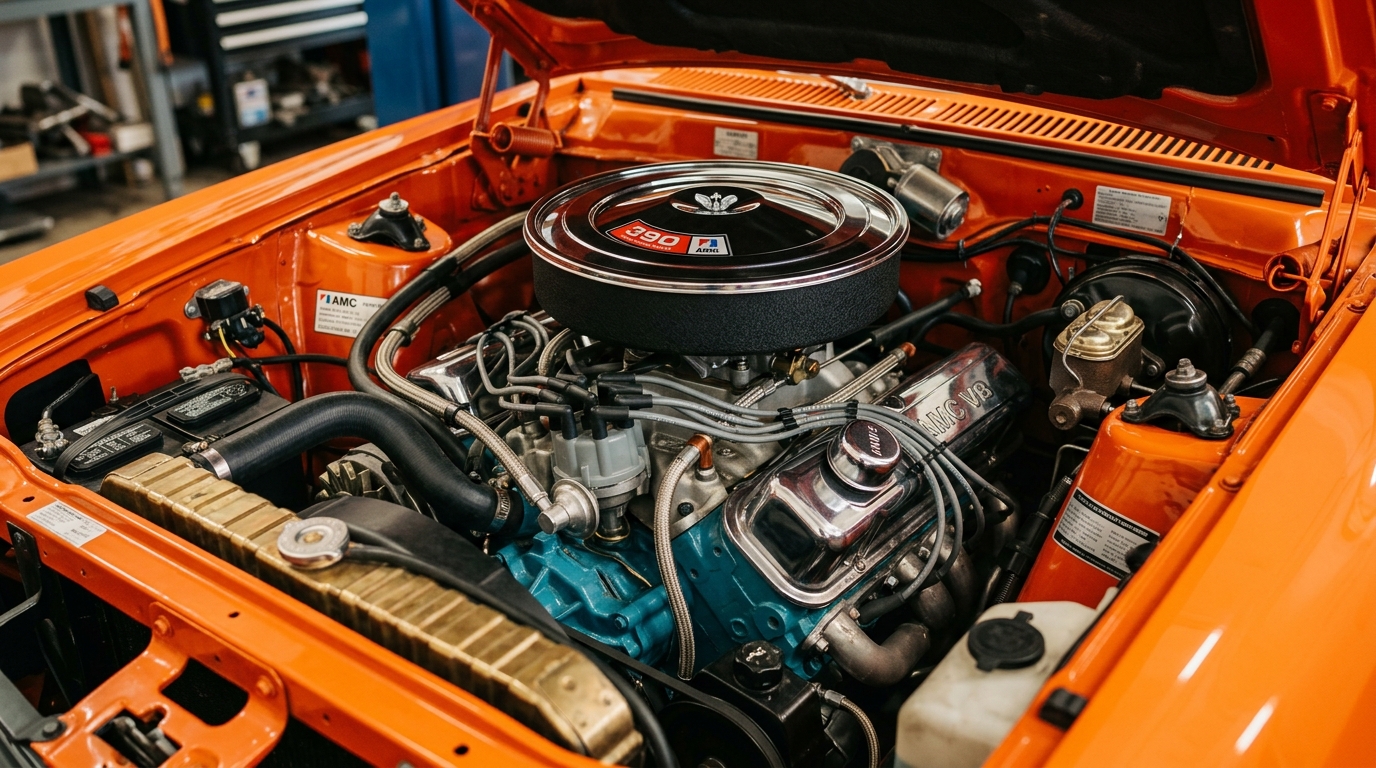
The 390ci V8 (340hp, 430 lb-ft) is the king of 2-seat AMX engines — available with the Go Package (4-speed, 3.54 gears, handling kit). The 401ci V8 (335hp, 445 lb-ft) is the top Javelin AMX engine — AMC's largest V8 ever. Both engines are AMC-designed and built, not sourced from the Big Three. The 390 and 401 are torque-heavy engines that perform well despite lower horsepower ratings than Big Three equivalents.
Go Package, Big Bad Colors, and Trans-Am Racing
The Go Package was the AMX's performance option: 390ci V8 (340hp), 4-speed manual (Borg-Warner T-10), 3.54:1 Twin-Grip rear axle, E70x14 red-stripe tires, front disc brakes, heavy-duty suspension, and dual exhaust. The Go Package transformed the AMX from a sporty car into a genuine muscle car — 0-60 in 6.5 seconds, quarter mile in 14.3 seconds at 97 mph. About 70% of 2-seat AMXs were ordered with the Go Package.
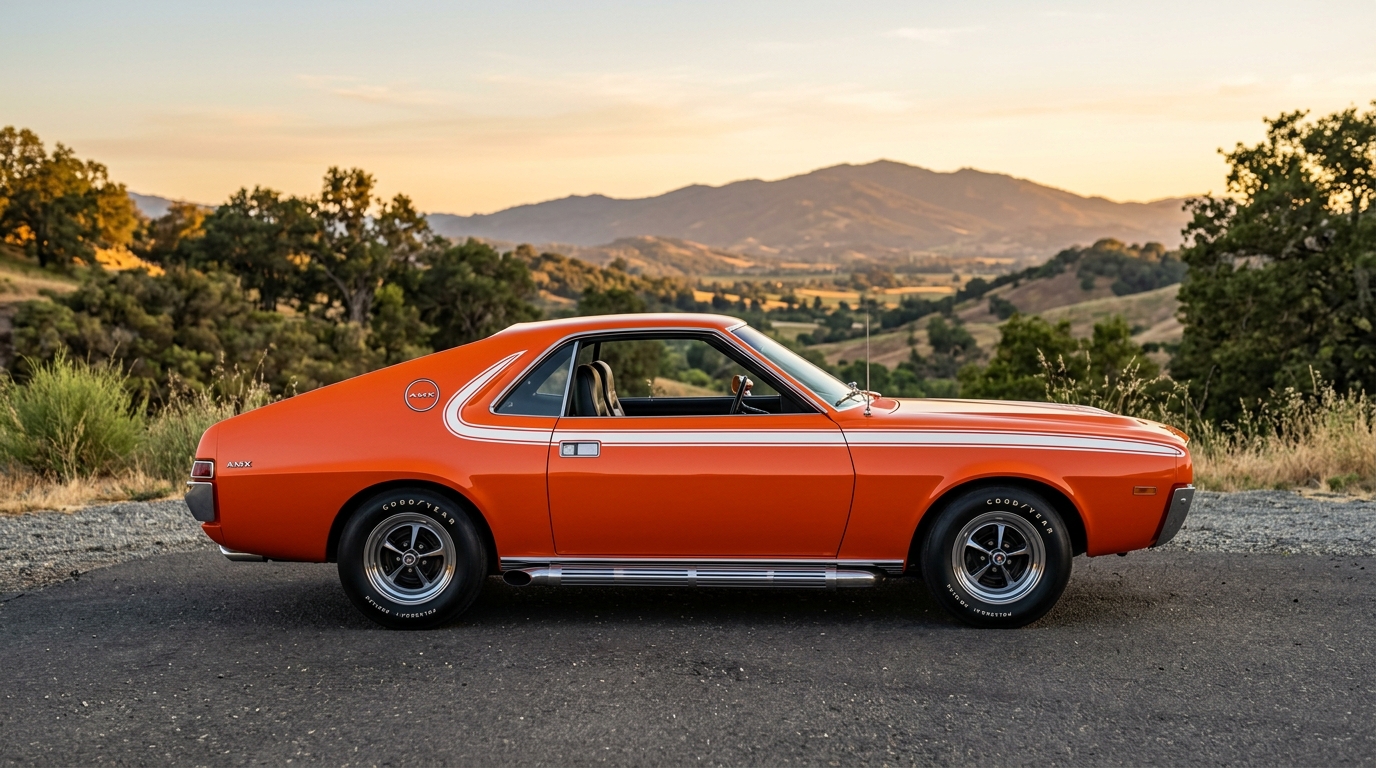
The "Big Bad" colors were AMC's answer to the muscle car paint wars: Big Bad Orange, Big Bad Blue, and Big Bad Green. These were full-body paint colors (not stripes) with matching painted bumpers. The Big Bad AMXs are the most visually striking and most sought-after by collectors. Approximately 15–20% of 1969–1970 AMXs were ordered in Big Bad colors.
AMC competed in the SCCA Trans-Am series from 1968–1970, finishing 3rd in 1968, 4th in 1969, and a strong 2nd in 1970 behind only Mark Donohue's Camaro. The racing program was run by Roger Penske with drivers including Peter Revson and George Follmer. The Trans-Am racing heritage adds to the AMX's collector appeal — it was the only independent manufacturer to compete against the Big Three in Trans-Am.
Market Values by Condition (2026)
| Variant | #1 Concours | #2 Excellent | #3 Good | #4 Fair | 5-Year Trend |
|---|---|---|---|---|---|
| 1970 AMX 390 Go Package (Big Bad) | $90,000 | $60,000 | $35,000 | $15,000 | +35% |
| 1969 AMX 390 Go Package (Big Bad) | $85,000 | $55,000 | $32,000 | $13,500 | +32% |
| 1968–1970 AMX 390 Go Package | $75,000 | $50,000 | $28,000 | $12,000 | +28% |
| 1968–1970 AMX 343 | $55,000 | $38,000 | $20,000 | $8,500 | +22% |
| 1968–1970 AMX 290 | $45,000 | $30,000 | $16,000 | $6,500 | +18% |
| 1971–1972 Javelin AMX 401 | $55,000 | $38,000 | $20,000 | $8,500 | +25% |
| 1971–1972 Javelin AMX 360 | $40,000 | $27,000 | $14,000 | $5,500 | +18% |
| 1973–1974 Javelin AMX 401 | $45,000 | $30,000 | $16,000 | $6,500 | +20% |
| 1971–1972 Javelin AMX 401 (Big Bad) | $65,000 | $45,000 | $25,000 | $10,500 | +28% |
| 1968–1970 AMX 390 Convertible | N/A (no convertible) | N/A | N/A | N/A | N/A |
Values from Mecum, Barrett-Jackson, and Bring a Trailer sold data (2024–2026). The 1970 Big Bad AMX 390 Go Package is the most collectible — rare color + final 2-seat year + top engine. The 2-seat AMX is worth 50–80% more than the equivalent Javelin AMX. The 401 Javelin AMX is the best value muscle car on the platform — 335hp for $38,000 (#2), cheaper than any Big Three equivalent. Note: AMC never built an AMX convertible — the 2-seat body was hardtop only.
Value Trend Chart (2020–2026)
AMC AMX Average Values (#2 Condition)
| 2020 | 2021 | 2022 | 2023 | 2024 | 2025 | 2026 | |
|---|---|---|---|---|---|---|---|
| 1970 AMX 390 Big Bad (#2) | 42000 | 48000 | 53000 | 56000 | 58000 | 60000 | 60000 |
| 1968–70 AMX 390 Go Pkg (#2) | 36000 | 42000 | 46000 | 48000 | 49000 | 50000 | 50000 |
| 1971–72 Javelin AMX 401 (#2) | 26000 | 31000 | 34000 | 36000 | 37000 | 38000 | 38000 |
AMX vs Camaro vs Firebird: The Pony Car Underdog
| Factor | AMC AMX 390 | Camaro SS 350 | Firebird 400 |
|---|---|---|---|
| Platform | AMC (97" WB 2-seat) | GM F-body (108" WB) | GM F-body (108" WB) |
| Top Engine | 390ci (340hp) | 350ci (295hp) | 400ci (330hp) |
| Torque | 430 lb-ft | 380 lb-ft | 430 lb-ft |
| 0-60 mph | ~6.5 sec | ~6.8 sec | ~6.7 sec |
| Quarter Mile | 14.3 @ 97 mph | 14.8 @ 95 mph | 14.5 @ 96 mph |
| Weight | ~3,100 lbs | ~3,300 lbs | ~3,400 lbs |
| Price when new | ~$3,300 | ~$3,500 | ~$3,700 |
| Value (#2, top) | $50,000–$60,000 | $45,000–$65,000 | $45,000–$70,000 |
| Unique feature | Only 2-seat muscle car | Most popular pony car | Pontiac's only pony car |
The AMX 390 is lighter than both the Camaro and Firebird, and it matches or beats them in acceleration despite being from an "independent" manufacturer. The AMX was cheaper when new and is still cheaper today — making it the best value pony car for collectors. The 2-seat configuration is unique in American muscle car history. The AMX handles better than the F-bodies due to its shorter wheelbase and lower weight.
Key Option Codes
AMC AMX Option Codes
| Code | Name / Description |
|---|---|
Go Package | Performance Package 390ci V8, 4-speed, 3.54 Twin-Grip, disc brakes, HD suspension, red-stripe tires; 1968–1970 |
X Package | Luxury Package Woodgrain trim, bucket seats, center console, AM/FM; 1968–1970; less common than Go Package |
Big Bad Orange | Paint Code B5 Full-body orange with painted bumpers; 1969–1970; ~5% of production; most striking AMX color |
Big Bad Blue | Paint Code B6 Full-body blue with painted bumpers; 1969–1970; ~7% of production; very collectible |
Big Bad Green | Paint Code B7 Full-body green with painted bumpers; 1969–1970; ~4% of production; rarest Big Bad color |
390ci V8 | AMC 390 V8 340hp, 430 lb-ft; top engine 2-seat AMX; Go Package; 1968–1970; most collectible |
401ci V8 | AMC 401 V8 330–335hp, 445 lb-ft; top engine Javelin AMX; 1971–1974; AMC's biggest V8 |
T-10 | 4-Speed Manual (Borg-Warner) Close-ratio; standard with Go Package; preferred over automatic |
Shift-Command | 3-Speed Automatic (Borg-Warner) AMC's automatic; strong; common on non-Go Package cars |
Twin-Grip | Limited-Slip Differential AMC's limited-slip; 3.54:1 ratio with Go Package; essential for performance |
E70x14 | Red-Stripe Tires Performance tires; included with Go Package; correct reproductions available |
Front Disc | Power Disc Brakes Standard with Go Package; optional on others; essential for safety |
Buying Guide
- Best investment: 1970 AMX 390 Go Package (Big Bad color)
- Final 2-seat year + top engine + rarest colors; $60,000 (#2)
- Only ~4,113 2-seat AMXs built in 1970; Big Bad is ~15–20%
- Verify Go Package: 390 engine code, 4-speed, 3.54 Twin-Grip, disc brakes
- Best 2-seat value: 1968–1970 AMX 390 Go Package (standard color)
- 340hp 390ci; 2-seat uniqueness; $50,000 (#2)
- Same performance as Big Bad without the color premium
- 70% of 2-seat AMXs had Go Package — easier to find
- Best overall value: 1971–1972 Javelin AMX 401
- 335hp 401ci; AMC's biggest V8; $38,000 (#2)
- Cheapest entry to 335hp muscle car ownership
- Less unique than 2-seat but much more affordable
- Best entry point: 1968–1970 AMX 290
- 225hp 290ci; 2-seat body; $30,000 (#2)
- Most affordable 2-seat AMX; still has the unique body
- Can upgrade to 390 later, but numbers-matching is worth more
- Best Javelin AMX: 1971–1972 Javelin AMX 401 (Big Bad)
- 335hp 401ci; Big Bad color; $45,000 (#2)
- Rarest Javelin AMX configuration; visually striking
- Verify 401 engine code and Big Bad paint code
- Best driver: 1971–1972 Javelin AMX 360
- 245–290hp 360ci; $27,000 (#2); great driver-quality car
- Good power without 401 price premium
- Reliable AMC V8; parts available from AMC specialists
- Best 343: 1968 AMX 343
- 280–290hp 343ci; one-year-only engine; $38,000 (#2)
- Rare mid-range engine; good value
- Less powerful than 390 but rarer
- Avoid: 1973–1974 Javelin AMX with 232ci I6 or 304ci 2-barrel
- 145–235hp; no performance appeal; not collectible
- Only buy as a cheap project or parts car
- Better to buy a 1968 AMX 290 than a 1973+ 304
Frequently Asked Questions
- What is the AMC AMX?
- The AMX (American Motors eXperimental) was AMC's muscle car. From 1968–1970, it was a unique 2-seat sports car based on the Javelin platform with 12 inches removed from the wheelbase. From 1971–1974, the AMX name became a performance package on the 4-seat Javelin. The 2-seat AMX is the only 2-seat American muscle car ever built — shorter than a Corvette by 1 inch.
- Is the AMX the same as the Javelin?
- No. The Javelin was AMC's 4-seat pony car (1968–1974). The 2-seat AMX (1968–1970) was based on the Javelin but shortened by 12 inches in wheelbase (97" vs 110") and had a 2-seat interior. From 1971 on, the AMX became a performance package on the Javelin rather than a separate body. All 2-seat AMXs (1968–1970) are Javelin-based, but not all Javelins are AMXs.
- What are the Big Bad colors?
- Big Bad Orange, Big Bad Blue, and Big Bad Green were special full-body paint colors available on the 1969–1970 AMX (and some Javelins). They featured painted bumpers matching the body color. Approximately 15–20% of 2-seat AMXs were ordered in Big Bad colors. Big Bad Orange is the most popular among collectors today, followed by Big Bad Blue and Big Bad Green (rarest).
- Did AMC really compete against the Big Three?
- Yes. AMC was the only independent manufacturer to compete in the muscle car wars and the SCCA Trans-Am series. The AMC racing team was run by Roger Penske (1968–1970) with drivers including Peter Revson and George Follmer. AMC finished 2nd in the 1970 Trans-Am championship behind only Mark Donohue's Camaro. The AMX also set 106 world speed records at the Bonneville Salt Flats in 1968.
- Why is the AMX cheaper than the Camaro and Firebird?
- Brand recognition — AMC is less well-known than Chevrolet, Ford, or Pontiac. The AMX was always the underdog, marketed as a value alternative to the Big Three. Today, the AMX 390 is 20–30% cheaper than an equivalent Camaro SS 350 or Firebird 400, despite being lighter, faster, and more unique (2-seat configuration). This makes the AMX the best value pony car for knowledgeable collectors.
Get an AI-powered valuation for your AMC AMX or Javelin — free, instant, based on real auction data.
Value My AMXSources & References
- Hagerty Price Guide — Valuation Tools — Independent valuation data by condition grade #1-#4
- Bring a Trailer — Auction Results — Real-world auction sale prices for market comparison
- Related: First Gen Camaro 1967 1969 Hub — In-depth related guide from our editorial library
- Related: Dodge Challenger Generation Hub 1970 1974 — In-depth related guide from our editorial library
- Related: Plymouth Barracuda Generation Hub 1964 1974 — In-depth related guide from our editorial library