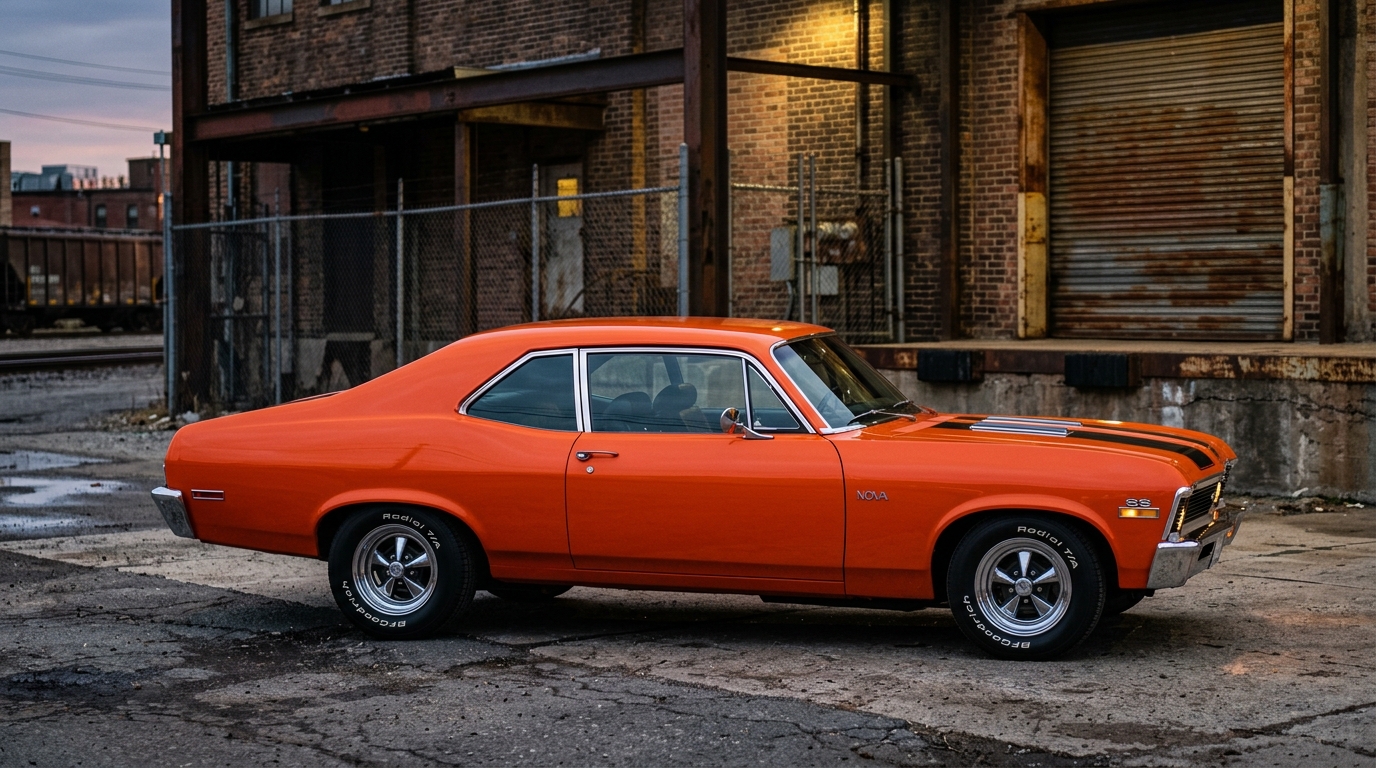
Production Overview: 1962–1979
The Chevrolet Chevy II was introduced in 1962 as Chevrolet's answer to the Ford Falcon and Plymouth Valiant — a compact, affordable, no-nonsense car. The name changed to Nova in 1969 (though Nova trim had been available since 1963). Over four generations, the Nova evolved from a basic economy car into a legitimate muscle car platform, peaking with the SS 396 L78 in 1968-1971. The Nova's lightweight body (under 3,000 lbs) made it a formidable drag racer, and it remains one of the most popular budget muscle car platforms today.
Generation Breakdown
| Generation | Years | Key Changes | Body Styles | Collector Appeal |
|---|---|---|---|---|
| 1st Gen (Chevy II) | 1962–1965 | Original compact design, 153ci I4 and 194ci I6 base, 283ci V8 optional from 1964 | 2-door sedan, 4-door sedan, 2-door hardtop, convertible, station wagon | Low — economy car roots, but 283 V8 models are rising |
| 2nd Gen (Chevy II) | 1966–1967 | Restyled with fastback roofline, 327ci V8 option, Nova SS package introduced | 2-door sedan, 2-door hardtop, 4-door sedan, convertible, wagon | Moderate — 327 V8 and SS models are collectible |
| 3rd Gen (Nova) | 1968–1974 | Complete redesign, semi-fastback styling, 396ci big-block (L78), 350ci V8, 302ci V8 (Z/28 transplant) | 2-door coupe, 2-door sedan, 4-door sedan, 3-door hatchback (1973+) | Highest — SS 396 and 350 models are premium collectibles |
| 4th Gen (Nova) | 1975–1979 | Larger, heavier, emissions-compliant, Nova Concours luxury trim, 350ci V8 detuned | 2-door coupe, 3-door hatchback, 4-door sedan, 5-door wagon | Budget entry — cheapest way into a classic Nova |
The 1968-1974 third generation is the most collectible — it's when the Nova became a true muscle car with the 396ci big-block. The 1975-1979 fourth generation is the budget entry point, with 350 V8 models available for under $18,000 in #2 condition.
Engine Specifications
| Engine | Displacement | Years | HP / Torque | Carb | Rarity |
|---|---|---|---|---|---|
| Blue Flame I4 | 153ci (2.5L) I4 | 1962–1964 | 90 hp / 102 lb-ft | 1-barrel Rochester | Rare — base engine, few survive |
| Hi-Thrift I6 | 194ci (3.2L) I6 | 1962–1967 | 120 hp / 177 lb-ft | 1-barrel Rochester | Common — base six |
| Turbo-Thrift I6 | 230ci (3.8L) I6 | 1963–1967 | 140-155 hp / 205-215 lb-ft | 1-barrel Rochester | Common — upgraded six |
| Turbo-Thrift I6 | 250ci (4.1L) I6 | 1968–1979 | 105-155 hp / 185-235 lb-ft | 1-barrel Rochester | Common — base six (3rd/4th gen) |
| Turbo-Fire V8 | 283ci (4.6L) V8 | 1964–1967 | 195-220 hp / 285-300 lb-ft | 2-barrel or 4-barrel | Moderate — first V8 option |
| Turbo-Fire V8 | 327ci (5.4L) V8 | 1966–1969 | 250-350 hp / 350-360 lb-ft | 4-barrel Quadrajet | Moderate — 350hp L79 is collectible |
| DZ 302 V8 | 302ci (4.9L) V8 | 1968–1969 | 290 hp / 290 lb-ft | 4-barrel Quadrajet | Very Rare — Trans Am racing engine, rarely in Nova |
| Turbo-Jet V8 (L78) | 396ci (6.5L) V8 | 1968–1971 | 375 hp / 410 lb-ft | 4-barrel Quadrajet | Rare — most desirable Nova engine |
| Turbo-Fire V8 (L48) | 350ci (5.7L) V8 | 1968–1979 | 195-300 hp / 280-380 lb-ft | 2-barrel or 4-barrel | Common — most popular V8 |
The L78 396ci (375 hp) is the holy grail of Nova engines — only available in the SS 396 package from 1968-1971. The L79 327ci (350 hp) is the second most desirable, available in 1966-1968. The 350ci V8 is the most common V8 and the best all-around choice for a driver-quality Nova.
Trim Levels & SS Package
| Trim | Years | Key Features | Engine Options | Current #2 Value |
|---|---|---|---|---|
| Chevy II 100 | 1962–1968 | Base trim, rubber floor mat, bench seat, minimal chrome | 153ci I4, 194ci I6, 230ci I6, 250ci I6 | $10,000–$18,000 |
| Chevy II 300 | 1962–1968 | Mid trim, carpet, vinyl bench, chrome trim | 194ci I6, 230ci I6, 283ci V8 | $12,000–$20,000 |
| Nova 400 | 1962–1968 | Top trim, full carpet, deluxe interior, chrome bumpers | 230ci I6, 283ci V8, 327ci V8 | $15,000–$25,000 |
| Nova SS | 1963–1967 | Sport package, bucket seats, console, SS badging, 283/327 V8 | 283ci V8, 327ci V8 (L79) | $25,000–$45,000 |
| Nova SS 396 | 1968–1971 | Big-block muscle car, 396ci V8, heavy-duty suspension, SS badges | 396ci V8 (L78 375hp, L35 325hp) | $55,000–$95,000 |
| Nova SS 350 | 1968–1974 | Small-block SS, 350ci V8, sport suspension, SS badging | 350ci V8 (L48 295-300hp) | $30,000–$50,000 |
| Nova Concours | 1975–1979 | Luxury trim, velour interior, woodgrain, power options | 250ci I6, 305ci V8, 350ci V8 | $10,000–$18,000 |
| Nova LN (Luxury Nova) | 1975–1979 | Luxury coupe, plush interior, rally wheels, two-tone paint | 250ci I6, 305ci V8, 350ci V8 | $8,000–$16,000 |
The SS 396 (1968-1971) is the most valuable Nova trim — the L78 375hp version is the peak. The SS 350 is the sweet spot for collectors who want muscle car performance at a lower price point. The 1975-1979 Concours and LN are the budget entry into Nova ownership.
VIN Decoding (1968-1979)
Nova VIN Decoder (1968-1979, 13-digit)
| Code | Name / Description |
|---|---|
Position 1-2 (Series) | 11=100 6-cyl, 14=100 V8, 15=Nova 6-cyl, 17=Nova V8, 27=SS 350, 29=SS 396 The first two digits identify the series and engine type |
Position 3 (Body Style) | 1=2-door sedan, 2=2-door coupe, 3=3-door hatchback, 4=4-door sedan, 5=4-door wagon, 6=2-door wagon Third digit identifies the body style |
Position 4 (Engine) | 0=6-cyl, 1=302 V8, 3=307 V8, 4=327 V8, 5=350 V8, 6=396 V8, 8=350 V8 (later) Fourth digit identifies the engine — critical for SS verification |
Position 5 (Model Year) | 8=1968, 9=1969, 0=1970, 1=1971, 2=1972, etc. Fifth digit is the model year code |
Position 6 (Assembly Plant) | A=Atlanta, F=Flint, J=Janesville, K=Leeds, L=Los Angeles, N=Norwood, T=Tarrytown, W=Willow Run Sixth digit identifies the assembly plant |
Position 7-13 (Sequence) | 1000001-9999999 Last 7 digits are the production sequence number |
Many base Novas have been cloned into SS 396 models. To verify an authentic SS 396: (1) Check the VIN 4th digit for engine code "6" (396), (2) Check the trim tag for SS option code, (3) Verify the engine block casting number (3902406 or 3902407 for 396), (4) Check for 12-bolt rear end (SS 396 only — base cars got 10-bolt). A cloned SS 396 is worth $20,000-$30,000 less than an authentic one.
Market Values & Appreciation Forecast
| Model | Condition #1 | Condition #2 | Condition #3 | 5-Year Forecast | Liquidity |
|---|---|---|---|---|---|
| SS 396 L78 (1968-71) | $95,000–$140,000 | $55,000–$95,000 | $30,000–$50,000 | +12-18% per year | High — 30-60 days at auction |
| SS 350 (1968-74) | $50,000–$75,000 | $30,000–$50,000 | $15,000–$25,000 | +8-12% per year | High — 30-60 days |
| Nova SS 327 (1966-68) | $40,000–$60,000 | $25,000–$40,000 | $12,000–$22,000 | +8-12% per year | Medium — 60-90 days |
| Nova 350 V8 (1968-74) | $30,000–$45,000 | $18,000–$30,000 | $8,000–$15,000 | +6-10% per year | High — 30-60 days |
| Nova 250 I6 (1968-74) | $22,000–$35,000 | $12,000–$22,000 | $5,000–$10,000 | +5-8% per year | Medium — 60-90 days |
| Nova Concours/LN (1975-79) | $15,000–$25,000 | $8,000–$18,000 | $3,500–$7,000 | +5-8% per year | Medium — 60-120 days |
| Chevy II 100/300 (1962-67) | $18,000–$28,000 | $10,000–$18,000 | $4,000–$8,000 | +6-10% per year | Low — 90-180 days |
Values based on 2024-2026 auction data from Mecum, Barrett-Jackson, and Bring a Trailer. The SS 396 L78 is the premium Nova at $55,000-$95,000 in #2 condition. The SS 350 is the value play — muscle car performance at half the price. The 1975-1979 fourth generation is the cheapest entry point at $8,000-$18,000.
Buying Guide: What to Look For
- Verify the SS package
- SS 396: VIN 4th digit must be "6", 12-bolt rear end, front disc brakes standard
- SS 350: VIN should show series 27, 12-bolt or 10-bolt rear depending on year
- Check the trim tag (cowl tag) for SS option codes — this is the definitive proof
- Many 6-cylinder Novas have been converted to SS clones — authentication is critical
- Inspect the frame and floors
- Nova floors rust in the front footwell area — check for patch panels
- The frame rails rust from the inside out — check the rear frame near the spring hangers
- Convertible models (1962-1967) need special frame inspection — check for sagging
- Hatchback models (1973+) check the hatch floor for rust around the spare tire well
- Engine verification
- 396 L78: Block casting 3902406 or 3902407, suffix code on pad should include "L78"
- 327 L79: Block casting 3902406 or 3892657, suffix code should include "L79"
- 350 L48: Block casting 3970010 or 3970014, very common and easy to find
- Matching numbers adds 20-40% to value — always check the engine pad stamping
- Aftermarket parts availability
- Nova has the largest aftermarket of any compact Chevy — nearly every part is reproduced
- Year One, Classic Industries, and OER carry complete Nova catalogs
- Interior kits: $800-$1,800 (seats, door panels, headliner, carpet)
- Sheet metal: Full floor pans $300-$500, quarter panels $400-$700 each
Frequently Asked Questions
- What is the most valuable Chevy Nova?
- The 1968-1971 Nova SS 396 with the L78 engine (375 hp) is the most valuable, with #2 condition examples selling for $55,000-$95,000. The L78 was the top engine option — only a few thousand were built. Authentic, matching-numbers L78 cars are the peak of Nova collecting.
- Is a Chevy Nova a good first classic car?
- Yes — the Nova is one of the best first classic cars. The 1975-1979 fourth generation is affordable ($8,000-$18,000 in #2 condition), the 350 V8 is reliable and easy to work on, and the aftermarket parts support is the best in the hobby. Insurance is affordable and the Nova is small enough to garage easily.
- How can I tell if a Nova SS 396 is real?
- Check the VIN 4th digit for "6" (396 engine), verify the trim tag has SS option codes, check for a 12-bolt rear end (base cars got 10-bolt), and verify the engine block casting number (3902406 or 3902407). The engine pad suffix code should include "L78" for the 375hp version. Many base Novas have been cloned — authentication is critical.
- What's the difference between Chevy II and Nova?
- Chevy II was the original model name from 1962-1968. "Nova" was originally a trim level (the top trim) starting in 1963. In 1969, Chevrolet dropped the "Chevy II" name and called all models "Nova." So a 1962-1968 car is a "Chevy II" (with Nova as a trim option), while a 1969-1979 car is simply a "Nova."
- How much does it cost to restore a Chevy Nova?
- A driver-quality restoration costs $15,000-$30,000. A show-quality restoration costs $40,000-$80,000. The Nova is one of the cheapest muscle cars to restore because of the massive aftermarket parts support. A full interior kit is $800-$1,800, sheet metal parts are readily available, and the 350 V8 is the cheapest engine to rebuild ($2,500-$5,000).
Get an instant AI-powered valuation for your Chevy Nova — including SS package verification and engine matching.
Value My CarSources & References
- Hagerty Price Guide — Chevy Nova Values — Independent valuation data for all Nova generations by condition grade #1-#4
- Bring a Trailer — Nova Auction Results — Real-world auction sale prices for SS 396, SS 350, and base Nova models
- Pre-1981 VIN Decoder — Interactive decoder for 13-digit pre-1981 Chevrolet VINs including Nova
- GM Cowl Tag Decoder — Interactive decoder for GM Fisher Body cowl tags including Nova trim and paint codes
- Best Classic Cars Under $20K (2026) — Budget classic car guide including 1975-1979 Nova models
- Classic Car Engine Rebuild Cost Guide — Complete cost breakdown for rebuilding Nova 350 and 396 engines