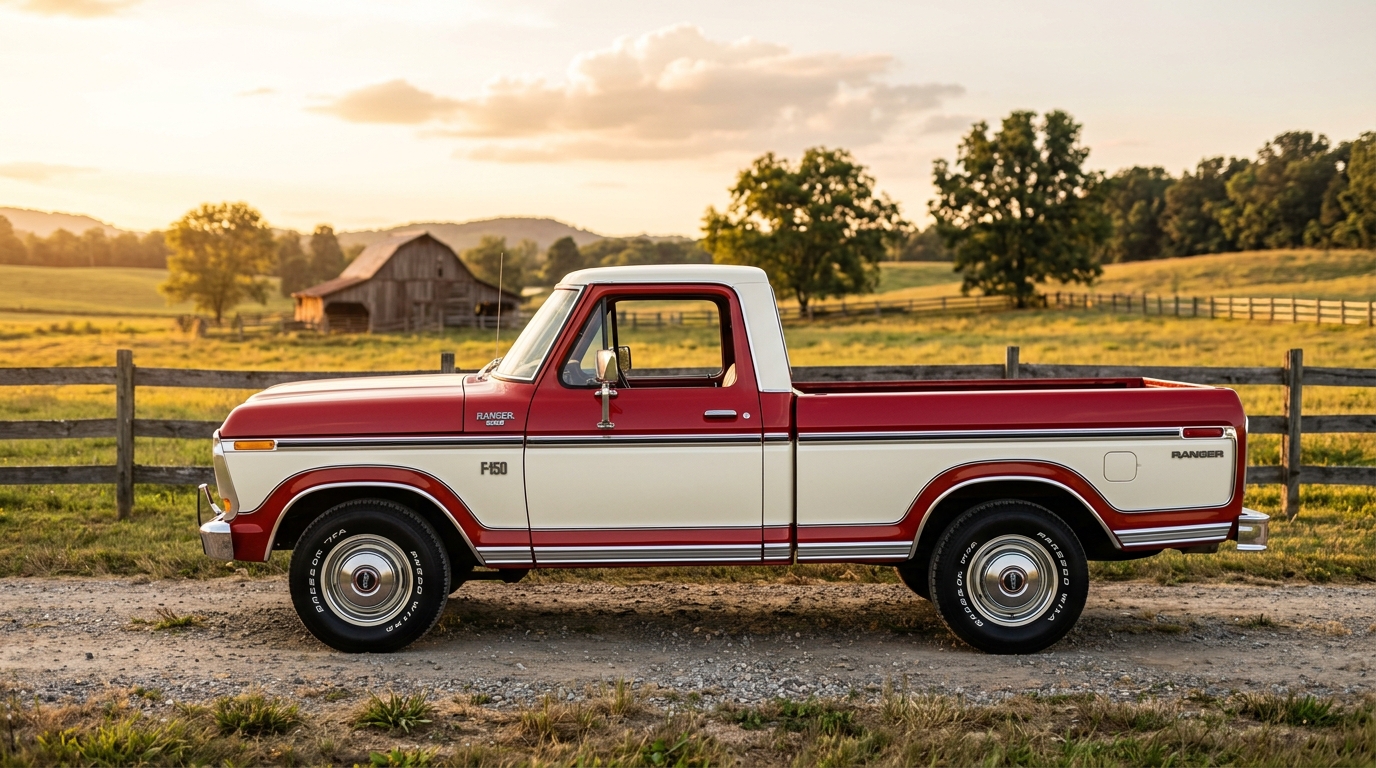
The Ford F-100 Bumpside (1967–1972) and Dentside (1973–1979) were produced on the fifth-generation F-series platform. The Bumpside gets its name from the protruding center body line; the Dentside from the concave body panel. The most collectible variants are the 1976–1979 F-150 with the 460ci V8 and the Ranger XLT trim. Short-bed Styleside examples in #2 condition currently average $35,000–$55,000, with 460-powered Ranger XLTs exceeding $70,000. The F-100 Ranger trim (1970–1979) is the best value buy — 80% of the desirability at 60% of the price.
Bumpside vs Dentside: What's the Difference?
The 1967–1979 Ford F-100 is often treated as one generation, but there are two distinct styling eras with different collector appeal:
| Feature | Bumpside (1967–1972) | Dentside (1973–1979) |
|---|---|---|
| Body Side | Convex "bump" center body line | Concave "dent" body panel |
| Grille | Horizontal bars, simpler design | Larger, more integrated with headlights |
| Cab Style | Slightly smaller, more rounded | Larger cab, more squared-off |
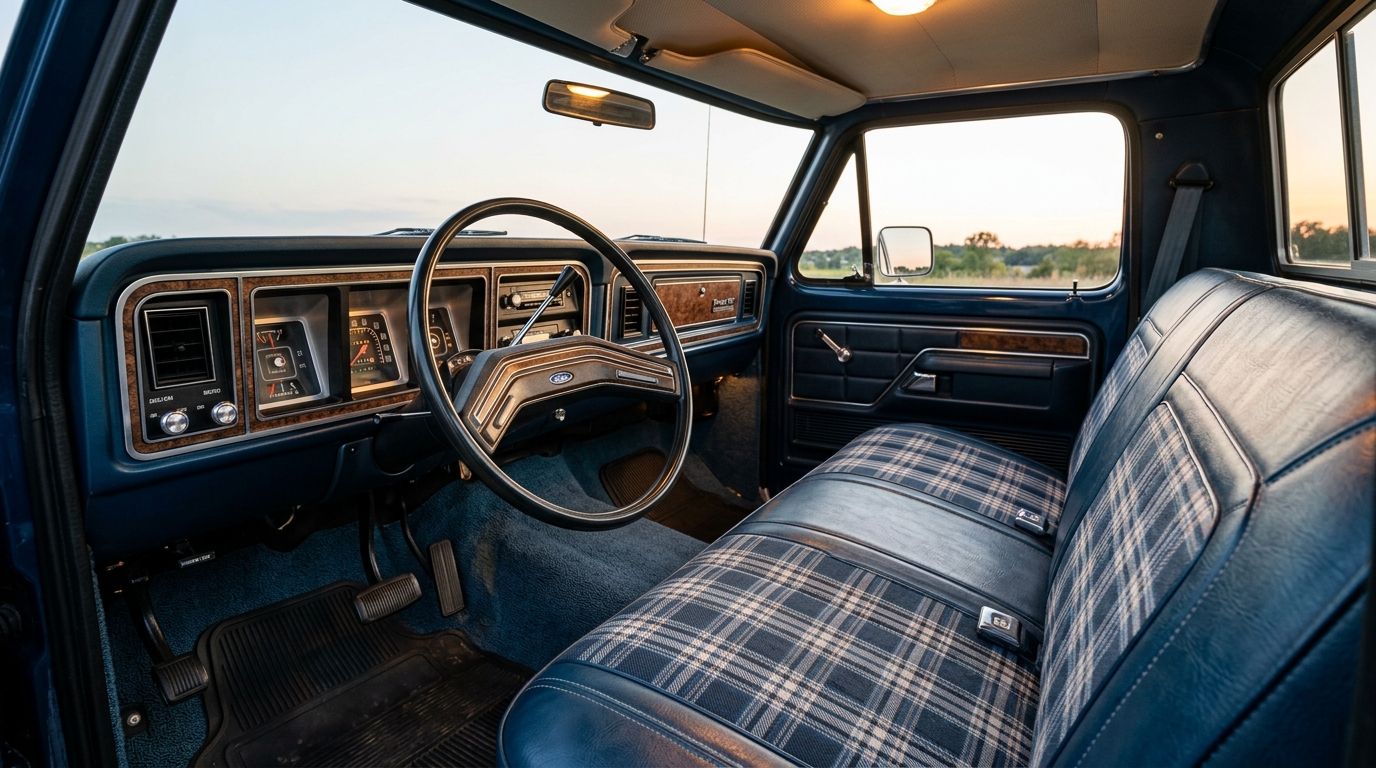
| Interior | Basic, metal dash | Improved interior, padded dash (1973+) |
| Suspension | Leaf spring front | Coil spring front (1973+, F-100 4WD still leaf) |
| Brakes | Drum standard | Front disc optional (1973+), standard on F-150 |
| Collectibility | Rising — 1967–1972 gaining attention | Higher — 1976–1979 F-150 is the peak |
The 1973 model year was a major redesign, not just a facelift. The Dentside has a larger cab, improved suspension, and better brakes. Most collectors prefer the Dentside for daily driving and the Bumpside for vintage character.
Production Numbers by Year
| Year | F-100 Production | F-150 Production | Notes |
|---|---|---|---|
| 1967 | ~250,000 | N/A | First year of 5th gen; 352FE V8 introduced |
| 1968 | ~265,000 | N/A | 360FE V8 replaces 352FE; 302 Windsor introduced |
| 1969 | ~270,000 | N/A | Ranger trim introduced (top level) |
| 1970 | ~245,000 | N/A | Ranger XLT trim introduced; 302 becomes base V8 |
| 1971 | ~235,000 | N/A | Minor grille update; Explorer trim added |
| 1972 | ~225,000 | N/A | Final Bumpside year; 390FE optional |
| 1973 | ~310,000 | N/A | Dentside introduced; major redesign; coil spring front |
| 1974 | ~330,000 | N/A | Front disc brakes optional; Custom trim replaces base |
| 1975 | ~340,000 | ~50,000 | F-150 introduced (heavy half); 460ci V8 optional |
| 1976 | ~320,000 | ~65,000 | F-150 gets 460 standard; catalytic converters added |
| 1977 | ~300,000 | ~70,000 | FE engines discontinued; 351M/400M introduced |
| 1978 | ~280,000 | ~75,000 | Square headlights on some models; 351W available |
| 1979 | ~260,000 | ~80,000 | Final year; 460ci available on F-150 only |
Production data from Ford Motor Company. F-100 and F-150 produced simultaneously from 1975–1979. The F-150 ("heavy half") was positioned between F-100 and F-250 for payload capacity.
Engine Specifications
| Engine | Displacement | Years | HP | Torque | Notes |
|---|---|---|---|---|---|
| 240 Thriftpower I6 | 240ci | 1967–1972 | 150–155 | 235 | Base I6; reliable but slow |
| 300 Thriftpower I6 | 300ci | 1967–1979 | 150–170 | 260–283 | Legendary durability; best I6 |
| 302 Windsor V8 | 302ci | 1968–1979 | 210–220 | 290–300 | Most common V8; great all-around |
| 352 FE V8 | 352ci | 1967–1968 | 208 | 315 | FE series; short production run |
| 360 FE V8 | 360ci | 1968–1976 | 196–215 | 321–360 | FE series; truck-specific |
| 390 FE V8 | 390ci | 1968–1976 | 255–266 | 376–401 | Most desirable FE; strong performer |
| 351M V8 | 351ci | 1977–1979 | 137–163 | 262–286 | Modified series; emissions-choked |
| 400M V8 | 400ci | 1977–1979 | 158–169 | 310–329 | Tall-deck M-block; decent torque |
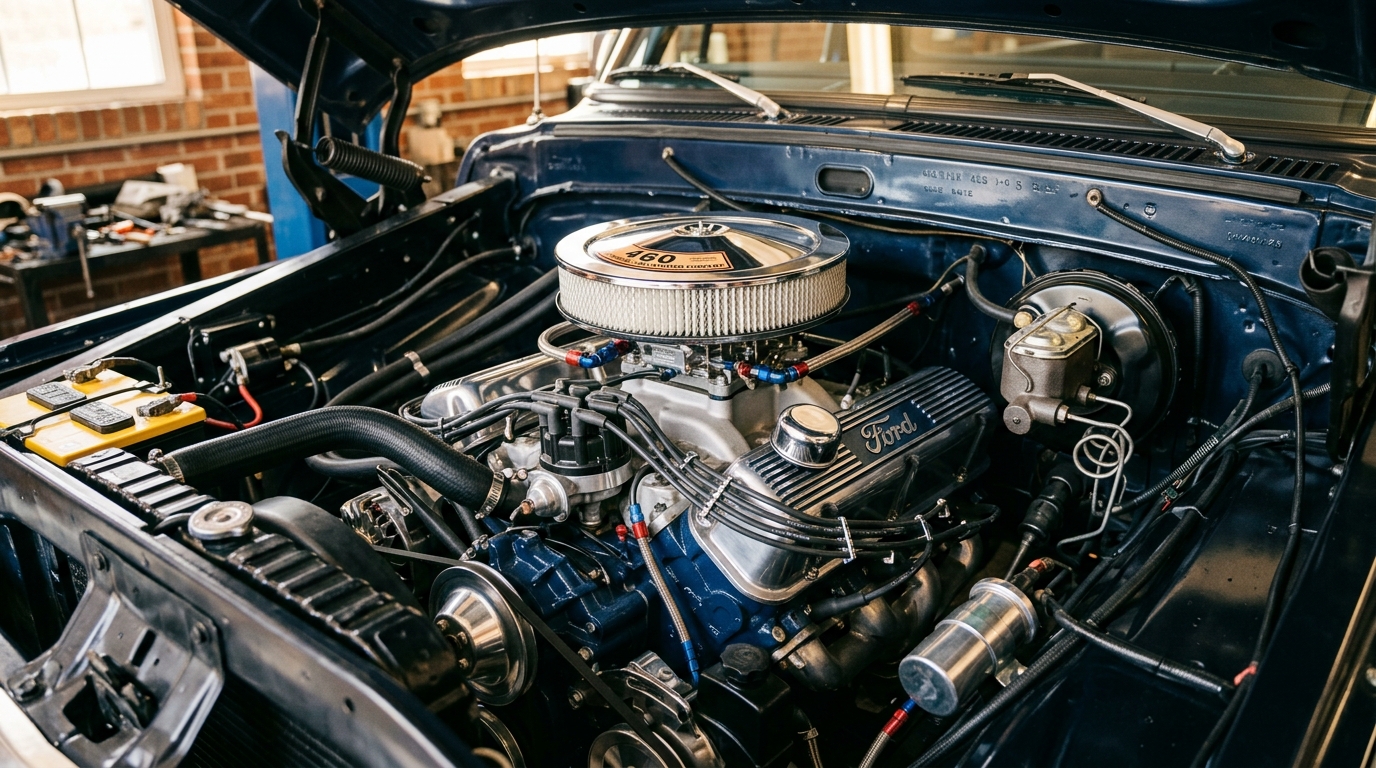
| 460 385 V8 | 460ci | 1975–1979 | 202–220 | 341–357 | Most powerful; F-150 only from 1976 |
The 300ci I6 is the most durable engine ever offered in the F-100 — many exceed 300,000 miles. The 302W is the best balance of power and economy. The 390FE is the performance choice for Bumpside. The 460 is the ultimate Dentside engine.
Trim Level Matrix
| Trim | Years | Key Features | Value Impact |
|---|---|---|---|
| Custom | 1973–1979 | Base model, vinyl bench, rubber mat, minimal trim | Baseline (lowest) |
| Custom Cab | 1967–1972 | Added chrome trim, upgraded seat fabric | +5–10% |
| Explorer | 1970–1972 | Mid-level, carpet, extra trim, clock | +10–15% |
| Ranger | 1969–1979 | Carpet, full trim, woodgrain accents, chrome bumpers | +15–25% |
| Ranger XLT | 1970–1979 | Top trim: velour seats, full carpet, woodgrain, A/C prep | +25–40% |
Ranger XLT is the most desirable trim. The Ranger (non-XLT) offers most of the visual appeal at a lower price point. Custom trim trucks are worth less but make excellent restomod platforms.
Bed Configurations
The F-100 was offered with two bed styles. The bed type significantly impacts value — short beds are worth 40–60% more than long beds in equivalent condition.
| Bed Type | Length | Style | Value Impact | Notes |
|---|---|---|---|---|
| Styleside Short | 6.5 ft | Flat-sided, flush with cab | +40–60% over long bed | Most collectible; rare on early years |
| Styleside Long | 8.0 ft | Flat-sided, flush with cab | Baseline | Most common; fleet/work truck |
| Flareside Short | 6.5 ft | Stepside with fender flares | +30–50% over long bed | Sporty look; less common than Styleside |
| Flareside Long | 8.0 ft | Stepside with fender flares | +10–20% over Styleside long | Unusual; some prefer the look |
| Utiline | 6.5/8.0 ft | Steel stepside (narrower) | −10 to −20% vs Styleside | Utility bed; least collectible |
Short-bed Styleside is the configuration every collector wants. If you find a 1976–1979 F-150 Ranger XLT short-bed Styleside with the 460ci V8, you've found the holy grail of this generation.
Market Values by Condition (2026)
| Variant | #1 Concours | #2 Excellent | #3 Good | #4 Fair | 5-Year Trend |
|---|---|---|---|---|---|
| 1976–1979 F-150 460 Ranger XLT SWB | $85,000 | $55,000 | $30,000 | $12,000 | +50% |
| 1973–1979 F-100 302 Ranger XLT SWB | $55,000 | $35,000 | $18,000 | $7,000 | +35% |
| 1973–1979 F-100 300 I6 Ranger SWB | $45,000 | $28,000 | $14,000 | $5,000 | +30% |
| 1967–1972 F-100 302 Ranger SWB | $50,000 | $32,000 | $16,000 | $6,000 | +40% |
| 1967–1972 F-100 390 Ranger SWB | $60,000 | $40,000 | $22,000 | $8,000 | +45% |
| 1973–1979 F-100 302 Ranger LWB | $35,000 | $22,000 | $11,000 | $4,000 | +25% |
| 1973–1979 F-100 Custom LWB | $25,000 | $15,000 | $7,000 | $2,500 | +20% |
| 1973–1979 F-100 460 Ranger XLT LWB | $50,000 | $32,000 | $17,000 | $6,000 | +35% |
| Flareside (any engine, SWB) | $58,000 | $38,000 | $20,000 | $7,500 | +38% |
Values are 2026 market estimates from Bring a Trailer, Mecum, and Hemmings sold data. SWB = Short Wheelbase (short bed), LWB = Long Wheelbase (long bed). 460ci V8 adds $10,000–$20,000 over 302ci in equivalent configuration.
Value Trend Chart (2020–2026)
F-100 Average Values (1976–1979 F-150 460 Ranger XLT SWB, #2 Condition)
| 2020 | 2021 | 2022 | 2023 | 2024 | 2025 | 2026 | |
|---|---|---|---|---|---|---|---|
| F-150 460 XLT SWB (#2) | 35000 | 40000 | 45000 | 50000 | 53000 | 55000 | 55000 |
| F-100 302 Ranger SWB (#2) | 22000 | 25000 | 28000 | 32000 | 34000 | 35000 | 35000 |
| Bumpside 390 SWB (#2) | 28000 | 32000 | 36000 | 38000 | 40000 | 40000 | 40000 |
Key Option Codes
Ford F-100 Option Codes (1973–1979)
| Code | Name / Description |
|---|---|
H72 | Ranger XLT Trim Package Top trim level: velour seats, full carpet, woodgrain, chrome trim |
H61 | Ranger Trim Package Mid-level trim: carpet, upgraded seat fabric, chrome bumpers |
H42 | Custom Trim Base trim: vinyl bench, rubber mat, minimal chrome |
A99 | 460ci V8 Engine 7.5L V8, 202–220hp; F-150 only from 1976; most desirable |
A97 | 390ci FE V8 Engine 6.4L FE V8, 255–266hp; best Bumpside performance engine |
A90 | 300ci I6 Engine 4.9L inline-six, 150–170hp; legendary durability |
F70 | 3-Speed Manual (T-18) Heavy-duty 3-speed; most common transmission |
F80 | 4-Speed Manual (T-18OD) 4-speed with overdrive; preferred for highway |
G95 | C6 Automatic 3-speed automatic; most desirable for cruising |
B41 | Power Front Disc Brakes Standard on F-150; optional on F-100 from 1975 |
C40 | Air Conditioning Factory A/C; adds $2,000–$4,000 value |
D52 | Tilt Steering Column Tilt wheel; adds $500–$1,000 value |
E20 | AM/FM Stereo Radio Factory radio; adds $300–$600 value |
L31 | Dual Fuel Tanks Two 19-gallon tanks; desirable for long-distance |
Common Rust Areas
The F-100 cab corners (lower rear of the cab) are the most common and most serious rust area. Water collects in the C-pillar channel and rots the cab corner from the inside out. Repair requires cutting out the rusted area and welding in a patch panel ($200 part, 8–15 hours labor). Always inspect behind the cab corner by reaching under the truck.
- Cab corners (lower rear of cab) — #1 problem
- Check from underneath — outside may look fine while inside is rotted
- Patch panels available from LMC Truck and CTP
- Floor pans, especially driver side
- Water leaks from cowl area soak the floor
- Check under the rubber mat for hidden rust
- Rocker panels
- Visible from outside; check for bubbling paint
- Full rocker replacement: $400 part, 6–10 hours labor
- Bed floor and wheel wells
- Wood bed floor (Styleside) rots from the bottom
- Check where bed bolts to frame for rust-through
- Frame rails near rear spring hangers
- Critical structural area
- If frame is rusted through here, the truck is unsafe to drive
- Front fender rear lower corners
- Where fender meets cab; mud and debris collect here
- Check inside the fender well
Buying Guide: Best Years and Variants
- Best investment: 1976–1979 F-150 460ci Ranger XLT short bed
- The holy grail — 460 V8, top trim, short bed
- Values at $55,000 (#2) and rising 10–15% annually
- Very few survive in original condition
- Best value: 1973–1976 F-100 302ci Ranger short bed
- 302 V8 is reliable and well-supported by aftermarket
- Ranger trim looks great without XLT price premium
- $18,000–$28,000 (#3) — entry point to the generation
- Best Bumpside: 1969–1972 F-100 302ci Ranger short bed
- Bumpside styling is gaining collector attention
- 302 Windsor is the best engine for this era
- Cheaper than equivalent Dentside — rising faster
- Best driver: 1977–1979 F-150 400M with C6 automatic
- 400M has good torque for cruising
- C6 automatic is bulletproof
- Front disc brakes standard on F-150
- Avoid: 1977–1979 F-100 with 351M
- 351M is the weakest V8 — emissions-choked, 137–163hp
- Known for head gasket issues
- If you find one, budget for an engine swap
Frequently Asked Questions
- What's the difference between F-100 and F-150?
- The F-150 was introduced in 1975 as a "heavy half" — slightly higher GVWR than F-100 but below F-250. From 1976, the F-150 got the 460ci V8 that wasn't available in the F-100. The F-150 also had front disc brakes standard while F-100 got them as an option.
- Which is more valuable: Bumpside or Dentside?
- Dentside (1973–1979) is currently more valuable, especially the F-150 with 460ci. However, Bumpside (1967–1972) is appreciating faster — up 40–45% in 5 years vs 30–35% for Dentside. The gap is closing.
- Are Flareside or Styleside beds worth more?
- Styleside short beds are worth slightly more than Flareside short beds — about 10–15% premium. Flareside has a sportier look but Styleside is more practical and more popular with collectors. Long beds (either style) are worth 40–60% less than short beds.
- Is the 300ci inline-six worth buying?
- Yes — the 300ci I6 is one of the most durable engines Ford ever built. It's not fast, but it's bulletproof and has excellent low-end torque. A 300ci F-100 is a great driver-quality truck. Values are 20–30% lower than 302ci V8 equivalents, making them a value buy.
- Should I restore or restomod my F-100?
- The market strongly favors originality for top-trim trucks (Ranger XLT 460). For base models (Custom trim, long bed), restomod is more acceptable — a Coyote-swapped F-100 Custom can be worth more than a stock one. Keep all original parts regardless.
Get an AI-powered valuation for your Ford F-100 — free, instant, based on real auction data.
Value My TruckSources & References
- Hagerty Price Guide — Valuation Tools — Independent valuation data by condition grade #1-#4
- Bring a Trailer — Auction Results — Real-world auction sale prices for market comparison
- Related: Squarebody C10 Generation Hub — In-depth related guide from our editorial library
- Related: Fox Body Mustang Generation Hub — In-depth related guide from our editorial library
- Related: Restoration Cost Calculator — In-depth related guide from our editorial library